Ricky Gervais Alley Cats
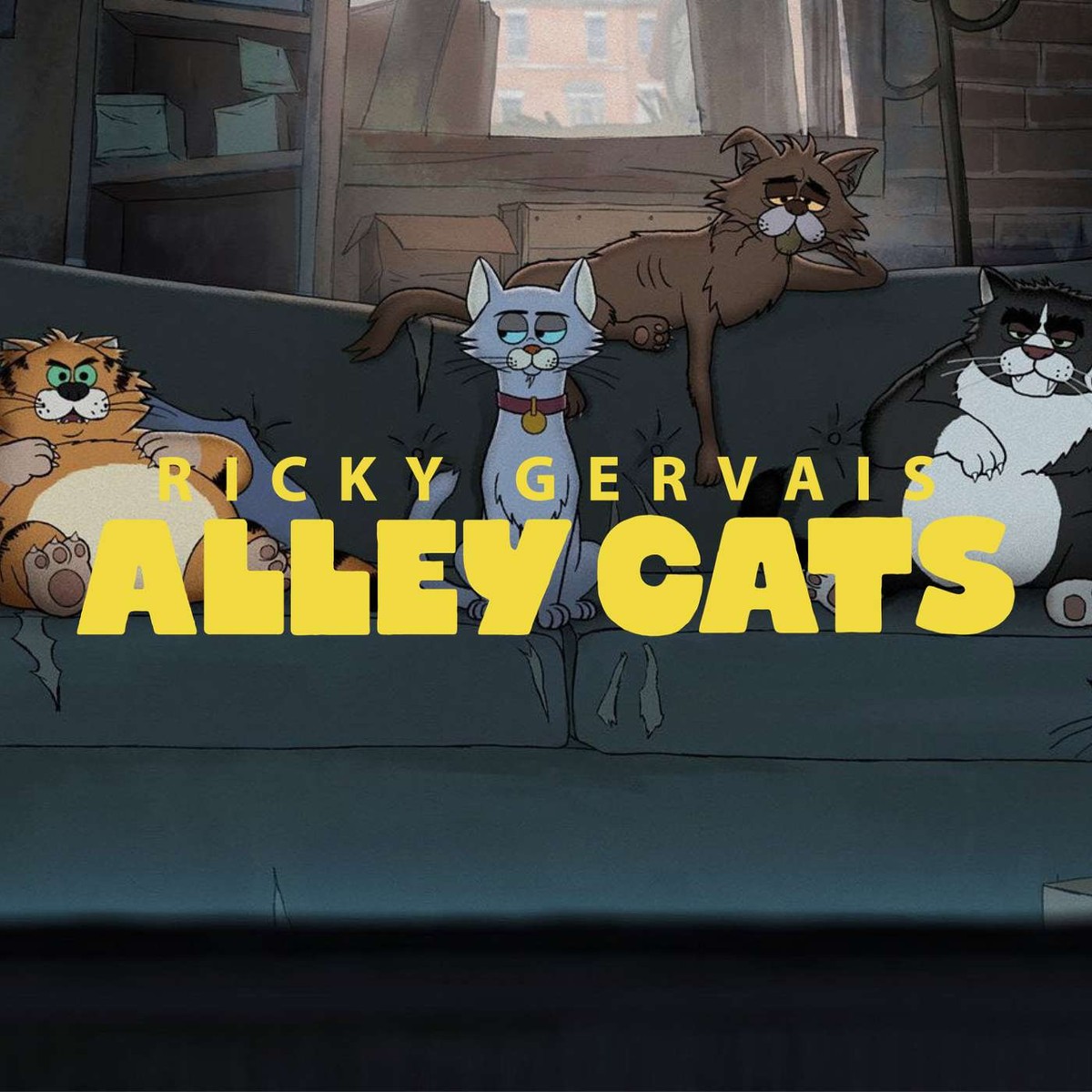
Ricky Gervais reunites his After Life cast as a gang of foul-mouthed London strays, and somewhere between the filth and the catnip, Alley Cats turns quietly, brilliantly moving.
 7.9/10 · RECOMMENDED
 A bit of context before we get to what I actually made of it, because this one arrives with an interesting little history behind it. Alley Cats is Ricky Gervais’s first originally scripted animated series, but it’s not actually his first time in animation at all. Some of you will remember The Ricky Gervais Show, which ran from 2010 to 2012 on HBO and Channel 4. Three seasons, 39 episodes, and it took the podcast conversations between Gervais, Stephen Merchant and Karl Pilkington and animated them in that lovely old Hanna-Barbera style. So the idea of Gervais talking rubbish in cartoon form is not new ground for him. The difference this time is that Alley Cats is written rather than lifted from recorded conversation; this time the cartoon has an actual story to carry. It’s made by Blink Industries alongside his own Derek Productions, and Gervais has his fingerprints on every part of it. He created it, he wrote it, he co-directed it alongside Elliot Dear and Paulo Ferreira, and he voices the lead. Six episodes, roughly 15 minutes each, all of them dropped on the one day on Netflix. The setup is simple enough: Gus, a foul-mouthed ginger stray, and his gang of feral cats surviving a hard human world in London, squatting in a rundown house and scraping by on the streets. And it kicks off properly when they take in a lost kitten and decide between them that they’re going to get her home.
Now, I have to be honest with you about where I was sitting before I pressed play, because I really did not know what I was going to feel watching this series. I am not a big cartoon fan. That is just not where I usually go, and if anybody else’s name had been on this thing I probably would have left it alone entirely. But it was written by one of my favourite comedians and writers, so I decided to give it a go. And once I started, I watched the whole thing in one sitting. All six episodes, straight through, and I am so glad that I did.
The first episode opens with Jerusalem, and if you’re from the UK you’ll know exactly what an iconic piece of music that is. Hearing it play over the introduction to this lot of scabby, foul-mouthed feral cats is a proper piece of setup. It had me from the first bar, honestly, because it tells you immediately that the series knows exactly what it’s doing with tone. There’s something so deliberately cheeky about laying one of the most stately, patriotic pieces of British music over a bunch of strays squatting in a derelict house. That’s the joke of the whole series in one image, before anybody has even opened their mouth. And then the voices start, and straight away I was recognising them from previous Ricky Gervais TV series, which gave the whole thing a familiarity before I had even worked out who was who. I’ll come back to that, because it’s one of the best things about the show.
Meet the Gang
Let’s talk about the gang, because this is very much an ensemble piece. Gus, voiced by Gervais himself, is the self-appointed leader of the group: fat, lazy, rude, opinionated, and nowhere near as smart or as brave as he thinks he is. It’s a character type Gervais has been playing in one form or another for his entire career, the delusional man who has crowned himself king of a very small kingdom, and it turns out that character works beautifully as a ginger tomcat. Around him you’ve got Tom Basden as Ponce, the middle-class house cat and pedant who’s slumming it with the strays. Andrew Brooke as Fang, the muscle. David Earl as Puke, the scabby one, and if you know David Earl’s work with Gervais you can already picture exactly what Puke is like. Kerry Godliman as Lara, who’s sharp and no-nonsense and ends up as Gus’s love interest, which gives Gus somebody who can actually puncture him. Jo Hartley as Kitten, the lost little black kitten who sets the whole story moving. Diane Morgan as Olive, Gus’s dim half-sister, and Diane Morgan doing dim is always worth the price of admission on its own. Then you’ve got Natalie Cassidy, who most people will know from EastEnders, as Gus’s old and ailing mum, and Tony Way as the street-corner drug dealer, supplying the neighbourhood with catnip and silvervine. Every one of these cats is carrying something. Loneliness, status anxiety, insecurity, the need for companionship. That’s where the comedy friction comes from, but it’s also where the heart comes from.
The thing that makes the season hang together is that lost kitten storyline. They find her in the first episode, they set about trying to get her home, and that thread carries you through everything else that happens. It’s a clever bit of construction, because the series isn’t really a serialised plot machine. It’s more a slice of alley-cat society, with each episode poking around a different corner of this grubby little world. But the kitten gives it a spine, something to hang all the chaos off, and it means that underneath every filthy set piece there’s this quiet through-line about a found family looking after someone who needs looking after. Classic Gervais, that. He’s been doing that trick since The Office, hiding something soft inside something that looks cynical.
Filthy, Then Suddenly Poignant
And when I say filthy, I do mean filthy. Let me give you the Puke storyline as the example, without giving away all of it, because it’s much better discovered on screen. Puke tells the others that he has three boys. Nobody believes him, because, well, look at him, so he takes them all off to meet his sons. And of course they meet the mother as well, who is blind, and it becomes clear that this is the only reason she slept with him in the first place. No sight, and no sense of smell. It is absolutely filthy and it is very, very funny, and it’s a good measure of where the humour on this show sits. Crude, cruel around the edges, playground-level in the best possible way, but always built on character. The joke isn’t just that Puke is disgusting. The joke is that Puke is desperate to be believed, desperate for a bit of status among the gang, and that’s a very human thing to hang a gag about a scabby cat on.
But here’s what I really didn’t see coming. I did not expect to be sitting there, partway through a series about swearing stray cats, thinking about mortality. There’s a stretch of this series that deals with life and death in a way that took me completely by surprise, and I’ve picked out the specific scene as my Frame 70 Moment below. The point I want to make here is about balance. This show is funny, it’s grubby, it’s crass, and then it turns around and becomes very poignant and very touching, and it moves between those registers without dropping either one. That is a hard thing to do at 15 minutes an episode. Plenty of half-hour comedies can’t manage it with double the runway. Gervais has always been better at this than people give him credit for. After Life was built entirely on that pivot between the cruel joke and the lump in the throat, and Alley Cats does the same dance in cartoon form.
The music deserves its own mention as well, because it’s doing real work across the season. Jerusalem at the top of the first episode is the obvious one, but the songs keep coming across all six episodes, from some very well-known artists, and each one seems to pull into its episode very nicely. It never feels dropped in for the sake of it, never feels like somebody just had a licensing budget to burn. Again, that’s a Gervais signature. Anyone who watched After Life knows how much weight he puts on needle drops, how he uses a song to land an emotional beat that the dialogue has been circling. The same instinct is all over this series, and it’s part of why something this short can feel this full.
The After Life Reunion
Now, connective tissue, because this show is absolutely swimming in it, and it’s a large part of why it felt like familiar ground to me even though the format is new. The voice cast here is essentially an After Life reunion. Kerry Godliman played Lisa, Tony’s late wife in that series. Tom Basden played Matt, the brother-in-law. David Earl played Brian. Diane Morgan played Kath. Jo Hartley played June, and Tony Way played Lenny. So if you loved After Life, you are going to spend the first episode of this going, hang on, I know that voice, over and over again, and it’s a lovely feeling. And there’s a production reason it works beyond nostalgia. The cast performed together in one room rather than recording their lines separately, which is why the conversations overlap and run into each other the way they do. Diane Morgan has described the result as being sort of like Derek and Clive with cats, which, if you know your Peter Cook and Dudley Moore, is about as accurate a pitch as you could ask for. She’s also said that reunion is part of why the sessions worked the way they did, because the group already knew each other from After Life and were all in the room together. You can hear it. There’s a looseness to the crosstalk that you simply do not get when actors are recording alone in separate booths months apart, which is how most animation gets made. It sounds like a gang of mates talking over each other, which is exactly what a gang of alley cats should sound like. And if you want to go further back down the Gervais rabbit hole after this, The Ricky Gervais Show is worth digging out. It’s a very different animal, unscripted where this is written, but you can see the seed of the idea. Gervais in cartoon form, saying appalling things, has a track record.
I want to spend a moment on my own angle here, because I think it matters for who this show is for. I came to this as somebody who does not watch cartoons, and I watched it purely because of who wrote it. And I think that actually helped, because I had no expectations built up around what an adult animated series is supposed to do. No comparisons to Rick and Morty or BoJack Horseman rattling around in my head. What I found was that the animation is not the point of it at all. This is a Ricky Gervais series that happens to be drawn. The writing is doing the work, the voices are doing the work, the relationships are doing the work, and once you settle into that, you honestly stop noticing that you’re watching a cartoon. If anything, the animation is just the licence. It lets Gervais put these characters through things you could never do in a sitcom with actors, and it lets him talk about being old and ill and unwanted through creatures we’re culturally allowed to feel simply about.
So, final thoughts. I went in not knowing what I was going to feel, and I came out having watched all six episodes in one sitting and being glad about it. It’s funny, it’s grubby, it’s crass, and then it’s very poignant and very touching when it wants to be. It’s short, it moves, and there is no fat on it, which is more than you can say for Gus. At six episodes of 15 minutes, the whole season is barely longer than a feature film, and honestly that’s the way to watch it: one sitting, straight through, like I did. This is for anybody who likes Ricky Gervais’s writing, obviously, and especially for the After Life crowd who’ll get that extra layer from the voices. But I’d say it’s also, maybe even especially, for people who, like me, do not usually go anywhere near animation. Do not let the cartoon put you off. The one warning I’ll give you is the obvious one. It is filthy from end to end, so this is not one to put on with the family around. The title sequence alone would get you some questions.
Listen to this episode
Follow Frame 70 on your favourite podcast app and new episodes find you the moment they drop.