The End of Oak Street
David Robert Mitchell rips a 1982 suburban street out of time and throws a family to the dinosaurs in a fast, surprisingly brutal ride with one death scene I still can't shake.
 8.0/10 · GREAT
 A little bit of context before we dive in, because the story behind this one is almost as interesting as the movie itself. The End of Oak Street is an original screenplay written and directed by David Robert Mitchell, and if that name rings a bell, he’s the filmmaker behind It Follows, which is probably the film most people know him for, and Under the Silver Lake back in 2018. This is his first film in eight years, only his fourth feature overall, and it’s the first thing he’s directed in over a decade that isn’t rated R in the States. Here in Australia it landed with an M rating for sustained threat, violence and coarse language, and hold that thought, because we’re going to come back to it. It’s produced by J.J. Abrams through Bad Robot alongside Matt Jackson’s Jackson Pictures, it was shot in London and Atlanta across early 2024, and it actually carried the title Flowervale Street right up until January of this year. Michael Giacchino wrote the score, Mike Gioulakis shot it, Warner Brothers put it in cinemas, it runs a lean 100 minutes or so, and the whole thing is set in 1982. Anne Hathaway and Ewan McGregor play Denise and Greg Platt, parents on an ordinary suburban street, with Maisy Stella and Christian Convery as their kids Audrey and Brian. And then the street gets ripped out of reality itself.
Now, I have to be honest with you right up front: this was definitely a different movie to what I was expecting. Not different in a wrong way, just different in a way that caught me off guard. The studio billed it as a different kind of dinosaur movie, and for once that’s not marketing fluff. It cuts straight to it. There’s no 40 minutes of throat clearing here. The movie establishes its family, drops the hammer, and gets right to the reaction. And there is a lot more violence, a lot more blood, and a lot more dinosaurs catching people, eating people and killing people than I ever expected walking in. I’ll admit I went in not knowing what kind of rating this movie carried, and it turned out surprisingly brutal, which, for the record, was all good by me. I enjoyed it thoroughly. It’s entertaining, it’s straight to the point, and there is no filler in this thing at all.
The Street That Left Reality
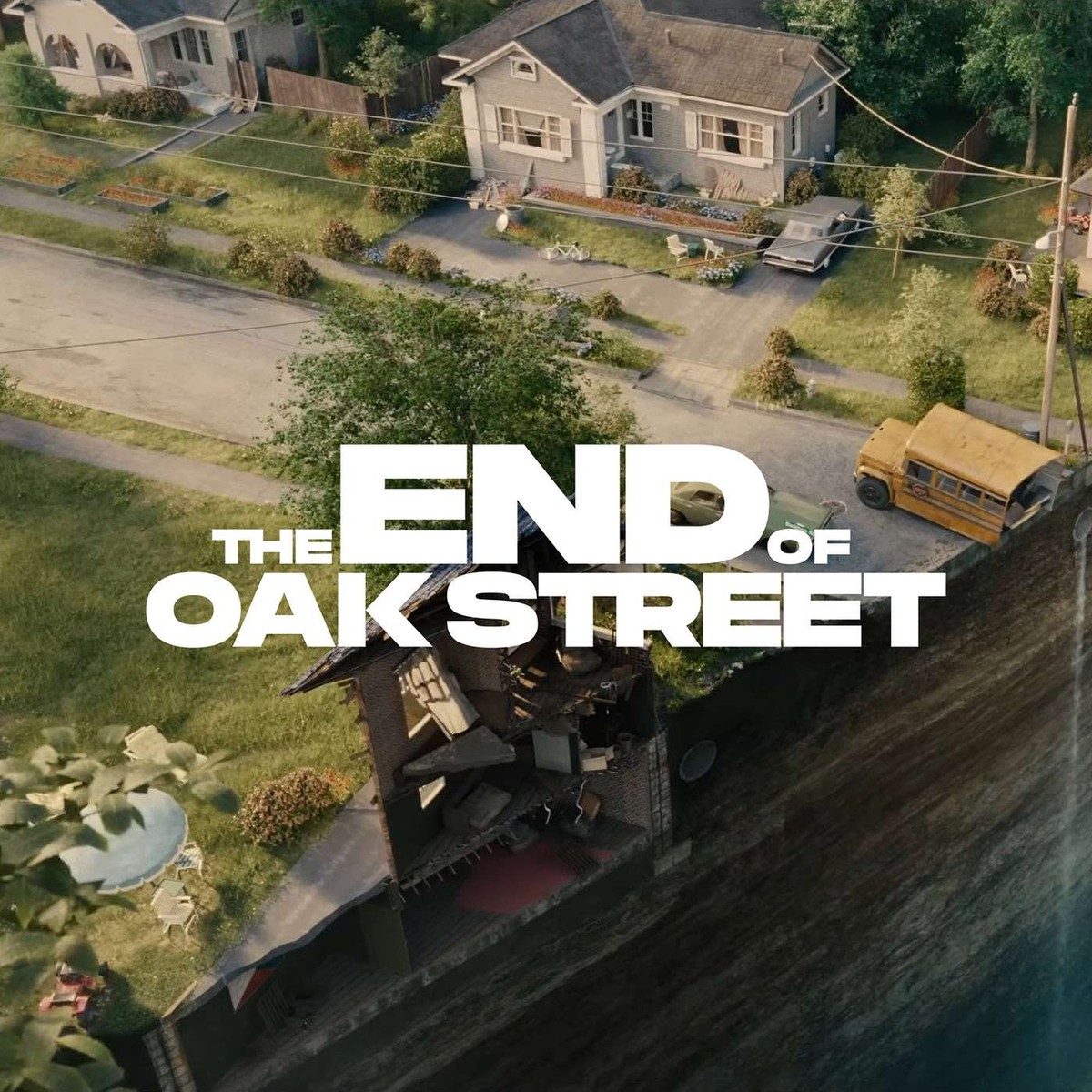
Let me set the table without giving away the good stuff. The movie kicks off with a street party, and it is very old school. You can practically smell the sausages on the barbecue. The parents are arguing because Greg has to duck out of the party and head off to his second job delivering pizzas, so the household tension is baked in before anything strange happens. And the strange stuff starts small, which I loved. There’s an odd plant growing in one neighbour’s backyard that has no business being there, and a big pile of manure that’s just turned up in another one’s. Nobody knows what to make of it. Then you get a storm at night, a huge flash, and after that, things are not what they seem. The family wake up and the weather’s turned humid in a way they’re not used to. It’s quiet outside. Too quiet: only nature noises, no traffic, no hum of the suburbs. And then they start hearing something else out there. Something that sounds hungry.
The build here is excellent, and I want to give Mitchell real credit for it. The parents split up, one goes looking for the family dog, Starbuck, while the other checks on the neighbours, and things start changing very quickly from there. Hathaway’s character comes across a huge forest that simply should not exist. The kids see large shapes moving between the trees. We get glimpses. And then McGregor’s character gets stalked by a raptor in a sequence that had me gripping the armrest. The family pile into the car and try to drive out, but the road ends at that forest and then a massive cliff, and there is no way off this street. That’s the moment they know they’re in real danger, so they head home and start barricading themselves into the house. The movie is smart about its escalation too. You meet the small dinosaurs first, and as things progress the bigger ones start showing up, each one nastier than the last.
Here’s the part of the movie I found quietly brilliant. Audrey, the daughter, is a Carl Sagan kid. Her whole ambition is to study science under Sagan at Cornell, and she’s the one who pieces together the how of it all. What she describes is a wormhole, and she puts it in Sagan’s own terms: an entry and an exit connecting two points in space and in time, like the hole you’d find running through an apple. Small things came forward to the present, that strange plant and that pile of manure sitting in the backyards at the start, and then the street itself went the other way. Back. A long, long way back. And here’s a lovely bit of real-world texture for you: Sagan really did propose the idea of a traversable wormhole, a concept later developed properly by physicists Kip Thorne and Michael Morris. The film is set in ‘82 and Sagan’s best-known wormhole work came a few years after that, so Mitchell is fudging the timeline slightly, but honestly, it’s the kind of fudge I’ll forgive every single time because it gives the science fiction a real spine.
Creatures, Carnage and Connective Tissue
From there the movie just moves. There’s a night sequence with huge dinosaurs crashing into the house, and a neighbour getting plucked off his own roof by pterosaurs, and it’s the same neighbour who had the manure appear in his backyard at the start, which is a nice bit of bookending that made me smile even mid-carnage. Young Brian spots Starbuck out in the danger zone and heads out after him, the family follow, and the back half becomes a scramble across the neighbourhood chasing a huge sphere of light, a portal, that keeps appearing and vanishing before they can use it. There’s fire, there’s a T. rex chase, and there’s an enormous snake in a house that I’m reliably informed is a Titanoboa, though at least one critic reckons it’s some kind of ancient eel. Either way, no thank you. And I have to mention this because I can honestly say I have never seen it in a movie before: at one point we see a couple of dinosaurs leaning against the house going at it. Fornicating dinosaurs. In a Bad Robot production. It’s very funny, it’s completely unexpected, and it tells you exactly how loose and confident this movie is feeling.
Let’s talk creatures, because this is where the movie earns its ticket price. The visual effects are absolutely brilliant. I’d put this up there with the best-looking dinosaurs I’ve seen in about 20 years, and I don’t say that lightly. And it’s a different roster than we’re used to. Yes, you get your T. rex and your raptors, but there’s also an Allosaurus in here, a big meat eater that almost never gets put to work in movies like this, and it lands one of the film’s biggest moments. There are these turtle-looking creatures that are weirdly amusing. Now, full disclosure: I did not study my prehistoric history as a kid. I loved dinosaur movies, but I could probably name maybe two species and that’d be it. So take it from a non-expert, the variety in here is honestly impressive, and the scares come from creatures you haven’t already seen a hundred times.
The connective tissue on this one is rich, so let’s pull the thread. The ’80s Amblin lineage is the whole spine of the thing. It feels like E.T., like Back to the Future, like Poltergeist, and like the old Amazing Stories anthology series, and crucially, it earns those comparisons rather than just wearing them like a costume. The film is set in 1982, the exact same year E.T. and Poltergeist were both in cinemas, and Poltergeist is the closest structural match of the lot: an ordinary suburban family, an ordinary suburban house, and something impossible coming through into it. If you’ve never seen Poltergeist, or if the old Amazing Stories has passed you by, this movie is a perfect excuse to go digging. On the craft side, Michael Giacchino’s score leans into that era beautifully, and his credits include the Jurassic World films, so the man knows his way around a dinosaur. And a little one for the sci-fi fans: the family dog Starbuck is named after the Battlestar Galactica character, which is exactly the kind of detail a 1982 household would land on. And yes, since I know you’re wondering, the dog comes back for the boy when it counts. Starbuck earns his keep and makes it through.
Where It Wobbles
Now, it’s not all roses, so let me be straight about what didn’t work. When the credits rolled, I was scratching my head a little bit. There are quite a few loose ends and undone threads here. I was sitting there going hang on a second, but what about this, and what about that? Because of the way it finishes, and especially the way the ending loops around on itself, you’re left with some weird lingering questions about what happened to other things as a consequence of the incident. Some of that is deliberate mystery-box stuff, this is a Bad Robot movie, after all, but some of it feels like threads Mitchell simply didn’t get back to in 100 minutes. It didn’t sink the movie for me, not even close to it, but it did take a bit of shine off the landing. The other thing, and this isn’t the film’s fault, is that it’s flying under the radar. It landed only a few weeks after Spider-Man, and when I was at the cinema the crowds were all queuing for that and The Odyssey, with barely anyone in my session. It deserves better traction than it’s getting.
So, final thoughts. This is an entertaining, fast, surprisingly brutal ride from a director who clearly loves the era he’s working in, and I definitely recommend it. It gets straight to the point, there’s no filler, and it wraps up with a well-rounded ending, helped along by a substantial swing it takes about 20 minutes before the finish, which was excellent. But fair warning: if you get squeamish about blood and guts, about dinosaurs running people down and ripping them apart, or about a couple of dinosaurs enjoying each other’s company against the side of a house, this is probably not the one for you.
But look, that’s just how The End of Oak Street landed for me. Entertainment is subjective, and a movie this strange and this bloody is going to hit everyone a little differently. What worked for me might not work for you, and that’s completely okay. For my money, though, this is the most fun I’ve had with dinosaurs in a cinema in a very long time, and I’d love to hear how it lands for you.
Listen to this episode
Follow Frame 70 on your favourite podcast app and new episodes find you the moment they drop.