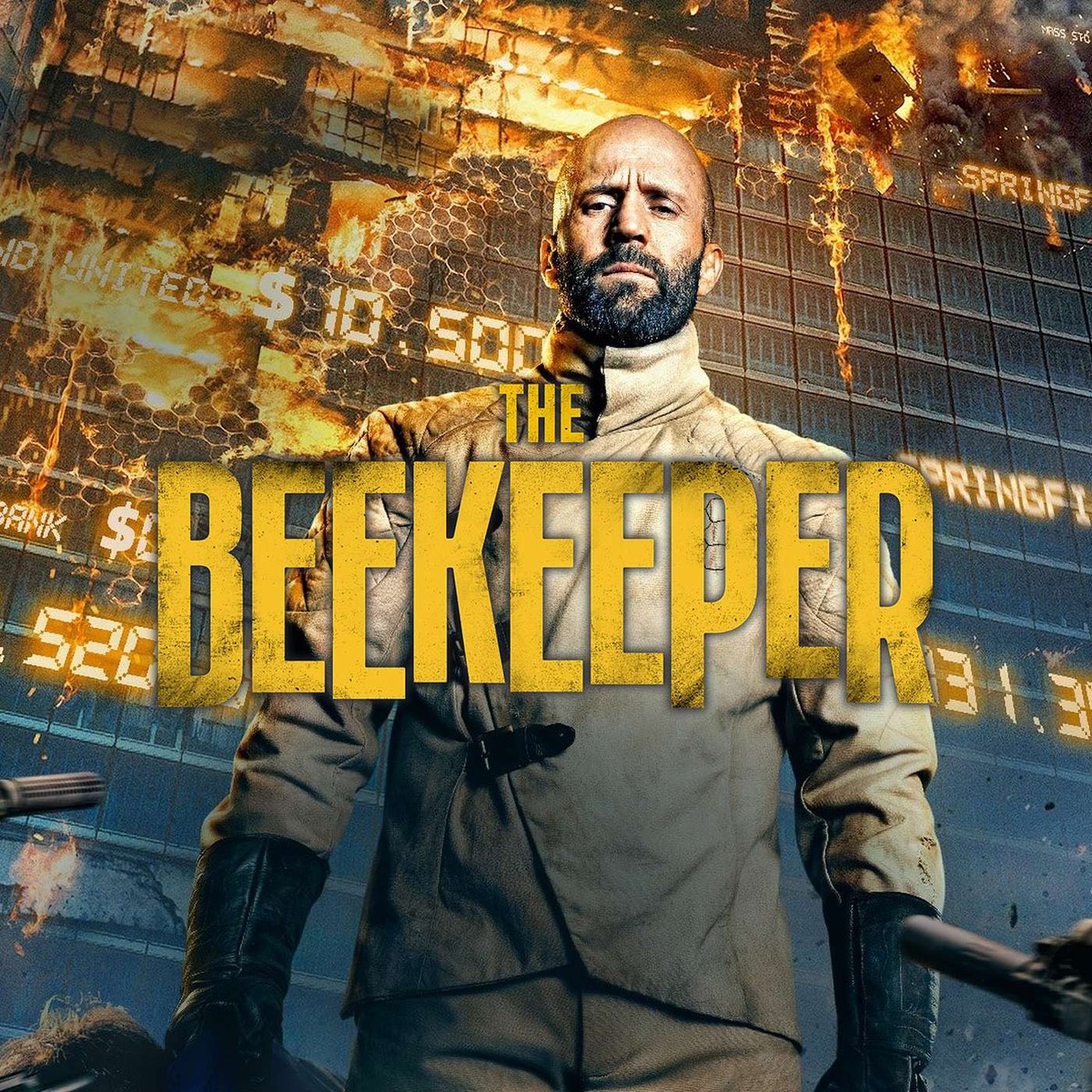
The Beekeeper
They tried very hard to kill Adam Clay, and every one of them failed. Jason Statham turns one man's grief into a war on the scammers preying on the vulnerable, and the people shielding them.
 7.5/10 · RECOMMENDED
 Before we get into what I thought, a little bit of context. The Beekeeper arrived in January 2024, written by Kurt Wimmer, the same writer behind films like Salt and Equilibrium, and directed by David Ayer, who most people will know from Fury with Brad Pitt, End of Watch, and as the writer of Training Day. That’s a filmmaker who knows his way around tough, gritty material, and pairing him with Jason Statham felt like a natural fit on paper. Statham has been one of the most reliable names in action cinema for over 20 years now, going all the way back to The Transporter, through the gloriously unhinged Crank films, and into the Fast and Furious franchise as Deckard Shaw. So my expectations going in were pretty simple: give me Statham doing what Statham does best, and wrap it in a story that gives him a reason to do it. And honestly, that’s exactly what this film delivers, with a little more on its mind than I expected.
The Scam That Hits Close to Home
The film opens with Adam Clay, played by Statham, keeping to himself and tending his bees on the property of Eloise Parker, a kind elderly woman played beautifully by Phylicia Rashad, who rents him her barn and treats him like family. And it’s these opening scenes that hit me harder than anything else in the movie. Eloise falls victim to a phishing scam through her computer, one of those fake warning screens with a helpful phone number, and before she knows it, these predators have drained her savings and a charity fund she looks after. The shame and despair drive her to take her own life. Now, watching how they portrayed just how easy it is for these scam operations to strip someone of everything they have, that is properly scary. We all know this happens in real life. Everybody’s aware of the scams, of people having their money stolen. But seeing it play out on screen, step by step, watching a good person get hollowed out by a room full of people treating it like a game, it makes you wonder how on earth we let this keep happening.
And I’ll be honest with you here, because this one is personal for me. As an elderly person myself, I know exactly how easy it is to fall into these traps. Some years back, someone got access to one of my accounts, and I was contacted by my bank asking me to confirm a very large purchase being made in Vienna, Austria, while I was sitting right here in Brisbane, Australia. I had to have every account cancelled and everything re-issued. I was one of the lucky ones because the bank caught it. But watching Eloise on that screen, I wasn’t just watching a movie character. I was watching something that could have been me, or could be any one of us. That’s what gives this film its engine. Because right from the beginning, you understand completely why the Beekeeper does what he does. The bad guys are scammers preying on the vulnerable. There’s no moral ambiguity to wrestle with. You are on Adam Clay’s side from the first frame, and you stay there.
Statham at Full Sting
So Clay, grieving for the one person who ever took care of him, tracks down the call centre behind the scam and burns the place to the ground. It’s a fantastic sequence, equal parts satisfying and darkly funny, and it kicks off the chain reaction that drives the rest of the film. The manager of that centre, Mickey, rings his boss, a smug tech-bro type called Derek Danforth, played by Josh Hutcherson. Yes, Peeta from The Hunger Games, having a great time playing an absolute weasel. Danforth turns to his security chief, a former CIA director played by Jeremy Irons, and asks him to find the man responsible. And Irons, being the only adult in the room, essentially tells him: you have no idea what you’ve just poked. Because Clay, as we learn, is a former member of the Beekeepers, a secret off-the-books organisation that exists to protect the hive, society itself, by eliminating threats that operate above the law. When the system fails, the Beekeepers step in. It’s a wonderfully simple piece of mythology, and the film wisely doesn’t over-explain it.
From there, Mickey and his cleanup crew come looking for Clay, and they find him at his beehives. What follows in his work shed, where he prepares his honey, is one of my favourite fights in the film. They try very, very hard to kill Adam Clay, and he takes every single one of them down, finishing with Mickey losing his fingers to a bandsaw. It’s brutal, it’s inventive, and it sets the tone for everything that follows. The action scenes throughout this movie do not disappoint. Statham’s fighting abilities are on full display here, and they remind you why he’s held his place at the top of this genre for so long. There’s a physicality and an economy to how he moves, no wasted motion, no showboating, and David Ayer shoots it cleanly so you can actually see what’s happening. The film keeps escalating too, from the call centre, to the shed, to a genuinely spectacular assault on a fortified office building, and each set piece tops the last. If you came for Statham putting bad people through walls, you will leave very satisfied.
What surprised me, though, was the bee stuff, and I mean that sincerely. The film leans into its metaphor with total commitment, and I found the real-world connection fascinating. As they say in the movie: no bees, no agriculture. No agriculture, no civilisation. And that’s not screenwriter invention, that’s real. Honeybees and humanity are bound together in a way most of us never think about, and the film uses that idea to give Clay’s mission a strange nobility. He’s not just an assassin with a grudge, he’s protecting the hive. Does the movie take this metaphor too far at times? Absolutely. There are bee puns and hive speeches that made me chuckle. But the film knows exactly what it is, and it commits without a single wink of embarrassment, and I respect that enormously. It reminded me of the first John Wick in that way: a simple, emotionally clean revenge premise, a secret world hiding underneath ordinary society, and a hero of few words moving through it. If you enjoyed this one, John Wick is the obvious next stop, and I’d also point you toward Statham’s own Wrath of Man with Guy Ritchie, which is a darker, moodier cousin to this film. And if you want to see David Ayer at his dramatic best, End of Watch remains one of the finest police films of its decade.
On the performances, Statham is Statham, and I mean that as high praise. He does so much with stillness and a low voice. Jeremy Irons brings genuine class to a role that could have been a throwaway, playing a man slowly realising he’s attached himself to something rotten. Josh Hutcherson is having a ball being detestable. And Emmy Raver-Lampman, who many will know from The Umbrella Academy, plays Verona Parker, an FBI agent investigating the case who also happens to be Eloise’s daughter. That relationship is the quiet heart of the movie. She’s pursuing the man who is, in his own terrible way, getting justice for her mother, and the film mines real tension from that. The trail leads upward, higher and higher, into corruption at levels I won’t detail here, because it’s much better discovered on screen. But the film swings surprisingly big with where it lands.
The Hive Grows: A Sequel Is Coming
And speaking of what comes next, the sequel is real, and it’s close. The Beekeeper 2 has been scheduled for a theatrical release on January 15, 2027, the same Martin Luther King long weekend slot that launched the original. David Ayer isn’t returning to direct this time. Instead the chair goes to Timo Tjahjanto, the Indonesian filmmaker behind The Night Comes For Us, who is no stranger to the action genre. If you’ve seen his work, you know that man does not hold back, so pairing him with Statham is a mouth-watering prospect. Statham, Emmy Raver-Lampman and Jeremy Irons are all reprising their roles, with Pom Klementieff and Yara Shahidi among the new additions. And the first film earned it: against a reported $40 million budget, The Beekeeper took over $160 million worldwide. I can’t wait. It should be an awesome follow-up to this one.
One last thought. If you have older parents, grandparents, or neighbours, maybe use this film as a reason to have a conversation with them about these scams. The movie is fiction, but that opening is not. Trust me on that one. I’ve had the phone call.
Listen to this episode
Follow Frame 70 on your favourite podcast app and new episodes find you the moment they drop.