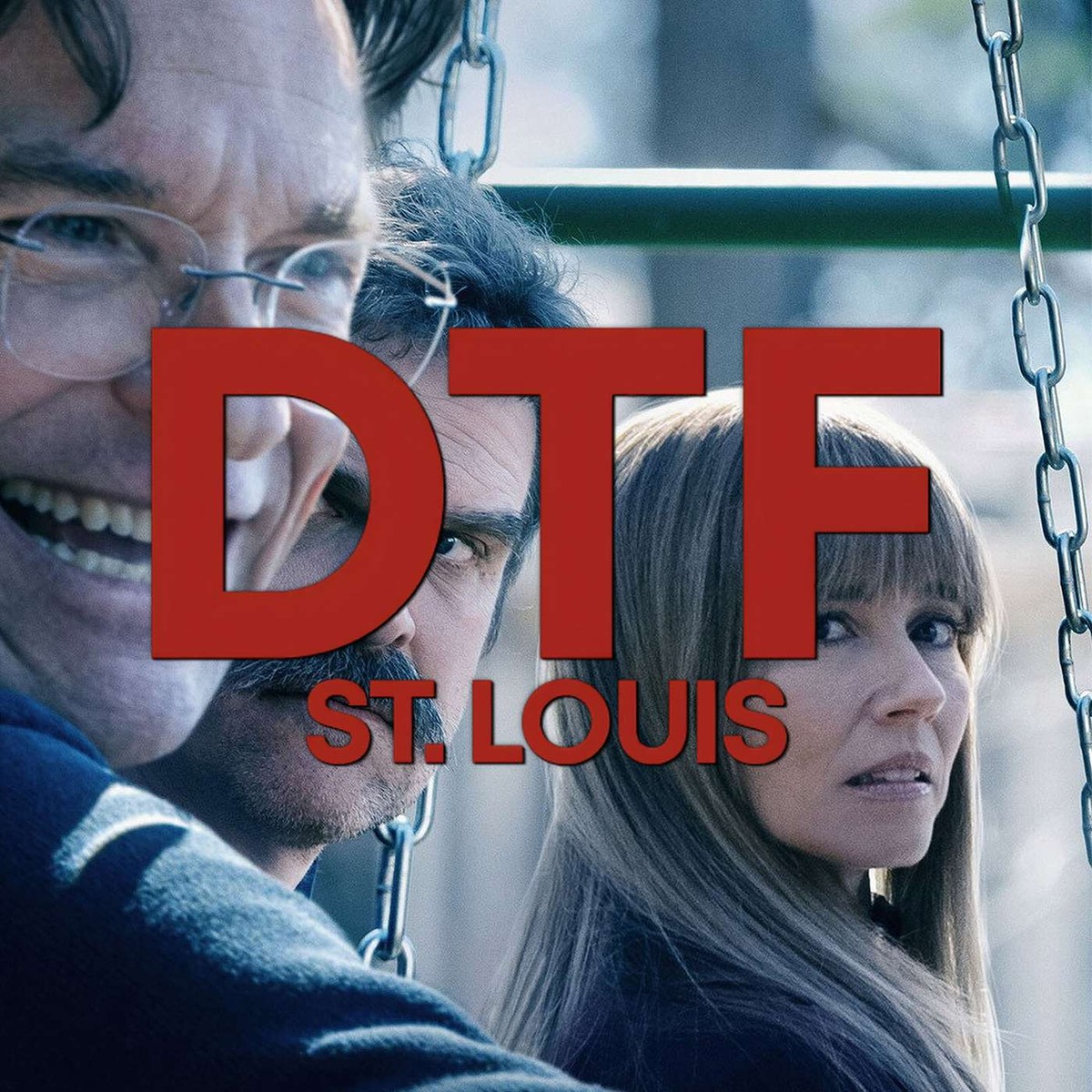
DTF St. Louis
Bateman and Harbour anchor HBO's strange, sad limited series that refuses to be the murder mystery it pretends to be, right down to a final sign language beat that quietly wrecked me.

Let’s set the table first, because this one has a genuinely interesting road to the screen. DTF St. Louis is an HBO dark comedy miniseries created by Steven Conrad, and it premiered back on March 1, 2026. If Conrad’s name rings a bell, he’s the guy behind The Secret Life of Walter Mitty and the series Patriot, and if you’ve seen Patriot, you already know the wavelength this man operates on. Deadpan, melancholy, strangely funny, all at the same time. What I found fascinating digging into the background is that this project actually started life under a completely different name, My Dentist’s Murder Trial, based on a 2017 New Yorker story, with David Harbour and Pedro Pascal attached to star. Pascal eventually moved on, and the whole thing evolved into an original story with no connection to that magazine piece, with Jason Bateman stepping in alongside Harbour. It ran weekly on HBO across seven episodes, wrapping up in mid April, and it’s all sitting there on HBO Max right now waiting for you.
Now, my expectations going in. I’ll be honest, the moment I saw that first trailer, this shot straight up my watchlist. I really enjoy Jason Bateman. Ozark proved he could carry dark, heavy material for years on end, and there’s just something about that dry, buttoned-down Bateman energy that works for me every single time. And on the other side of the table you’ve got David Harbour, finally doing something that isn’t Hopper, because let’s face it, the man has been Stranger Things for the better part of a decade now, and I was eager to see him stretch into something completely different. So the ingredients were all there. The question was how it would actually play out.
Not What the Trailer Sells You
Here’s the first thing you need to know: this show is not what the trailer sells you. That title makes it sound cheeky and tawdry, and yes, DTF St. Louis is literally the name of an app in the show, catering to married people who are curious about opening things up. But what you actually get is a dark comedy drama about friendship, about an affair, and about what looks like a murder case. And I say looks like very deliberately, because everything in this show is not as it seems. That’s honestly its strongest trait. It keeps pulling the rug, gently, episode after episode, right up until the very end. But I want to be upfront early, because this is where the show will divide people: it is a real slow burn. And I mean a real one. If this had dropped all at once as a binge, I honestly don’t know if I would have made it through. Some of these episodes feel drawn out, because there’s a lot of quiet friendship building going on, and if you’re here purely for the mystery, you’re going to feel that stretch. More on that in a bit.
Let me give you the shape of it without giving too much away. Bateman plays Clark Forrest, a local weatherman, Harbour plays Floyd Smernitch, his sign language interpreter, and Cardellini plays Floyd’s wife Carol. The show splits its time between two tracks. In the flashbacks, we watch the friendship form: Clark and Floyd, the dating app, the affair quietly taking root, all these secret little meetings between Clark and Carol. And in the present, two detectives, Richard Jenkins as Donoghue and Joy Sunday as Jodie, are trying to get to the bottom of what happened, because Floyd has been found dead, poisoned, at the community pool. The show flips between those timelines constantly, drip-feeding you the friendship, the dating, the affair on one side, and the investigation closing in on the other. And the writing does something quite clever with your suspicions. Very early on, you’re nudged toward thinking Clark might be behind it all, because he keeps helping Floyd. Financial problems, insurance, he’s just there, constantly, being helpful. And that question sits in the back of your head the entire time… why is he doing all of this? Meanwhile Floyd’s own journey on the app takes him somewhere he never expected. He meets a few men on there and simply doesn’t know how to process that, which the show handles in this odd, sad, surprisingly human way. And then there’s the turn where Floyd finds out about the affair and, rather than blowing everything up, wants to watch. He becomes a voyeur to his own marriage. It’s uncomfortable, it’s strange, and it’s exactly the kind of choice that tells you this show does not fall into any pigeonhole. By the end, I still couldn’t tell you what box it belongs in, and honestly, I think that’s the point.
Performances That Earn Their Keep
The performances are where this thing really earns its keep. The characters are very, very well developed across the board, and the Clark and Floyd relationship is the beating heart of the whole series. Bateman is doing that thing he does better than almost anyone: the reasonable, helpful guy whose motives you can never quite pin down. Every kind gesture reads two ways. Harbour, meanwhile, is a revelation here. Floyd is this big, open-hearted, slightly lost suburban dad, and Harbour plays him with zero vanity. After years of watching him be gruff and heroic, seeing him be soft and confused and vulnerable is a proper reminder of his range. And Linda Cardellini, who was so good in Dead to Me (and if you haven’t seen that show, add it to the list), threads an impossible needle as Carol, someone caught between wanting more from her life and being terrified of what wanting more actually costs. And I have to shout out the detectives, because Jenkins and Sunday play off each other beautifully. It’s an older and younger dynamic, but flipped from what you’d expect: the younger detective is the one who knows the ins and outs of how the modern world actually works, apps and all, and the older one is being educated as he goes. Their scenes are some of the funniest and warmest in the show. It’s no shock to me that the series picked up 13 Emmy nominations, including Outstanding Limited Series, with acting nods for Bateman, Cardellini, Harbour, Richard Jenkins and Joy Sunday. Every one of those is deserved.
Now let’s talk about the pacing properly, because this is my biggest issue with the show. Every episode left me intrigued to see what would happen next, and there were a few proper oh my God moments in here, moments where I sat up on the couch, but between those peaks, the show asks a lot of patience from you. It plays out a bit like a slow-motion train wreck. You can’t look away, but you’re also aware that not a lot is technically happening in any given stretch. The back half tightens up, with a lot of it unfolding in the police station: Clark locked up, the confessions coming out in layers, the detectives honing in on him hard, then pivoting to his wife, then to Floyd’s stepson because of this tricycle that keeps showing up in the background of the video evidence. That stretch is gripping. But getting there requires you to sit with a lot of quiet, awkward, suburban nothing, and I understand why, because the friendship is the point, but I’d be lying if I said every episode justified its full runtime. All the way up until the end, I did not know where this show was going or what it was doing, and depending on who you are, that’s either the pitch or the warning.
The Ending, and Who This Is For
Which brings me to the ending, and I’m going to tread carefully here, because the final stretch is much better discovered on screen and I won’t spell out exactly what the truth turns out to be. What I will say is this: the murder mystery gets subverted, properly subverted, and the answer recontextualises almost everything you’ve watched. It lands somewhere far sadder and far more human than a whodunit has any right to. There’s a final beat built around a single line of sign language, and a character who doesn’t understand what was said to him until someone else explains it, that quietly wrecked me. But here’s my honest problem: the ending doesn’t leave you with anything satisfying to hold onto. Clark’s midlife crisis ends in complete ruin. Nobody really gets out of this clean. It’s a very open, very muted, very sad conclusion, and the only small, warm note the show offers is that the two detectives end up growing into something a little deeper together. That’s it. That’s your consolation prize. Now, I respect a show that commits to its melancholy, but after seven episodes of investment, I wanted the landing to give me just a little more than it did. And on the plus side of that same coin, this is a true micro show. It’s seven episodes, it’s done, there is no way they could squeeze a season 2 out of this and thankfully nobody seems interested in trying. In an era where everything gets stretched into franchises, there’s something refreshing about a story that simply ends.
So who is this for? Let me connect some dots, because this show sits in a very specific neighbourhood. The closest cousin tonally is another wonderfully obscure HBO show called The Chair Company. If that one worked for you, with its deadpan absurdity wrapped around a mystery, I think this will too. And if you’re drawn to the prestige side of it, the grief, the suburban rot, the investigation peeling back a community’s secrets, then think Sharp Objects, Mare of Easttown, The Outsider, The Undoing, The Staircase, Love and Death. If those shows sit well with you, there’s a very good chance this one will as well. I’d also point Conrad newcomers toward Patriot on Prime Video afterwards. It’s his masterpiece, criminally underseen, and once you’ve got a taste for his rhythm here, it’s the natural next step. But whatever you do, hear me on this: do not binge DTF St. Louis. Take it one episode a night. Give each hour room to breathe. I honestly think if you hammered through this in one sitting, you’d be pulling it off your watchlist before episode three. Watched slowly, the way it aired, it works. Watched in a heap, I think it collapses.
But look, that’s just how this one landed for me. Entertainment is subjective. The pacing that tested me might be exactly the slow simmer someone else falls in love with, and the ending that left me a bit hollow might hit another viewer as the bravest choice of the year. What works for me may not work for you, and that’s completely okay. But for my money, the sight of Jason Bateman and David Harbour circling each other in the suburbs is one of the most quietly compelling things HBO has put out this year.
Rated SEP 2026LISTEN TO THIS EPISODE
Follow Frame 70 on your favourite podcast app and new episodes find you the moment they drop.