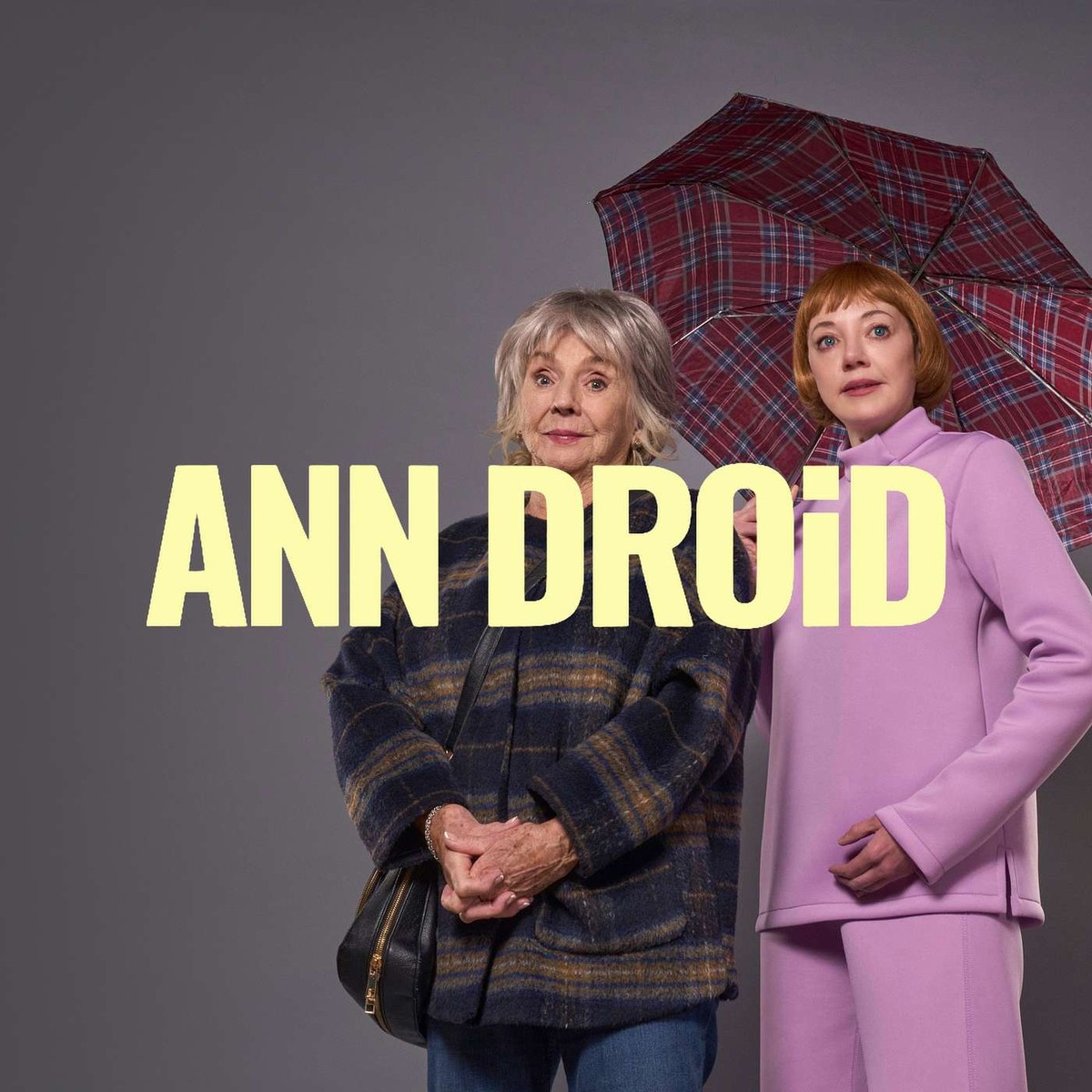
Ann Droid
A grieving widow, a clapped-out secondhand care android, and six episodes of British comedy that go from charity shop farce to a finale that absolutely floored me.

Ann Droid is a six-part comedy created by Diane Morgan and Sarah Kendall, and if that pairing rings a bell, it’s because the two of them have history. They worked together on Frayed and The Other One, so this isn’t a first date. Morgan doesn’t just co-create here either, she writes and stars as Linda, a secondhand eldercare android, and the title itself is a bit of wordplay on the in-universe brand name of the robots. The show is set a few years into the near future, in a Britain where AI carers for the elderly are becoming the norm, and it dropped as a full box set on BBC iPlayer alongside a weekly Friday night slot on BBC One. Now, full disclosure on how I watched this one. It’s currently not available in Australia, where I am, which is genuinely unfortunate, but I had the privilege of seeing all six episodes in advance before it lands here in the next few months. So if you’re in the UK, you can watch the whole thing right now. If you’re where I am, keep it on your radar, because it’s coming.
And look, my first impression, straight off the bat, is that this is another one of those great little British TV shows. Six parts, straight into it, no filler, done. It reminded me a lot of what we covered last month with Small Prophets, Mackenzie Crook’s six-part BBC comedy, which had that same wholesome, complete, watch-it-in-a-weekend feel. There’s something about this format that British television just gets right. Nobody’s stretching a good idea across 22 episodes. You get six, they all count, and you walk away satisfied. Ann Droid is exactly that kind of show, and I’ll come back to that comparison later because I think there’s a real thread between the two.
A Robot on the Doorstep
Let me set up the premise, because it’s a good one. Sue, played by Sue Johnston, is a widow. Her husband Dave has been gone a while, and she’s still very much grieving: keeping busy, keeping the house going, but you can feel the hole in her life from the first scene. Her son Michael, played by Paul Ready, is a bit lost himself. His marriage is on the rocks, and he’s moving out of his mum’s place to go back to his wife Renee and try to patch things up. But he doesn’t want to leave his mum on her own, and he definitely doesn’t want to pay for a human carer to move in, so he does what Michael does, and finds the cheap option. He buys his mum a surprise care robot. Not one of the shiny new models, mind you. A hand-me-down. Older technology, secondhand, a bit clapped out. And when Linda arrives on the doorstep wrapped in bubble wrap, Sue’s reaction isn’t gratitude, it’s horror. She wants nothing to do with it. By the end of the first episode she’s arranged for Linda to be sent back within the 48-hour trial period, and honestly, you believe she means it.
But the thing that turns her around, and this is where the show first showed me it had more going on than the setup suggests, is beautifully done. While Sue is sleeping, Linda goes around the house, quietly taking in everything Sue has done, all the little traces of a life, and how losing her husband has affected her. And what actually stops Sue from getting rid of her is a small thing. She finds that Linda has planted a plant in the front garden, which is why Linda’s got dirt all over her hands. That’s it. That’s the turning point. No big speech, no swelling music, just a robot with dirty hands and a widow who suddenly can’t bring herself to send it back. For a comedy, that’s a really confident, understated bit of writing, and it set the tone for everything that followed.
Morgan and Johnston, a Proper Double Act
Now let’s talk about Diane Morgan, because she is the engine of this entire show. As Linda, she is completely deadpan, she has absolutely no filter, and she is just brilliant. You’ve seen her before. Most people will know her as Kath from Ricky Gervais’s After Life, where she was a consistent scene stealer, and that same delivery is exactly what makes Linda work. An android with no social filter is basically the character Diane Morgan was born to play. Every blunt observation, every wildly inappropriate comment delivered with total sincerity, it all lands because Morgan never once winks at the camera. She commits. And speaking of commitment, here’s my favourite bit of trivia from this whole production. Linda the android doesn’t blink. At all. Across six episodes. I saw an interview with Morgan where she explained that because the contact lenses she wore were quite thick and blue, she deliberately trained herself not to blink for the role, and she ended up getting an ulcer in her eye for her trouble. That is proper, old-fashioned dedication to a bit. You watch the show knowing that, and you can’t stop noticing it. It’s a small physical choice that does an enormous amount of work in selling Linda as a machine.
But a double act needs two, and Sue Johnston is every bit her equal. Johnston is one of those actors British TV fans will know instantly, with decades of warm, grounded, deeply human work behind her, and she brings all of that here. Sue could easily have been a one-note grumpy widow, but Johnston gives her this lovely mix of stubbornness, grief and slowly reawakening mischief. And the chemistry between the two of them is the heart of the show. Because as the season goes on, something really nice happens on both sides. With Linda around, Sue starts opening up, being more adventurous, getting out of the house, actually experiencing life again after her husband’s death. And on the flip side, Linda starts to evolve too. She warms to Sue in a way that goes beyond her programming, and you can see a solid connection building between them episode by episode. It’s an odd couple story at its core, the grieving widow and the malfunctioning robot, but by the back half of the season it’s become something more like a friendship, and the show earns every step of it.
And I want to be clear, this isn’t just a gentle, misty-eyed drama about grief. From episode two onwards, it’s an absolute riot. We’re introduced to a whole gallery of Sue’s elderly friends who work at the local charity shop, the op shop for my fellow Australians, and they’re great fun as a supporting ensemble. Sue offers to work at the shop for a day, and it turns into a complete disaster when Linda locks them out of the store. It’s one of the funniest sequences in the season, pure escalating farce. Things get even worse when Sue tries to show up for Michael at his girlfriend Renee’s Brazilian jiu-jitsu presentation, which goes about as well as you’d expect when you bring a malfunctioning android to a martial arts event. Then there’s the episode where Linda drags Sue to the seaside to scatter her husband’s ashes, and the whole thing detours into a trip to a rundown funfair, riding roller coasters, one of which goes properly wrong, and yet somehow the two of them end up having the time of their lives. That episode is the show in miniature, honestly. It starts with ashes and ends with joy, and the tonal balancing act between those two things is what Ann Droid does better than almost anything else on TV right now. Meanwhile, in the background, Linda is quietly sabotaging Michael’s open-mic rock ambitions, which is exactly as petty and wonderful as it sounds.
Which brings me to Michael, because I need to talk about him. Michael is the character you love to hate. He’s cheap, he’s self-absorbed, he consistently puts himself before his mum, and every time he was on screen I wanted to reach through the television and shake him. And here’s the thing: that’s not a flaw in the show. That’s a credit to the writing, and to Paul Ready’s performance, because Michael is meant to grate. He’s the human measuring stick that makes Linda, an actual machine, look like the more caring presence in Sue’s life, and that contrast is doing a lot of the show’s thematic heavy lifting. There’s also a lovely bit of casting history here, because Paul Ready and Diane Morgan have shared a screen before. They were both in Motherland, where Ready played the gloriously useless Kevin. If you enjoyed the two of them in that, watching them spark off each other again here in completely different registers is a real treat.
The Back Half, and Where to Go Next
The back half of the season is where the story properly deepens. Sue invites Michael and Renee round for a family dinner, and it comes out that the two of them, back together after some turbulence involving Renee’s jiu-jitsu instructor, have their own reasons for the visit, and it’s not to check in on mum. Sue is hurt, and rightly so. But that same stretch of the season also gives Linda her big hero moment, when a choking incident at the table lets her prove her worth by averting a real tragedy, and her AI tech picks up on something in the process that sends the whole family story spinning in a new direction. I won’t go too deep into the details of what unravels from there, because it’s much better discovered on screen, but there’s a revelation involving Michael that flips his entire world upside down, a camping trip to watch a meteor shower that brings everything to a head, and by season’s end Michael is back living at home, unemployed, and telling Linda he can no longer afford to keep her. And here’s the gut punch: the week Linda is due to be returned would have marked Sue’s 50th wedding anniversary. Before the pickup, Linda takes Sue to a ballroom dancing class, which is extremely funny and quietly devastating at the same time, and that’s this show all over.
Let me pull on the connective tissue a bit more, because Diane Morgan is having quite the year. Beyond After Life, she’s reuniting with Ricky Gervais again in Alley Cats, his new animated series on Netflix, so if you become a fan of hers through Ann Droid there’s more on the way. And she’s built an impressive body of her own material too. There’s Mandy, her gloriously strange sitcom, and of course the Cunk mockumentaries, where her clueless documentary presenter Philomena Cunk has become a genuine cultural export. If Linda’s deadpan delivery tickles you, Cunk is the natural next stop: same comic instrument, completely different tune. And as I said up top, if you’re after the same overall feeling this show gives you, Small Prophets is the companion piece. Both are six-part British comedies with real warmth underneath the jokes, both are complete stories rather than franchise-building exercises, and both reward watching straight through in a sitting or two rather than being strung out week to week. If you liked one, I’d put money on you liking the other.
So, final thoughts. The writing here is very good: sharp enough to be properly funny, brave enough to sit in grief when it needs to, and clever enough to give you characters you absolutely love sitting right next to characters you absolutely can’t stand. Diane Morgan delivers one of my favourite comic performances of the year, Sue Johnston matches her beat for beat, and the bond between a widow and her malfunctioning robot turns out to be one of the most affecting relationships on television in 2026. Six episodes, no wasted motion, real heart under the jokes. My fingers are firmly crossed for a second season.
But look, this is just how Ann Droid landed for me. Entertainment is subjective, and what works for me may not work for you, and that’s completely okay. Maybe a deadpan robot scattering ashes at a funfair isn’t your idea of a good night in. But for my money, this is the most wholesome hour-and-a-half of British comedy you’ll find this year, and I’d love to hear how it lands for you.
Rated OCT 2026LISTEN TO THIS EPISODE
Follow Frame 70 on your favourite podcast app and new episodes find you the moment they drop.