Contact
Her recorder caught nothing but static, and it caught 18 hours of it. Nearly 30 years on, Contact is still one of the smartest, warmest first contact stories ever put on screen.
 8.7/10 · EXCELLENT
 Today we’re taking a look at Contact, the 1997 film directed by Robert Zemeckis and starring Jodie Foster and Matthew McConaughey. This one’s a From the Vault review, which means we’re winding the clock back nearly 30 years, and because it’s from the vault, I’m going to talk about the whole film, start to finish, the way you’d talk about it with a mate who’s seen it a dozen times.
Prime Numbers From Vega
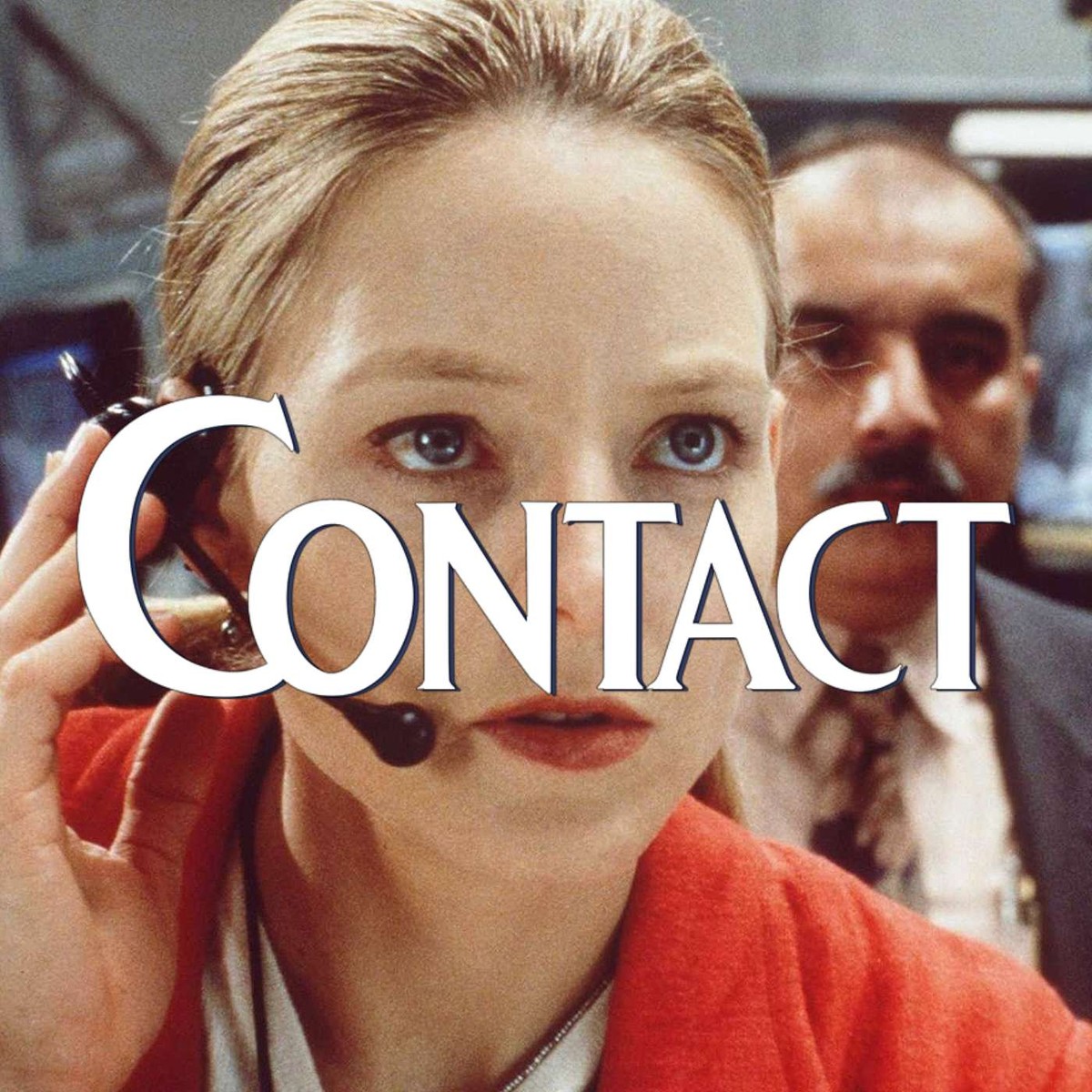
A little context before we dive in, because the story behind this one is almost as good as the film. Contact is based on the 1985 novel by Carl Sagan, yes, that Carl Sagan, the astronomer behind Cosmos, and he and his wife Ann Druyan had actually been developing it as a film since the late ’70s before it ever became a book. It finally landed at Warner Bros with Robert Zemeckis directing, fresh off Forrest Gump, and that connection is going to matter later in this review, so tuck it away. Jodie Foster plays Doctor Ellie Arroway, a SETI scientist who spends her nights with headphones on, listening to the static of the universe, hoping something listens back. And one night, something does. A signal from the star Vega, 26 light-years away, and it’s not random noise. It’s prime numbers. Maths. The one language that doesn’t care what planet you were born on. From there, the film unfolds into a global scramble as humanity discovers there are layers buried inside that signal: audio, video, and eventually more than 60,000 pages of schematics for a machine built to carry a single passenger. Where to? Nobody knows. That’s the movie.
This is probably one of the best slow burn sci-fi films ever made, and I want to be upfront about the words slow burn, because they’re doing a lot of work here. Contact runs 2.5 hours, and it earns every minute, but it is in absolutely no hurry. This is a rainy Sunday afternoon film. It’s the kind of movie you settle into with a cuppa while the weather does its thing outside, and these days you can find it sitting on just about any streaming service, which makes it the perfect lazy weekend discovery.
Now here’s the funny thing. I didn’t always feel that way about it. When I first watched Contact, I was too young for it, plain and simple. The ’90s had trained me on films that were 90 minutes long and took off like a rocket from the opening frame. So a 2.5 hour film about radio telescopes and faith and government committees? I remember sitting there waiting for it to hurry up. But every rewatch over the years has pulled me closer to it, and watching it again now in 2026, the slow burn is exactly what I love about it. It needs that runtime to get into the maths, the politics, the religion, the doubt, all of it. The film has room to breathe, and it uses every bit of that room.
Faith, Proof and the People in Between
It’s such a treat to see Jodie Foster in a role like this. She’s one of those actors who simply hasn’t done enough movies for my liking. She broke through as a kid, she was barely a teenager when Taxi Driver happened, and maybe because she started that young, she became incredibly selective later in her career. The roles thinned out. But when she picks one, she picks it, and Ellie Arroway might be the best example of that. Foster plays her as brilliant, stubborn, a little bruised by life, and completely allergic to taking anything on faith, which is exactly the person this story needs at its centre, because Contact is a film that spends 2.5 hours poking at the question of what faith actually is.
That’s where Matthew McConaughey comes in. He plays Palmer Joss, a religious philosopher who describes himself to Ellie as a man of the cloth, without the cloth, which is one of my favourite little character introductions in the film. He’s essentially her opposite number. She needs proof for everything. He believes in things he can’t measure. And the film just lets them bounce off each other for the whole runtime. Should we build this machine? If they’ve sent us the instructions, why wouldn’t we? But should we? It’s the good and the bad, back and forth, and neither of them is written as the idiot, which is rarer than you’d think. Most films would pick a side. Contact refuses to, right up to its final scene, and I love it for that.
Then you’ve got the characters orbiting those two, and this cast is stacked. Tom Skerritt plays David Drumlin, the government science advisor, and Drumlin is the kind of guy who is really only ever looking out for himself. He wants the credit, he wants the attention, and you can see it from the very first scene he shares with Ellie all the way through to him putting his own hand up to be the first person through the machine, the machine built off the back of a discovery he originally cut the funding for. He’s the kind of guy who just loves the sound of his own voice, and I reckon most of you have met a Drumlin at some point in your life. Every workplace has one.
And then there’s S.R. Hadden, the reclusive billionaire played by John Hurt, and this character is fascinating to watch in 2026. Here’s a man with so much money that when the world’s governments build the machine, he quietly says, well, let’s also build machine number two, just in case something happens to machine number one. Watching it today, this character feels like he was written about the billionaires we have running around now, the Elon Musks, the Jeff Bezos types, funding their own private space ambitions while the rest of us watch from the ground. Obviously none of those guys were doing what they do now back when this film was made, which makes Hadden feel weirdly ahead of his time. He’s the one who bankrolls Ellie when Drumlin pulls her funding, he’s the one who decodes the schematics, and by the end of the film he’s literally running his empire from orbit.
And John Hurt’s presence is always great. Now here’s a fun bit of connective tissue for you. John Hurt was in the very first Alien back in 1979, and he’s responsible for one of the greatest death scenes ever put on screen. If you’ve seen Alien, you know exactly the scene I’m talking about, those facehuggers will get you every time. If you haven’t seen it, you’re missing out on a stone cold classic. And here’s the kicker: he’s not even the only Nostromo crew member in this film, because Tom Skerritt was in Alien too, as Captain Dallas. So Contact quietly has two survivors of that ship (well, survivors might be a generous word for either of them) sharing a cast list. I love little threads like that.
Now, the science. This feels to me like one of the first big sci-fi movies where the filmmakers actually went and got real, educated people involved. And it turns out that instinct is spot on. The production had technical consultants from the SETI Institute, from Caltech, from the Very Large Array itself, and Carl Sagan was on set doing last-minute rewrites. You can feel that rigour all over the film. A lot of movies from that era didn’t bother with any of it, and it’s why Contact sits so comfortably next to the properly researched stuff we get now: The Martian, Project Hail Mary, the Andy Weir books. All of that heavily researched, show-your-working science fiction owes something to what this film was doing back in the ’90s.
And it films the science beautifully. You get those gorgeous early scenes at the observatory in the jungle, that’s the real Arecibo dish in Puerto Rico, and then we flip over to the Very Large Array out in the New Mexico desert, this enormous line of radio dishes stretching to the horizon. That is a real place, by the way, and it’s on my list. That’s somewhere I would love to physically stand one day and just look at.
I also love how the film handles the signal itself. Whoever contacted us buried the message deep, deep in maths, deep in audio, layers upon layers upon layers of information, and humanity just has to be clever enough to find the next one. There’s something so satisfying about watching characters peel an onion like that. And the scene where it all starts is one of my favourites in the film. I call it the chaos scene. Ellie’s out there on her own, headphones on, when she first hears it, and then it’s just beautiful, escalating mayhem. Her scrambling on the radio to the research lab, the team spilling out of their chairs, everyone trying to work out what this sound is and where it’s coming from, coordinates flying back and forth. The film makes discovery feel like panic and joy at the same time, and I don’t think many movies have ever captured that feeling better.
18 Hours of Static
Something else that struck me on this rewatch: you can see the film slowly pushing Ellie aside, and it’s infuriating in exactly the way it’s meant to be. She’s the one who found the signal. She’s the one who kept the lights on when the funding was cut. And piece by piece, the credit drifts towards men like Drumlin, right up until the selection panel picks him, the man who called the whole search a waste of money, to be the one who takes the journey. And then the film flips it. During the first test of the machine, a religious extremist gets onto the platform and destroys the whole thing in a suicide bombing, taking Drumlin with it. And it’s Hadden, up on the Mir space station, who reveals the second machine in Japan and hands Ellie her second chance. It’s a genuine gut-punch sequence, and it resets the entire final act.
Which brings us to the journey itself, and the ending, and this is where Contact becomes the film people are still arguing about nearly 30 years later. Ellie drops through the machine and experiences this surreal voyage through wormholes, glimpses of Vega, an alien civilisation, the works, before making first contact with an intelligence that appears to her in the form of her deceased father, plucked straight from her memories to make the whole thing easier on her. And I love how the film uses her dad. David Morse is all over the opening act, shaping who young Ellie becomes, and then he returns as the face of first contact at the end. Because think about it: if you’re in the camp that says it really happened, what do these beings actually look like? We never know. They just borrowed a memory. It bookends the film perfectly.
But then she comes back, and here’s the twist of the knife. From the outside, the pod simply fell straight through the machine into the safety net. Seconds. Ellie insists she was gone for hours, but her recording devices captured nothing but static, and suddenly the scientist who needed proof for everything is sitting in front of a congressional committee asking them to take her experience on faith. It’s the film’s whole argument folded back on itself, and it’s brilliant. Some of you will land in the camp of no, she fell straight through, the whole thing played out in her head. Others will say she absolutely went, and what she experienced was time behaving very differently out there than it does down here. We’ve all been educated by enough science fiction since then to know time doesn’t have to run at the same speed for everyone, and the best example is a Matthew McConaughey film, of all things. Interstellar. Christopher Nolan’s film taught a whole generation about time dilation with that water planet sequence, where a few hours on the surface near a black hole costs the crew more than two decades back on the ship. Watch Contact after Interstellar and Ellie’s journey suddenly has a very tidy explanation sitting right there: minutes for us, hours for her. Interstellar was famously researched to within an inch of its life too, with physicist Kip Thorne consulting on the science. Nolan even named one of the robots KIPP after him. And talking about it this much is reminding me that I really do need to lock Interstellar in for its own review soon, so consider that a little promise for the future. But let’s stay on the level here, we’re talking about Contact.
And here’s the detail I love most about the ending. The film gives you one quiet thumb on the scale. In a private conversation after the hearing, two government officials note that yes, Ellie’s recorder only captured static, but it captured 18 hours of it. The film never announces it. It just leaves it there for the people paying attention. That, to me, is the perfect way to handle an ambiguous ending: let the audience finish the movie themselves.
One more thing, because it’s worth saying out loud. Contact is a film that started tropes. You cannot watch it today and accuse it of borrowing, because in 1997 most of this was fresh ground. The layered alien signal, the message hidden inside a broadcast, the first contact wearing a familiar face, the ambiguous did-it-really-happen return. We’ve now seen decades of films reach for those same ideas. Contact is the springboard. Watching it in 2026 is like visiting the source of a river you’ve been swimming in your whole life.
While we’re on Zemeckis, here’s something that’s bugged me for years in the best way. There’s a gentle little piano theme running through Contact, you hear it around the emotional beats, including just after the funeral, and I always swore it sounded like it wandered in from Forrest Gump. Turns out my ears weren’t lying to me. Both films were scored by the same man, Alan Silvestri, who has been Zemeckis’s composer for basically his entire career: Back to the Future, Forrest Gump, Contact, Cast Away, the lot. The main piano theme in Contact really does sit right next door to that famous feather theme from Gump, and once you hear the family resemblance, you cannot unhear it. It’s the same warm, wondering sound, just pointed at the stars instead of a park bench.
And can we take a second for how deep this cast goes? Beyond Foster, McConaughey, Skerritt and John Hurt, you’ve got James Woods as the national security hardliner, Angela Bassett in the White House, Rob Lowe popping up as a slick religious lobbyist, and then Larry King playing himself, alongside a small army of real CNN reporters covering the signal, which was Zemeckis’s trick for making the whole thing feel like it was actually happening on the news. Even the opening is a flex: that famous pull-back from Earth through the solar system, riding humanity’s radio broadcasts out into silence. A message from Vega comes back down that same river of noise. Beautiful stuff.
So, final thoughts. Contact is a film I appreciated more with every year I put between myself and that first viewing. What felt slow to a young me now feels patient. What felt talky now feels rich. It’s a big, sincere, 2.5 hour conversation about science, faith, grief and wonder, anchored by one of Jodie Foster’s very best performances, and it ends by handing you the question instead of the answer, which is exactly why people are still talking about it.
And look, that’s just how Contact lands for me, especially after all these rewatches. Entertainment is subjective, and a patient film like this won’t be everyone’s cup of tea. If slow burns aren’t your thing, this one might test you the way it tested a much younger me, and that’s completely okay. But if you let it in, I reckon there’s a very good chance you’ll still be thinking about that ending days later, just like I am.
Listen to this episode
Follow Frame 70 on your favourite podcast app and new episodes find you the moment they drop.