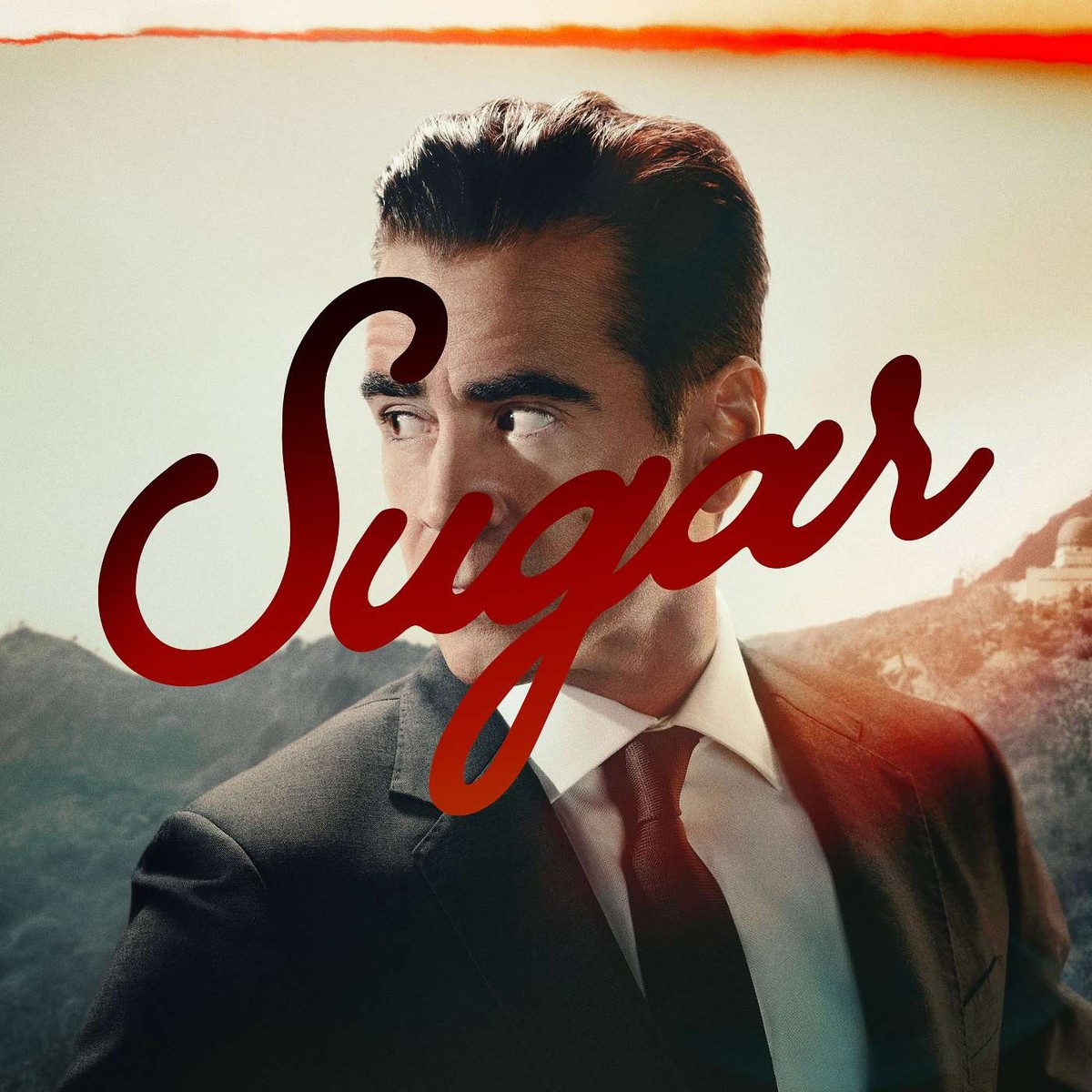
Sugar
Colin Farrell's alien private eye returns with a nastier case, a crooked cop, and a growing ledger of broken rules. Season two is the same effortlessly stylish show, with the machinery working better.
 8.1/10 · GREAT
 A quick bit of context before we dig in, because this show has a strange and honestly quite lovely history. Sugar arrived back in 2024 looking like a straight private detective show, a stylish, old-movie-loving investigator working the underbelly of Los Angeles, and then it pulled the rug out from under everybody in episode six of eight, when it turned out John Sugar was not from around here at all. If you’re already up to season two you know exactly what I mean. He’s an alien, part of a group who came to Earth to observe and report on human behaviour, and the show dropped that on us late and then had the confidence not to turn into a completely different series afterwards. That first season finished in May 2024, and Apple didn’t renew it until October, a full five months later, so this second season was never a sure thing. When it did come back, it came back with a change behind the camera. Sam Catlin runs season two, taking over from Mark Protosevich and Simon Kinberg, with Colin Farrell continuing as an executive producer alongside Kinberg. The gorgeous score is once again from Ali Shaheed Muhammad and Adrian Younge, with Kamasi Washington’s Street Fighter Mas as the theme, and we get eight episodes, released weekly from June 19 through to August 7, running anywhere from just over half an hour up to nearly 50 minutes each. So the question going in was simple: could they do it again, and could they do it with a new hand on the wheel?
The Scotch Bar Effect
I’ll tell you where I landed straight away. I have never watched a show that has so many cool little elements going on with it at once. This is oversized neo crime set in LA. It’s gritty, but it knows it’s cool, from Farrell’s little voice-overs letting us know what’s going on and how he’s feeling, right up to those cut-ins of old-school black-and-white movies stitched through the episodes. And here’s the best way I can describe the experience of watching it. This is the kind of show that makes me feel like I’m sitting in one of those brilliant little scotch bars: wooden floors, the smell of whiskey and cigars, beautiful leather Chesterfield couches. The show just makes you like it. You soak it in and you get comfortable. There’s a lot of Dean Martin in the air, both in the actual music and in the whole attitude of the thing, and this season leans on era needle-drops as well, Frank Sinatra and Glenn Miller sitting alongside that Muhammad and Younge score. It all matches. Nothing about the atmosphere ever feels like an accident.
And then there’s the man himself. Colin Farrell is like a great red wine: the bloke is just getting better with age. Sugar season one, straight into The Penguin, and now back around to Sugar season two. I also think he’s one of the best dressed men in Hollywood at the moment. He always looks great in that suit, and the show knows exactly what it has in him. It’s not asking him to be an action hero. It’s asking him to be tired and decent and a little bit out of step with everyone around him, and he is so well suited to that. Because here’s the thing. I don’t think I’ve ever watched a show with a private eye this well mannered and this nice. They always come across rugged, rough, alcoholic, down on their luck. Not this one. And the alien of it all is handled with real restraint. They gave us the reveal late in season one and they don’t dig hard into it here. No huge powers, no big spectacle, just a man who isn’t quite a man, trying to do the right thing in a city that doesn’t. I think the premise is brilliant. And we probably shouldn’t do a review without mentioning that gorgeous blue car, a 1966 Chevrolet Corvette Sting Ray convertible in Nassau Blue with a white interior, which the show has openly tied back to Mike Hammer’s Corvette in the 1955 noir Kiss Me Deadly. That’s the level of care we’re dealing with. Even the car is a film reference.
The Case, the Cop, and the Ledger
So where does season two pick things up? Sugar is feeling very, very alone. It’s pretty much assumed from the end of season one that he’s by himself now, with a lot of his friends and companions gone back home, and into that emptiness lands a new case. A couple of brothers. One of them, Danny Moon, is a boxer, played by Jin Ha. The other, Ji, has gone missing, and it turns out he ended up in the wrong place at the wrong time, saw something he wasn’t supposed to see, and went into hiding. Sugar is brought on by Danny to find him, and while he’s out questioning people he runs into a young woman named Val. That’s Sasha Calle, who played the Supergirl character in the Flash movie, and it was good to see her back in something else. But the real friction of the season comes from a pretty nasty piece of work called Lieutenant Ray Vega, played by Tony Dalton, and it turns into a proper game of cat and mouse between the two of them. Sugar tries to get clever. He goes to a cartel figure named Sergey to get some leverage over Vega, and then that fella dies in a plane crash and the leverage evaporates completely, because Sergey’s son Diego, who survives, turns out to be the one actually running the whole rotten operation. That all builds to a huge showdown out in the desert. Sugar tricks Vega, there’s a big fight, a car crash, and Sugar kills him. And it’s not clean. He chokes the man with his own tie. For a show this composed and this well dressed, that moment lands hard.
And that’s where the season quietly becomes something more interesting than a missing persons case, because you can feel Sugar racking up violations. He’s had a relationship with a woman. He’s eaten food he wasn’t supposed to eat. Now he’s killed a man. The whole time I was watching, I kept coming back to the same conclusion: he is obviously going to be sent home. The show is keeping a ledger, and every episode adds another line to it. Episode seven wraps up the case itself, with Sugar finding the boys, making sure they’re safe and getting them reunited, and then episode eight flips into something a little bit different, and I liked that it did. All season there’s been an underlying thread about a scientist and a mansion Sugar has been circling, because he was worried the people inside had technology from his home planet. Episode eight opens out in a desert with scientists using that technology to create an atmosphere for growing in harsh environments, exactly the sort of thing you’d expect from his planet, and then the scientist gets on the phone, and we find out she’s talking to Sugar. It’s his sister. The one we’ve been hearing about across two whole seasons. That’s Djen, played by Mireille Enos this time around, and the show is clever enough to lock that phone call into a scene we’ve already watched from the other side, which is the kind of construction I really admire. I won’t lay out every beat of where the sister story goes, because it’s much better discovered on screen, but I’ll say this. She is not quite the person we were led to believe she was, and by the end of the hour, the question of what that environmental technology is actually for gets a lot darker and a lot more intriguing. The episode also cleans up the season’s corruption story, an ugly scheme called Fire Sale that had been preying on the homeless, with deaths, stolen identities, and government money claimed against people who are already gone, and watching the arrests roll through is deeply satisfying. Then the season finishes back on the brothers, in Las Vegas, with Danny about to fight and Sugar there in his corner. Full circle, in the warmest possible way.
Where It Stumbles
Now, it’s not all smooth pours and Chesterfield couches, so let’s talk about the gripes, because I do have a couple. The main one is over-explaining. Even at eight episodes, this could have been six. We did not need an entire strand telling us exactly why one of Sugar’s companions on Earth was sent back home for breaking the rules. We all knew what the rules were, because he’s been telling us constantly across two seasons. I understand why they did it. It’s all setup for Sugar breaking those same rules himself, with the woman at the hotel, and then with Vega and what he had to do to protect those brothers. But the show holds your hand through it like you might miss the point, and this audience will not miss the point. Same deal with the machine in his hotel room, the one he can use to contact others from his home planet, introduced nice and early and then very pointedly left silent. Nobody is contacting him. He doesn’t know if anyone from his group is even left on Earth. And the more the season built, the more I thought: I know exactly what’s going to happen with that thing. I guaranteed myself that by the end of episode eight, that machine would start dinging. There were a few moments like that across the season which were a little bit infuriating, because the show was laying it out too much, like we were idiots. It’s a small thing against everything Sugar does well, but on a show this smart, being talked down to stings a bit more than it otherwise would.
Let’s do some connective tissue, because this show is swimming in it. First, if you want to see just how hot a streak Farrell is on, go from Sugar season one into The Penguin. That ran on HBO in late 2024, only a few months after Sugar’s first season finished, and he won the Golden Globe, the Screen Actors Guild Award and the Critics Choice Award for playing Oz Cobb, plus an Emmy nomination. Two performances that could not be further apart, back to back, and he’s flawless in both. Second, those black-and-white cut-ins aren’t decoration. They’re the show talking to you. There’s a moment in episode seven, right after the plane crash, where Sugar spends his evening watching Here Comes Mr. Jordan, a 1941 film about a boxer who dies in a plane crash and gets a second chance. That’s the show winking at its own plot, and if Sugar sends you off to discover a few classics like that one, it’s done you a favour. And third, there’s Apple against Netflix, and how differently they treat a show that doesn’t immediately find a giant audience. I knew as soon as season one finished that this is not a show for everybody, and that it might not have a big enough pool of viewers to justify coming back. But unlike Netflix, who will put out an amazing first season and then two and a half hours later decide to cancel it, and yes, I am talking about you, Apple gave this show time to breathe and time to mature. Exactly like a wine. And that’s the only reason we’re sitting here talking about season two at all.
So, final thoughts. Even with the gripes, this is still a very, very cool show. It’s obviously not for everyone, with the way it’s laid out, the old-movie cut-ins, the voice-over, the deliberate pace, but if it’s for you, it is really for you. Episode eight plays like a standalone that could have been episode one of a season three, and I mean that as a compliment. The case is wrapped, the corruption gets cleaned up, and the show quietly repositions itself around the sister and everything she represents. As of right now Apple hasn’t announced a renewal, and given season one took five months to get picked up, we might be waiting a while. But here’s my hope: if we do get a season three built on where episode eight leaves things, that could be a brilliant way to conclude the entire chapter. Three seasons, wrapping back around on itself, with characters carried all the way through from the first hour to the last. Fingers crossed we get it.
But look, that’s just how season two of Sugar landed for me, sitting in my imaginary scotch bar with the Sinatra playing. Entertainment is subjective, and a slow-burn detective story with an alien wearing the best suit in Los Angeles is always going to hit some people square in the heart and leave others cold. What works for me may not work for you, and that’s completely okay. But for my money, Sugar remains one of the most effortlessly stylish things on television, and I’ll be keeping a seat warm for season three.
Listen to this episode
Follow Frame 70 on your favourite podcast app and new episodes find you the moment they drop.