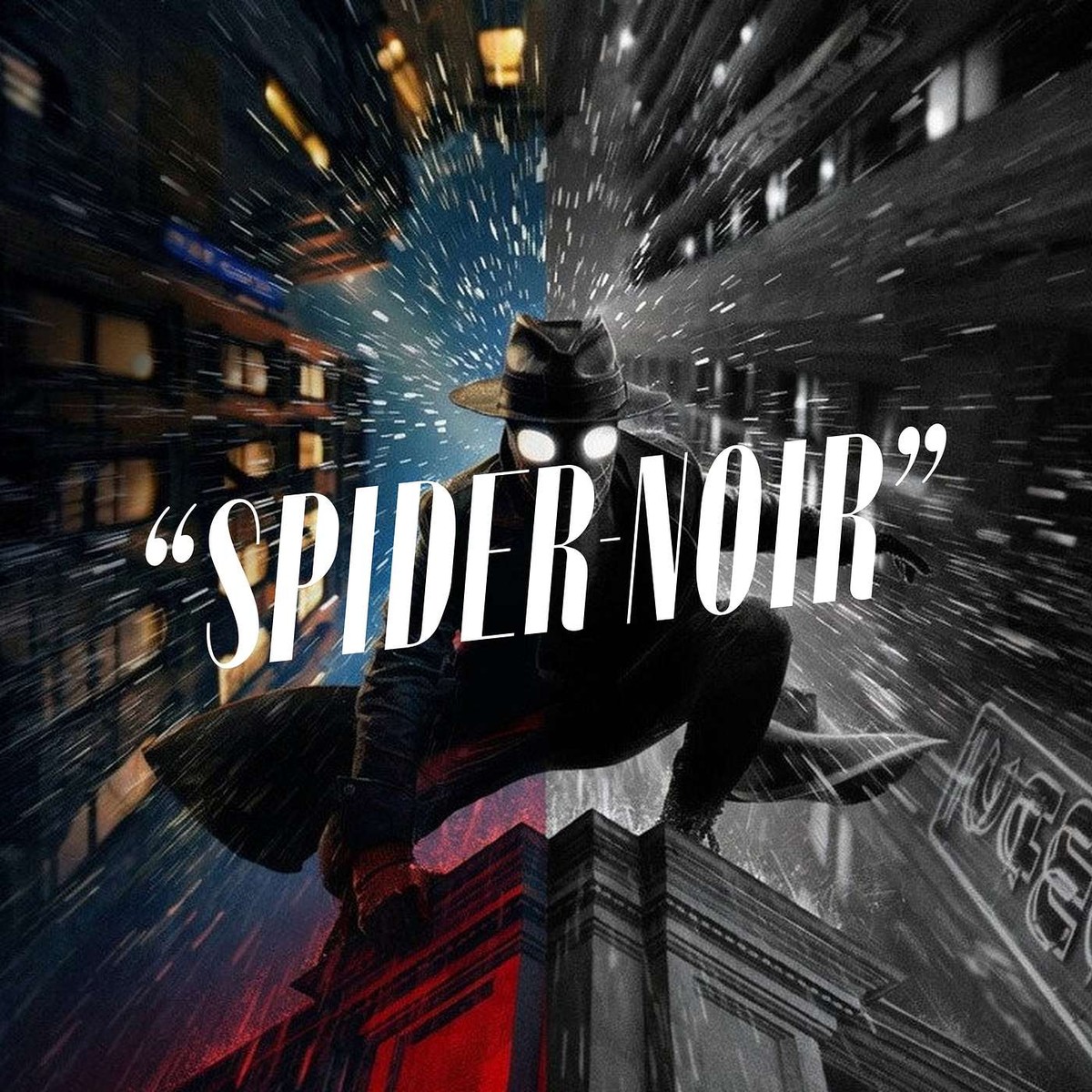
Spider-Noir
Nicolas Cage prowls a shadowy 1930s New York as a hardboiled, hard-drinking Spider, and the result is the most fun a superhero show has been in years.
 8.3/10 · GREAT
 Let me just get this out of the way right at the top: this show was an absolute hoot to watch. I mean, come on. Who doesn’t love watching Nicolas Cage go completely unhinged? That’s practically a genre of its own at this point, and Spider-Noir understands exactly what it has on its hands. This is eight episodes of Cage in a trench coat, prowling around a shadowy 1930s New York, punching mobsters, drinking too much, and mumbling hardboiled detective wisdom like a man who’s seen far too much and slept far too little. If that sentence alone doesn’t sell you, I honestly don’t know what will.
A little bit of context before we dig in, because the backstory here is genuinely interesting. And yes, I caught myself, that’s the one time I’m allowed that word per review, so let’s move on. This is essentially the same hardboiled take on Spider-Man that Cage voiced in Spider-Man: Into the Spider-Verse, that black-and-white, gravel-voiced detective version of the character that stole every scene he was in. So getting to see Cage bring a flesh-and-blood version of that idea to the screen was a huge part of the appeal for me. And the pedigree behind the camera is real too. The series was developed with Phil Lord, Christopher Miller and Amy Pascal, the Oscar-winning team behind Into the Spider-Verse, and Harry Bradbeer, the Emmy-winning director of Fleabag, directed and executive produced the first two episodes, with Oren Uziel and Steve Lightfoot serving as the showrunners. On top of all that, this is actually the first starring role in a TV series for Nicolas Cage, which feels almost impossible to believe given how long the man has been working, but here we are. All eight episodes landed in May, and on Prime Video you can watch it in both black-and-white and colour versions.
Two Ways to Watch
And that viewing choice is worth talking about, because it’s such an unusual thing for a show to offer. You’ve got that brilliant option of watching it in full black-and-white authenticity, proper old-school noir, the way the genre was born, or watching it in colour. But here’s the thing, it isn’t standard colour either. It’s a very unusual, very deliberate palette, all muted tones and smoky golds, like a photograph from the 1930s that someone has hand-tinted. I decided to watch the entire season in the colour version, and honestly, I’m happier that I did. I’d heard a few whispers that once other characters with powers start showing up, and they do show up, those powers come across a lot better in colour, and having seen the season, I’d say that’s true. The fire effects in particular really pop against that muted palette. But I’ll admit, part of me is tempted to sit down one day and rewatch the whole thing in black-and-white, just to experience the version the noir purists are raving about. Not many shows give you a legitimate reason to watch the same season twice in two completely different ways, so credit where it’s due.
Now, I’ll be honest about where I stood with Cage going in. He’s a little bit hit and miss for me these days. He’s brilliant at this exact kind of larger-than-life character, nobody does it better, and I watched a lot of his movies back in the ’90s. Face/Off, Con Air, The Rock, that stretch where Cage was the most watchable man in Hollywood. But I’ll admit that over the last few years I’d been leaning away from a lot of his output. What pulled me back in here was simple. I’m a huge Marvel fan, and I wanted to see what on earth they would do with this. A Spider-Man loose variant, in the retirement phase of his life, played by Nicolas Cage in a period detective drama? That’s a pitch you don’t walk past.
So here’s the setup. Ben Reilly is a private eye scraping by in Depression-era New York, five years into his retirement from the mask. The show kicks off giving us a scoop on his day-to-day work, tailing cheaters, taking photographs, cashing small cheques, before a case lands on his desk that changes everything. He’s hired to find a man named Jimmy Addison, and Jimmy Addison, as it turns out, has a fire-based power set. And I’ve got to say, that came across really, really well on screen. The effects work sells it completely. That case goes sideways in spectacular fashion when another investigator tries to bring Addison in and the whole thing ends in an explosion, and suddenly Ben is staring at the edges of a much larger conspiracy. From there he picks up what looks like a bread-and-butter job, tailing a supposedly cheating wife named Cat Hardy, and Cat, played by Li Jun Li, turns out to be a nightclub songstress and femme fatale with connections running deep into the city’s criminal underworld. The season keeps peeling back layers from there: a failed supersoldier serum experiment from the Great War, a mob boss named Silvermane using metahuman muscle to squeeze the city, and Cat slowly piecing together exactly who Ben used to be. I won’t go too deep into how all those threads tie together, because it’s much better discovered on screen, but I will say the finale earns its fireworks, pulling the experiments, the syndicate and Cat’s own agenda into one satisfying knot.
Cage Off the Leash
Let’s talk about the man himself, because Cage is the engine of this entire show. The way he’s described his take on the character is a mix of Bugs Bunny and Humphrey Bogart, and honestly, that is exactly how it plays out on screen. There’s this rubbery, cartoonish energy underneath a genuine hardboiled detective performance, and somehow the two things don’t fight each other. Cage has talked about the films that informed the show, The Big Sleep, The Maltese Falcon, In a Lonely Place, a lot of Bogart, and about wanting to embody the style of old-world actors like Bogart, Cagney and Edward G. Robinson, designing his performance to fit the black-and-white format. You can feel all of that homework in the finished product. Now, I will say it does take a couple of episodes for Cage to fully push into that personality. The early stretch is doing a lot of table-setting, introducing the character, leaning into the private eye material, establishing the world, and Cage plays it a little more restrained than you might expect. But once he gets going, he’s magnetic. There’s a running gag through the flashbacks where a drunk Ben has apparently told just about everybody in his circle who he really is, and then completely forgotten he did it, because he was that drunk, and those scenes are laugh-out-loud funny. And the moment he retrieves his old suit from where he’d hidden it, inside the wall of some poor couple’s apartment, tearing their bathroom apart while they watch in horror, is the point where the show shifts gears. Once he dons that suit again, things really start to ramp up, and they don’t let off.
One of my favourite choices the show makes is that nobody ever calls him Spider-Man. Not once. He’s the Spider, and his outfit is nowhere near a classic Spider-Man suit. It’s this very stripped-back, black-and-white period getup with a really cool mask, something a man in the 1930s could plausibly have stitched together. It sells the era completely. The show also jumps back and forth in time occasionally, and through those flashbacks we get to see exactly how Ben got his powers, and it’s a completely different scenario to anything we’ve been shown in a Spider-Man story before. I won’t spell it out, but it ties into the wider mystery in a way that made me appreciate the season’s structure a lot more by the end. This is one of those shows where the flashbacks are actually doing work, not just padding the runtime.
The Company He Keeps
The supporting cast around Cage is stacked, too. Lamorne Morris plays the journalist Robbie Robertson, and Karen Rodriguez plays Ben’s assistant, Janet, and both of them are terrific. Janet is this very savvy receptionist who’s constantly two steps ahead of her boss, and Robbie is the reporter friend who grounds Ben whenever the case threatens to swallow him. If you know Morris from New Girl, you know his comic timing, but he’s also proven he can do serious period work. He was fantastic in season 5 of Fargo, and he brings both sides here. Then you’ve got Brendan Gleeson as Silvermane and Jack Huston as Flint Marko, and Gleeson in particular is having a ball as the mob boss. If you’ve seen him in In Bruges or The Banshees of Inisherin, you know the man can make menace and warmth sit in the same sentence, and he does it again here. Villains in superhero shows so often feel disposable. This one doesn’t.
And while we’re connecting threads, if this show works for you, there’s a whole world to explore off the back of it. Obviously start with Into the Spider-Verse if you somehow haven’t seen it, because that’s where this version of the character first grabbed everyone. If you want more of Cage at his recent best, Pig is a quiet, devastating little film that reminded everybody what he’s capable of. And if the noir atmosphere is what hooks you, go back to the source. The Maltese Falcon and The Big Sleep are the exact films this show is built on, and they hold up beautifully.
Final thoughts, then. This is a Spider-Man tale we’ve seen the bones of many times, the reluctant hero forced to embrace his destiny and become the city’s protector, but done in this light, in this era, with this actor, it feels completely fresh. It’s not a slow burn either, which surprised me for a period detective show. The action scenes are plentiful and great fun, the humour lands constantly, and the mystery has enough pull to carry you through all eight episodes without sagging. Cage does a wonderful job from the moment the show lets him off the leash, and honestly, I’m already excited for a new season. And I’m clearly not alone. The series has been received positively, with Cage’s performance singled out for particular praise.
But look, that’s just how Spider-Noir landed for me. Entertainment is subjective, and what works for me may not work for you, and that’s completely okay. Maybe unhinged Cage isn’t your flavour, or maybe the noir pacing isn’t your thing. But for my money, this is the most fun I’ve had with a superhero show in a long, long time.
Listen to this episode
Follow Frame 70 on your favourite podcast app and new episodes find you the moment they drop.