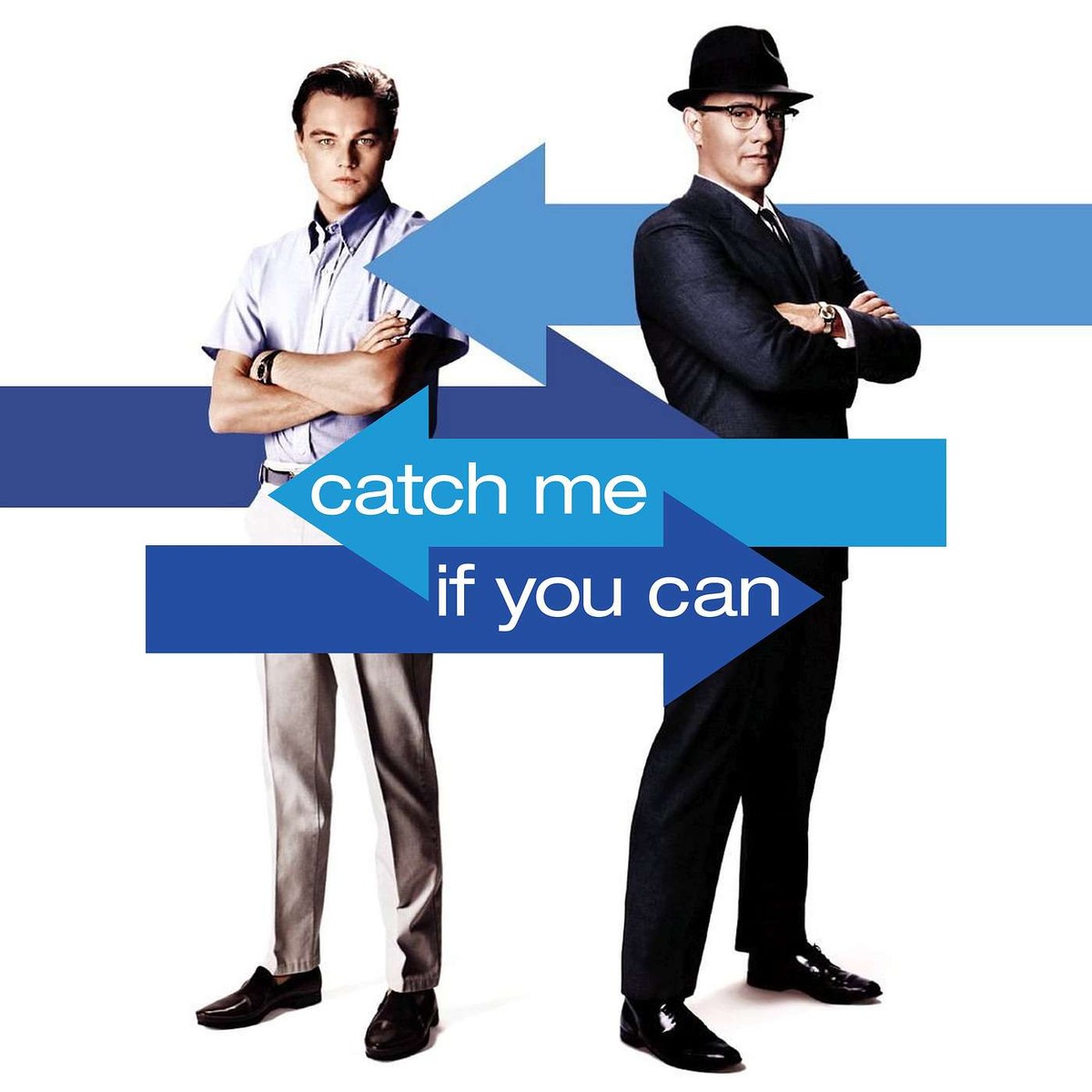
Catch Me If You Can
Spielberg's jazzy '60s caper hides real heartbreak: every forged check and stolen identity is a lonely kid's attempt to buy back the family he lost.

Directed by Steven Spielberg in the same year he gave us Minority Report, which is a remarkable one-two punch for any filmmaker, Catch Me If You Can is based on the semi-autobiographical book by Frank Abagnale Jr. Abagnale claims that before he turned 19, he pulled off cons worth millions of dollars by posing as a Pan Am pilot, a Georgia doctor, and a Louisiana parish prosecutor. Now, I should say up front that the truth of his story has been heavily disputed over the years, and journalists have picked apart a lot of his claims. But honestly, that almost makes it more fitting. A con man whose greatest con might be the story of his cons? That feels right at home in this movie. What attracted me to it in the first place was that star-studded cast, DiCaprio and Hanks at the top, with Christopher Walken, Amy Adams, and Martin Sheen filling out the supporting roster, and I’m happy to report it did not disappoint.
A Lonely Kid Underneath the Caper
The film opens in 1969 with FBI agent Carl Hanratty, played by Tom Hanks, arriving in Marseille, France, to collect a prisoner: Frank Abagnale Jr., played by DiCaprio, who has fallen seriously ill in the grim conditions of a French prison. From there we flash back to 1963, to Frank’s comfortable life in New Rochelle, New York, with his father, Frank Sr. (Christopher Walken) and his French mother, Paula, played by Nathalie Baye. And this is where the movie quietly plants everything that follows. Young Frank grows up watching his father charm and con his way through life, and when tax trouble with the IRS forces the family out of their house and into a small apartment, the cracks start to show. I had to laugh at Frank’s very first con. After getting bullied at his new school, he simply stands up at the front of the classroom and poses as the substitute teacher. It’s such a perfect introduction to who this kid is. Then he discovers his mother is having an affair with his father’s friend Jack Barnes, the parents divorce, and Frank runs away rather than choose between them. Needing money to survive, he turns to confidence scams, and they grow bolder at a frightening pace. Before long he’s posing as a Pan Am pilot named Frank Taylor and forging payroll checks worth millions.
What surprised me most is how much heart there is underneath the caper. On the surface this is a glossy, jazzy, ‘60s-set chase movie, and it absolutely delivers on that front, but every single con traces back to a lonely kid trying to rebuild the family he lost. He keeps handing his father stolen money, keeps trying to buy back the house, the marriage, the life. Walken is heartbreaking in these scenes, all faded charm and wounded pride, and he earned an Oscar nomination for the role, which, when you think about it, was a lovely late-career moment for the man who won an Oscar decades earlier for The Deer Hunter. And then there’s the cat-and-mouse dynamic between Frank and Carl, which is really the spine of the whole film. Carl tracks Frank to a motel early on, and Frank, cornered and improvising, convinces him he’s a Secret Service agent named Barry Allen and walks right out the door. Comic book fans will clock that name immediately, because Barry Allen is the Flash, and it’s a nice little wink that Frank is pulling his aliases straight out of the comics he grew up with. From there the two men fall into this strange ritual of phone calls and near-misses. Frank even rings Carl every Christmas Eve, because deep down, Carl is the only person in the world who actually knows him. Hanks plays it beautifully, all rumpled persistence and dry humour, and it’s fascinating watching him and DiCaprio essentially audition for the surrogate father-and-son relationship the movie is secretly about.
Miami, Madrid, and the Art of the Escape
The middle stretch takes Frank into his doctor phase, where he falls for Brenda, a sweet, naive young hospital nurse played by a very early-career Amy Adams, and it’s fun watching this performance now, knowing she’d go on to Enchanted, Doubt, and Arrival. Frank asks her attorney father, played by Martin Sheen, for her hand in marriage and for help arranging to sit the Louisiana State Bar exam, which, incredibly, he passes. Carl tracks him to the engagement party, Frank escapes through a bedroom window, and he tells Brenda to meet him at Miami International Airport two days later. And that sets up one of my favourite sequences in the entire film. Frank arrives at the airport, spots the plainclothes agents, and realises Brenda has been followed. So what does he do? He stages a fake recruiting drive for stewardesses at a local college, and then strolls through Miami Airport, past what the film suggests is 100 FBI agents and 50 police officers, surrounded by eight young women in Pan Am uniforms. Every eye in the terminal goes to the stewardesses, and Frank glides straight through the middle of it onto a flight to Madrid. And then, just to twist the knife, he has Carl paged to a phone and tells him he’s sitting in a car right at the front of the airport. The confidence of it. The showmanship. It’s the movie in miniature.
Now, I do have to be honest about the pacing, because it’s my one real gripe. At around 2 hours 20 minutes, some stretches felt a bit long-winded to me, particularly through that middle section, where the rhythm of con, escape, new identity, con, escape starts to repeat itself before the story kicks into its final act. It never lost me, but I did feel the runtime in a way I don’t with Spielberg’s tightest work. What keeps it afloat through those slower patches is the sheer craft on display. The animated opening titles are a gorgeous throwback to the Saul Bass style of 1960s design, and they set the tone perfectly before a single frame of footage. John Williams turns in one of the most unusual scores of his career, a sly, jazzy, finger-snapping thing built around saxophone rather than his usual orchestral thunder, and it earned him yet another Oscar nomination. The costume and production design soak the whole film in that early-’60s Pan Am glamour, the golden age of air travel when a pilot’s uniform basically functioned as a skeleton key to American society. That’s the insight the film is built on, really. Frank never needed to be a pilot or a doctor or a lawyer. He just needed people to want to believe he was.
Where It All Lands
The final act is where the emotion hits hardest. In 1967, Carl tracks Frank to his mother’s hometown of Montrichard, France, and convinces him to surrender before the French police take him by force. Then, on the flight home in 1969, Carl has to tell Frank that his father has died, and DiCaprio’s reaction in that moment is devastating. Grief-stricken, Frank escapes the plane and makes his way to his mother’s house, and what he finds there, standing outside in the snow, is the image that stayed with me longest after the credits rolled. It reframes the entire adventure that came before it. All that dazzle, and underneath it, just a kid at a window.
The ending is a lovely coda too. Sentenced to 12 years, Frank is visited in prison by Carl, who shows him a fraudulent check, and Frank immediately deduces that a bank teller was involved, just from the way the check was handled. Carl is impressed enough to convince the FBI to let Frank serve the remainder of his sentence working for their Financial Crimes Unit, which echoes what the real Abagnale says happened after his capture. There’s one last wobble, where a restless Frank suits up as a pilot again and Carl intercepts him. But instead of arresting him, Carl simply tells him nobody’s chasing him anymore, and that whether he comes back is his own choice. Frank returns to his desk the following week, and that quiet act of trust closes the father-and-son story the film has been telling all along.
If this one works for you, there’s a whole trail worth following afterwards. Hanks and Spielberg reunited two years later for The Terminal, and again for Bridge of Spies and The Post. DiCaprio would circle back to charismatic fraudster territory a decade later with The Wolf of Wall Street, a much darker riff on similar ideas. And if it’s the caper energy you loved, the granddaddy of the genre is The Sting with Paul Newman and Robert Redford, which this film is clearly tipping its hat to. There was even a Broadway musical adaptation of Catch Me If You Can, which tells you how much affection this story has earned.
Rated OCT 2026LISTEN TO THIS EPISODE
Follow Frame 70 on your favourite podcast app and new episodes find you the moment they drop.