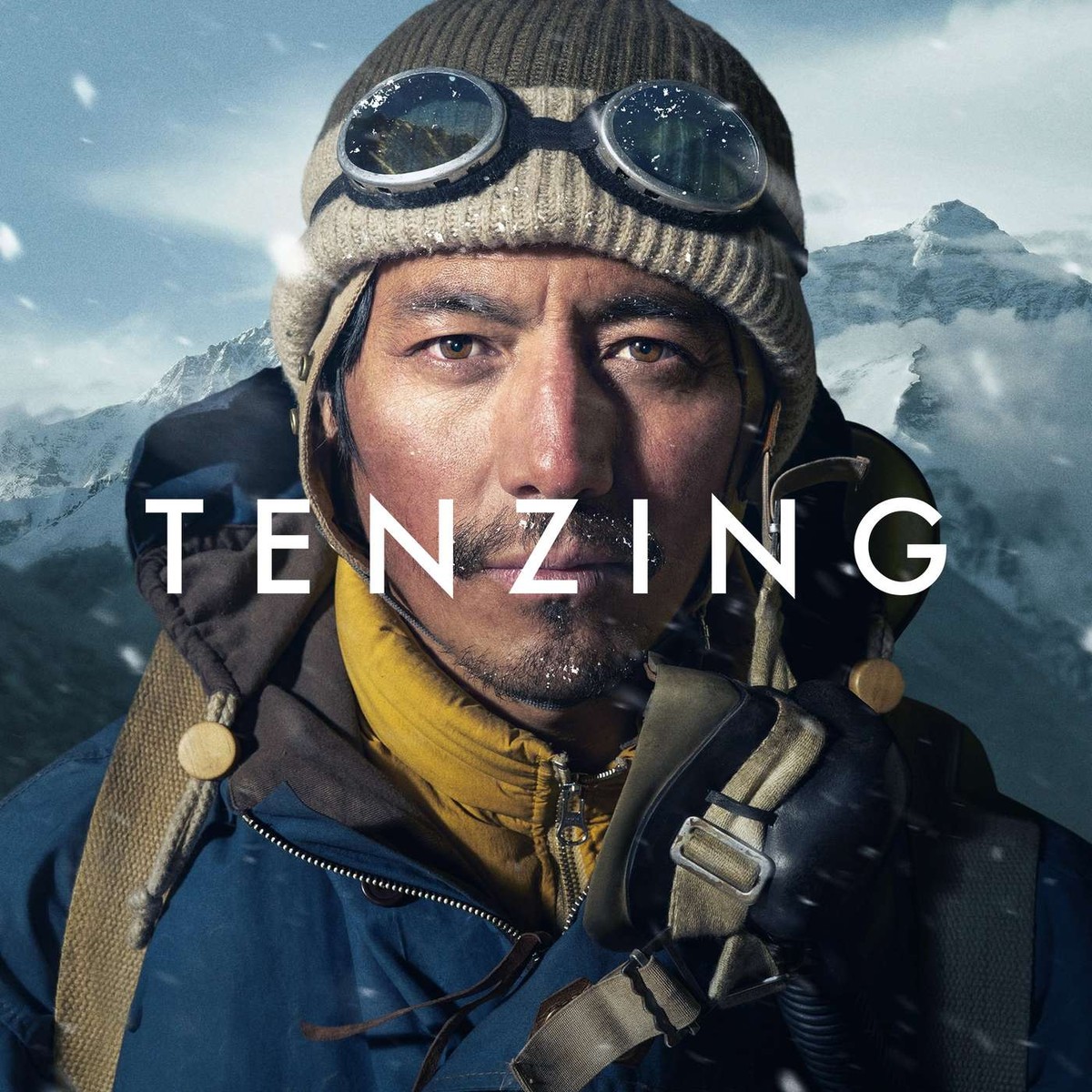
Tenzing
The most famous mountaineering photo ever taken shows the Sherpa on top of the world, not the Westerner. Tenzing finally turns the camera around on the man history kept cropping out of the frame.

I have to put my cards on the table right from the start with this one, because being a Kiwi, there was no way I could go past a movie like this. Sir Edmund Hillary is an absolute national treasure in New Zealand, or Sir Ed, as we like to call him, and I actually remember him coming to visit our schools when I was young. What I always remembered was just how huge he was. A very tall man, enormous hands, very lean, but with this amazingly big smile, and he was hugely generous with his time. He’s woven into the fabric of growing up in New Zealand. He’s on our $5 note, for goodness’ sake. But here’s the thing, and this is important for this review: even though Sir Ed is in this movie, this film is not about him. This is Tenzing Norgay’s story, and honestly, it’s about time. There have been plenty of documentaries made about Sir Edmund Hillary, plenty of books written, but Tenzing has never received anywhere near enough of that spotlight. So while I’ll weave bits and pieces of Sir Ed into this review, the spotlight today stays exactly where the movie puts it: on Tenzing.
Whose Story Is This?
There’s some background worth knowing before I get into what I thought, because it genuinely shapes how this film was made. Tenzing is an Apple Original Films production, and it’s directed by Australian filmmaker Jennifer Peedom. Now if that name sounds familiar, Peedom made the documentary Sherpa, and if you haven’t seen that, go and track it down, because it’s a stunning piece of filmmaking about the Sherpa community on Everest. She spent years working alongside Tenzing’s family and the Sherpa community before making this, which is actually her first narrative feature. And that groundwork shows in every frame of this movie. The script comes from Luke Davies, the writer behind Lion, and if you remember how beautifully Lion handled a true story across two cultures, you’ll have a sense of the sensibility he brings here. Genden Phuntsok plays Tenzing, Tom Hiddleston plays Sir Edmund Hillary, Willem Dafoe plays the expedition leader, Colonel John Hunt, and Caitríona Balfe plays the expedition secretary, Jill Henderson. And one detail I really love: Tenzing’s eldest son, Norbu Tenzing, is one of the executive producers on this film. The family’s fingerprints are on this, and you can feel it. The film also picked up the overall audience award at the Mill Valley Film Festival back in October, which tells you this isn’t just critics nodding politely. Audiences are connecting with it.
Going in, I had two big questions. One, would this actually be Tenzing’s movie, or would it quietly drift back towards the famous names? And two, and this is the Kiwi in me, how on earth was Tom Hiddleston going to handle the New Zealand accent? Because let me tell you, that is not an easy accent to master. We’ll get to that second one. But on the first question, I’m delighted to say this movie knows exactly whose story it’s telling, and it never wavers.
What I really appreciated is that we get Tenzing’s backstory properly, starting with his childhood. The film opens in the Solu Khumbu region, with a young Tenzing growing up hearing stories of these foreign expeditions attempting the mountain his people call Chomolungma, the Mother Goddess of the World. His family has to move from Tibet into Nepal, and on that journey he gets sick, and his parents are forced to leave him behind at a monastery because he’s simply too weak to travel. It’s heartbreaking stuff, and it sets up everything about who this man becomes. Samdrup Dorje Lama plays him as a boy, and Tenzin Dalha plays him as a young man, and both of them are excellent. There’s a real continuity of spirit across all three performances that makes the character feel like one whole life rather than three separate chapters. And out of that childhood grows the thing that sits at the absolute heart of this film: his love for the mountain. Where the Western climbers look up and see Everest, something to be conquered, a flag to be planted, Tenzing sees Chomolungma, the sacred mother goddess. He reveres it. That contrast in worldviews is the engine of the whole movie, and the film handles it with real care. It never lectures you about it. It just lets you sit in both perspectives until you understand why they can’t quite see each other, and why it matters so much when they finally do.
The flashback structure works beautifully too. We see his life with his wife Dawa, played by Thinley Lhamo, and his kids, and Dawa is the one who encourages him, who pushes him to keep reaching for this thing he’s chased his whole life. Because here’s what a lot of people don’t realise, and what the film makes wonderfully clear: by the time of the 1953 British expedition, Tenzing had already climbed higher on Everest than anyone before him, alongside the Swiss climber Raymond Lambert. This wasn’t a porter who got lucky. This was arguably the most experienced Everest climber alive, and yet the expedition hierarchy of the day still wanted to slot him in as support staff. Watching him position himself to be physically part of the climbing team, rather than just the head Sherpa serving it, is where so much of the film’s tension comes from. And Caitríona Balfe’s Jill Henderson becomes his ally in that fight. Together they persuade Willem Dafoe’s Colonel Hunt that Tenzing belongs on the team, not beneath it. Balfe is great here, Dafoe is great here, and honestly, all of the supporting characters landed for me. There isn’t a weak link in this cast.
Now, I have to share my favourite little moment, because this one got a proper laugh out of me. When Tenzing is being introduced to the other climbers, he meets the two New Zealand climbers, who get called the Kiwis, and Tenzing turns around and asks, what is a Kiwi? I found that so funny, because the whole world knows now that Kiwis are New Zealanders. These days we hardly call ourselves New Zealanders at all. But in 1953, fair enough, mate. Why would a Sherpa climber know that? And by the way, Hillary wasn’t the only Kiwi on that expedition. George Lowe, a teacher from Hawke’s Bay, was the other New Zealander on the team, and it was lovely to see him represented too. Two blokes from little old New Zealand, standing on the roof of the world with a man from the Solu Khumbu. There’s something quite special about that.
Hiddleston, the Background Movie Star
Let’s talk about Tom Hiddleston, because this is one of the most interesting choices in the whole film. You’ve got a genuine movie star here. The man has been Loki for over a decade, he can carry a franchise on his back, and this movie deliberately keeps him in the background. Across the entire runtime, which comes in just over two hours, Hiddleston probably only has about 10 minutes on screen in total. He’s there, he interacts with plenty of people, he’s Tenzing’s climbing partner when they make that final push, but he never overpowers the film, and they never push him as the centrepiece. And I think that’s exactly the right call. A lesser production would have panicked, looked at the poster, and rebuilt the whole thing around the famous face. This one holds its nerve, and the movie is so much better for it. And look, Hiddleston plays a very good Sir Edmund Hillary. He gets the physicality, he gets the warmth, he gets that quiet, unassuming decency that everyone who met Sir Ed talks about. The one thing I think Tom needs to work on is really getting that Kiwi accent down. He just doesn’t nail it enough for me. It’s not a dealbreaker, and in fairness, almost nobody from outside New Zealand ever gets it right. It’s a genuinely slippery accent that sits in this weird space between Australian and something else entirely. And I’ll freely admit I could be biased here, because I’ve been listening to that accent my whole life and I’m going to notice every vowel that drifts off course. But it was the one thing that occasionally pulled me out of the movie, so it has to be said.
Shot on Two Rooftops of the World
Visually, this thing is stunning. The cinematography from Stefan Duscio is amazing, and the production made a really smart choice with locations. Everything up until the expedition reaches base camp was shot in Nepal, and everything above that was shot in the high mountains of New Zealand’s South Island, including Aoraki Mount Cook, which stands in for the summit. And as a Kiwi, there’s a lovely poetry in that, because Aoraki is the mountain where Hillary himself learned to climb. So in a way, Sir Ed’s training ground gets to play the mountain that made him famous. The stunt work on the mountain sequences is really, very well done. There are moments on those ridgelines where my hands were sweating, and I knew exactly how the story ends. That’s the mark of a film that’s doing its job.
So where does that leave us? This was a great movie. It takes a story we thought we knew, turns the camera around, and shows us the man history kept cropping out of the frame. It’s beautifully shot, wonderfully acted, and it’s made with the kind of care you only get when the filmmakers have spent years earning the trust of the people whose story they’re telling. It’s also one of those films I can already tell will be around for a while. It’s a proper rewatch movie, the kind you’ll happily put on again when someone in the house hasn’t seen it, just so you can watch them discover it.
But as always, that’s just how this one landed for me. Movies are subjective. What hits home for a Kiwi who grew up with Sir Ed’s story might land completely differently for you, and that’s completely okay. For my money though, Tenzing is one of the most quietly powerful films of the year, and I’d love to hear how it lands with you.
Rated OCT 2026LISTEN TO THIS EPISODE
Follow Frame 70 on your favourite podcast app and new episodes find you the moment they drop.