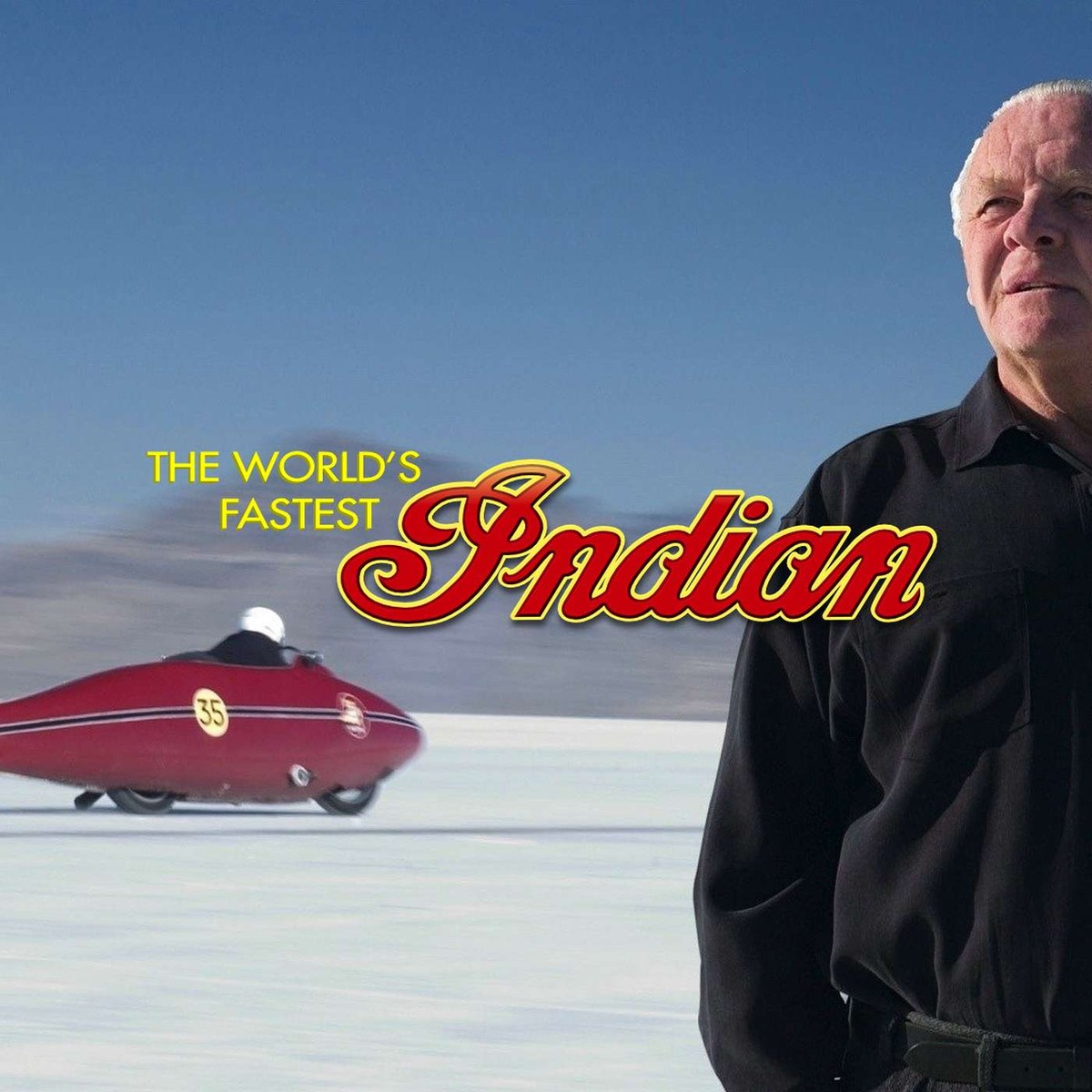
The World's Fastest Indian
A 68-year-old from Invercargill, a 1920 bike rebuilt in a shed, and a speed record still standing nearly 60 years later. Hopkins makes Burt Munro's story one worth catching up on.

A bit of background first, because the story behind this film is nearly as good as the story in it. This is the true story of Burt Munro, a New Zealander who spent about 20 years boring out a 1920 Indian Scout motorcycle in a shed behind his house in Invercargill, right at the bottom of the South Island, and then took it all the way to the Bonneville Salt Flats in Utah to chase a land speed record. Roger Donaldson wrote and directed this, and he had been circling Burt Munro for most of his working life. Back in 1971 he made a short documentary about him called Offerings to the God of Speed, filmed over more than two years while Munro was still working on the bike. The feature came 34 years later, which means this film is effectively Donaldson returning to his own first subject three decades into an international career. I love that. Anthony Hopkins plays Burt at 68, which is exactly the age the real man was in 1967. And it’s worth knowing that the film compresses nine separate Bonneville trips, beginning in 1962, into one single journey. That’s the kind of streamlining biographical films do all the time, and here it works.
Now, I’ll be honest with you, I was not sure what to expect going in. What I came out with was a film I enjoyed immensely, and a fair bit of disappointment in myself for not watching it when it first came out in cinemas. Twenty years I left this sitting there. Don’t be me.
Hopkins, Completely Out of His Usual Range
So let’s talk about what makes it work, and that starts and ends with Hopkins. Sir Anthony can do the professional acting gig quite nicely; he has made a career out of respectable, dignified performances. He can also go completely off the hook when a role calls for it, and Hannibal Lecter is the obvious example. But what he had not done, at least not to my memory, is an everyday role. A man who could be you or me. A man of great simplicity, true working class. Burt Munro is exactly that man, and in the hands of an actor like Hopkins he comes alive with a complexity and a depth that turns what could easily have been a heart-tug of the week into something emotionally bonding. Burt is balanced between real character flaws and unshakeable spirit, and he changes people simply by being around them: the young boy next door, the women he charms along the way, and eventually the whole racing crowd at Bonneville. And here’s the thing that impressed me most. Hopkins does it without a single showy moment. Give him a dignified man or a monster and you know roughly what you’re getting. Give him a bloke in a shed in Invercargill with a cork on the petrol tank and no obvious reason for anyone to care, and he has to build the whole performance out of ordinariness. He does it. That’s the achievement here, and it’s why the film never becomes the sentimental thing it could so easily have been.
The film opens with Burt in his backyard trying the bike out at six in the morning, waking all the neighbours, and they look properly annoyed. And then there’s a lovely touch: the young boy from next door, Tom, played by newcomer Aaron Murphy, comes over to help him. He makes Burt a cup of tea and then asks if he can have a biscuit, a ginger nut, one of New Zealand’s iconic Griffin’s biscuits, and they’ve been making those since the 1930s. That’s the whole relationship captured in one small exchange, and it tells you everything about the film’s touch. Invercargill turns out for Burt too, and you get some of New Zealand’s iconic faces in there. Annie Whittle plays Fran, and Frank is played by Tim Shadbolt, who was the actual serving Mayor of Invercargill when the film was made. He went on to become the longest-serving mayor in New Zealand’s history, he was knighted in 2019, and he passed away in January this year. So there’s a little piece of real New Zealand history sitting right there in the cast. Then Burt has an angina attack and is rushed into hospital, and on being discharged he’s told to stop riding the motorcycle. As Burt says, that won’t be happening.
From Invercargill to the Salt Flats
The shape of the film shifts about halfway through, and I found the two halves talk to two different films I really like. The Invercargill half feels like a spirited Waking Ned Devine, the 1998 film from Kirk Jones, and it has the same cultural flavour, the same small town feeling, the same community camaraderie where everyone’s in on it together. Then once Burt is on the road, and he gets to America by working his passage as the cook on a cargo ship to Los Angeles, which is such a Burt way to travel, it becomes a fish-out-of-water story crossed with something like The Straight Story, David Lynch’s 1999 film. Same ingredients. An older man, a slow journey, and strangers who turn out decent. And The Straight Story was drawn from a true story as well, so the two films make a lovely double feature if you’re building a watchlist. Time after time, Burt’s gentle spirit and straightforward manner win over his cynics, and in the end they keep him protected through a whole range of tricky situations: a seedy Hollywood motel, a breakdown on the road to Utah, a randy but helpful woman turning up right when the trailer gives out again. There are some very funny light-hearted moments in this stretch. When Burt arrives at the motel he meets Tina, played by Chris Williams. He takes her for a woman at first, and she’s transgender, and he sticks with her regardless; she’s the one who helps him buy a car. And the test drive, where he heads off down the wrong side of the road, got a proper laugh out of me.
The film is centred on Hopkins, but the support is nicely done throughout. Aaron Murphy as young Tom, Diane Ladd as Ada, Christopher Lawford as fellow racer Jim Moffet, and Paul Rodriguez as Fernando, the car dealer Burt meets along the way. And two of the supporting players are worth flagging for anyone watching this now. Antony Starr, who plays Jeff, went on to Banshee and then to Homelander in The Boys, so if you only know him as television’s most terrifying superhero, seeing him here is a treat. And Walton Goggins appears as Marty Dickerson, who was a real Bonneville racer, the man behind the Vincent known as the Blue Bike. Goggins has become one of the most reliably interesting character actors working, and spotting him this early is part of the fun of going back to a 2005 film.
What didn’t work? Very little, and nothing that stuck. The journey from New Zealand to Utah is an unrealistic one for a man of Burt’s age and condition, but the film knows it; that’s the point of the thing rather than a flaw in it. If there’s a criticism to make, it’s that the story runs on a familiar shape, and you can see where it’s heading well before it gets there. It did not cost me anything, but if you need your underdog stories to surprise you structurally, this one won’t. What I’d say to that is the destination isn’t the point. The point is who Burt is when he arrives, and the officials at Bonneville who have to weigh up a 68-year-old man on a 47-year-old bike with improvised safety gear. That stretch of the film has real tension in it precisely because you like him so much by then.
The Record That Still Stands
And here’s where the real story earns its place. The 1967 run in the film actually happened, though the figure of just over 200 mph shown on screen is a dramatisation. The mark Burt actually set was 184.087 mph as a two-way average, in the under 1,000cc streamliner class. And here’s the bit that gets me every time I think about it: that record has never been beaten. A pensioner from Invercargill, on a 1920 bike he rebuilt in his shed, and nobody has topped it in nearly 60 years.
Final thoughts, then. This is a film I enjoyed immensely, and my only real regret is the 20 years I spent not watching it. It’s for anyone who likes an underdog, anyone with an interest in bikes or the salt flats, and anyone who wants to see Anthony Hopkins do something completely outside his usual range. It also cleaned up at home: seven wins from 10 categories at the 2006 Air New Zealand Screen Awards, including Best Picture, Best Director, and Best Actor for Hopkins. And if it sends you looking for more, chase down Donaldson’s original 1971 documentary, Offerings to the God of Speed, and put Waking Ned Devine and The Straight Story on the list beside it. That’s a lovely little season of gentle, big-hearted films right there.
Rated OCT 2026LISTEN TO THIS EPISODE
Follow Frame 70 on your favourite podcast app and new episodes find you the moment they drop.