The Boys from Brazil
Ninety-four identical boys, all cloned from Hitler, and a 1978 thriller that plays its outrageous premise dead straight while leaving one question open: is evil born, or is it raised?
 8.1/10 · GREAT
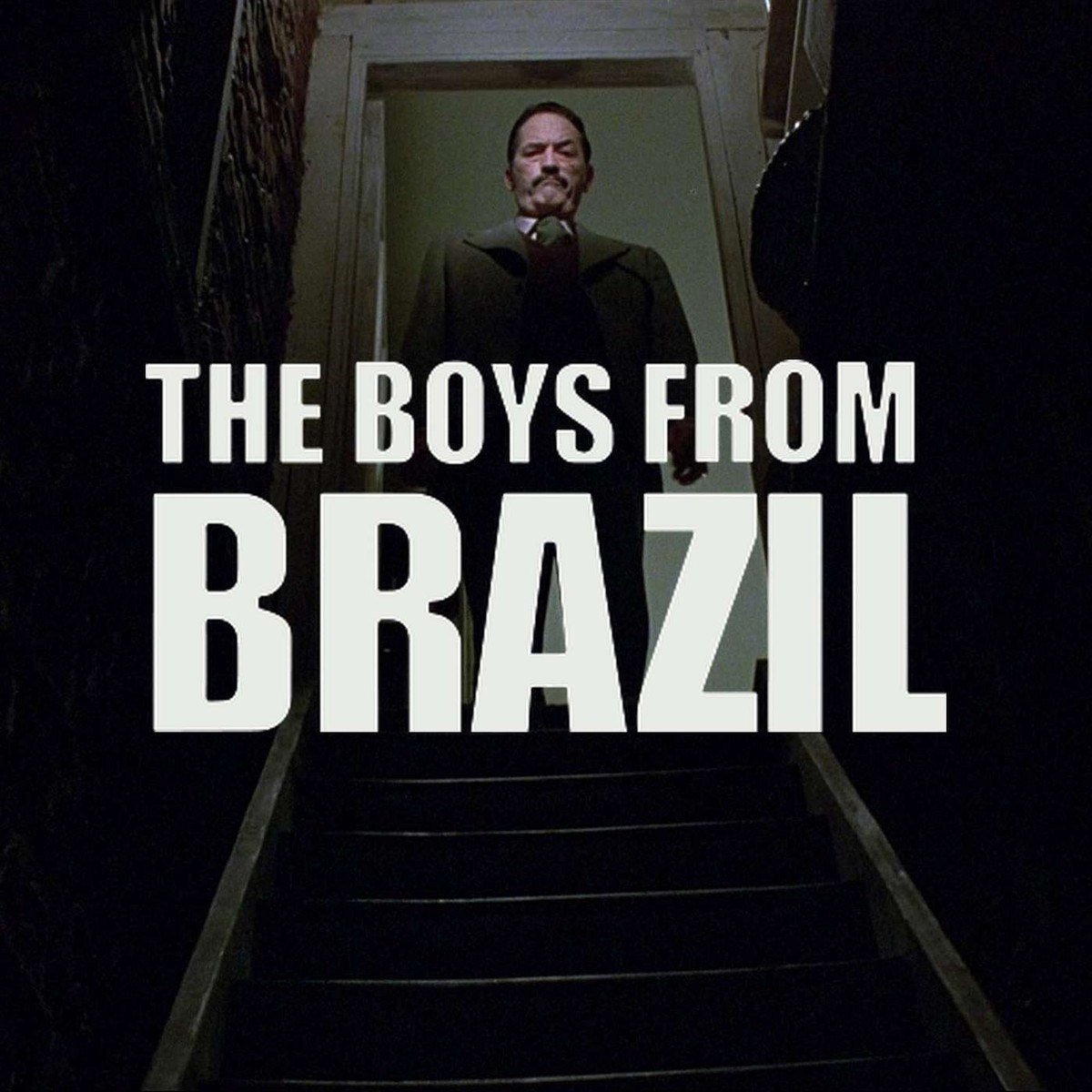
 The Boys from Brazil is the 1978 thriller directed by Franklin J. Schaffner and starring Gregory Peck, Laurence Olivier, James Mason, Lilli Palmer, Denholm Elliott and a very young Steve Guttenberg. This one comes with quite a pedigree. The film is based on the novel by Ira Levin, and if that name rings a bell, it should: this is the same man who wrote Rosemary’s Baby and The Stepford Wives. Levin had this incredible knack for taking something ordinary, something almost cosy, and slowly peeling it back to reveal something monstrous underneath. The Boys from Brazil is that formula operating at full power. And behind the camera you’ve got Franklin J. Schaffner, who by this point had already given us Patton, Planet of the Apes and Papillon. So this was not some cheap exploitation picture. This was a serious, big-budget production with some of the biggest names of their era, tackling one of the strangest premises ever put in front of a mainstream audience. I first saw this movie when it came out in 1978, and sitting down with it again today, I was struck by how well it holds up, and by how that ending still leaves me with the exact same question it left me with all those years ago. We’ll get to that.
Ninety-Four Men, One Impossible Question
The story opens in Paraguay, where a young Nazi hunter named Barry Kohler (that’s Steve Guttenberg, years before Police Academy made him a household name) spots a former Nazi climbing into a Mercedes in the middle of the city. He starts digging, and what he uncovers is a gathering at a palatial home, a meeting of former SS men presided over by none other than Doctor Josef Mengele himself, played by Gregory Peck. Kohler manages to plant a microphone and gets some of the meeting on tape: Mengele dispatching a squad of young operatives to travel the world and murder 94 unassuming 65-year-old civil servants, each at a precisely timed moment over the next two years. Kohler phones the veteran Nazi hunter Ezra Lieberman in Vienna, played by Laurence Olivier, and starts playing him the tape down the phone line. And then Mengele’s men arrive at his door. It’s a brilliant opening. Lieberman is left holding fragments. Ninety-four men. Sixty-five years old. Civil servants. Why on earth would anyone want them dead?
That question is the engine of the whole film, and Schaffner lets Lieberman answer it the hard way, piece by piece, widow by widow. With help from his sister Esther, a British journalist, and a young friend of Kohler’s who wants to carry on his work, Lieberman starts visiting the families of men who fit the profile and have died suddenly. And the pattern he finds is deeply unsettling. Every dead man has an adopted son around 13 years old. Pale skin, dark hair, ice-blue eyes. And the boys don’t just resemble each other. They are identical. Same face, same voice, same cold, watchful manner. All of them illegally adopted, some of the placements arranged by a former camp guard named Frieda Maloney, who’s now sitting in prison. When Lieberman finally consults a biologist and hears the word cloning explained to him, the pieces fall into place, and honestly, it still gives me a chill. The boys are clones of Adolf Hitler, grown from a preserved sample, and the murders are the final ingredient. Hitler’s own father died when he was 13. Mengele isn’t just copying the biology. He’s trying to copy the childhood. The cold, authoritarian father, the doting younger mother, and then the father’s death at exactly the right moment, 94 times over, in the hope that at least one of these boys grows up to walk the same path. It’s nature and nurture weaponised, and for a mainstream thriller made almost 20 years before Dolly the sheep, it’s remarkable how carefully the film walks its audience through the science.
Peck Against Type, Olivier on the Other Side of the Hunt
Let’s talk about the performances, because this is where the film really earns its place. Gregory Peck as Mengele is one of the great against-type castings of the ’70s. This is Atticus Finch, the screen’s ultimate symbol of decency, playing the most notorious doctor of Auschwitz, and Peck leans all the way in. He’s vain, imperious, utterly convinced of his own destiny, and there’s a scene at his compound in the jungle, where he’s still conducting his experiments on children, that tells you everything about the man without a single word of explanation. Some critics at the time thought Peck went too big. I don’t agree. Mengele in this film is a fanatic performing his own greatness, and Peck plays the performance. And opposite him, Olivier goes the other way entirely. His Lieberman, loosely inspired by the real Nazi hunter Simon Wiesenthal, is elderly, shabby, underfunded, fussing over phone bills and damp offices. He’s not an action hero. He’s a tired man with a filing cabinet and a conscience, and Olivier makes every scene feel lived-in and humane. It earned him an Oscar nomination, and there’s a lovely bit of connective tissue here: just two years earlier, Olivier played the Nazi war criminal Szell in Marathon Man. In the space of two films he stood on both sides of that hunt, the hunted and the hunter, and both performances are remarkable in completely different registers. When Peck and Olivier finally collide in that Pennsylvania farmhouse near the end, two giants of their generation sharing the screen for the only time, the film absolutely delivers on the promise of its cast. James Mason is quietly excellent too as Mengele’s increasingly nervous colleague, and Lilli Palmer brings real warmth as Esther.
The Craft, and the Chilling Timing
A quick word on the craft. Jerry Goldsmith’s score is a masterstroke. He wraps this monstrous story in an elegant Viennese waltz, and that ironic beauty makes everything underneath it feel more sinister, not less. Goldsmith had just won his Oscar for The Omen, and you can hear that same gift for making music feel like a character in the story. The film also travels beautifully, from Paraguay to Vienna to rural Pennsylvania to the Brazilian jungle, and Schaffner gives it the scale of a proper international thriller. If you enjoy this era of Nazi-hunting cinema, it sits alongside The Odessa File and Marathon Man as part of a fascinating ’70s wave, made at a time when these men were not history. They were fugitives. And that’s the detail that made the film so eerie in 1978. The real Mengele was still alive and still hiding in South America when this movie was in cinemas. He died in Brazil the following year, and the world wouldn’t confirm it until the mid-’80s. Audiences watched Gregory Peck play a man who was, at that very moment, out there somewhere.
Listen to this episode
Follow Frame 70 on your favourite podcast app and new episodes find you the moment they drop.