Hunt for the Wilderpeople
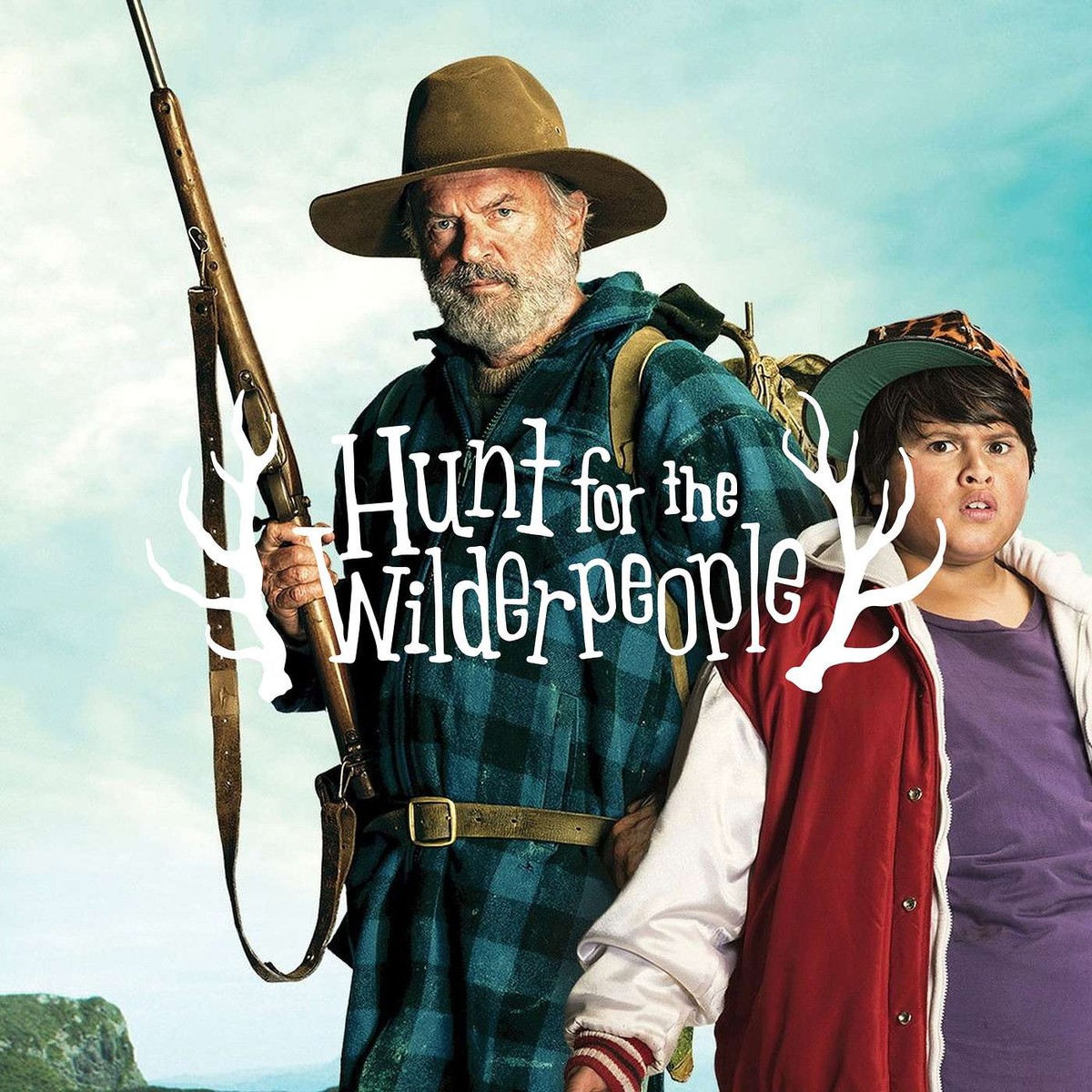
Hec speaks in grunts and glares, but Sam Neill never had a grumpy bone in his body. A Kiwi tribute to New Zealand's favourite son, raised with a glass of his own Pinot.
 9.0/10 · ESSENTIAL
 Before we go anywhere near the movie itself, I need to tell you why we’re here, because this review is a little different to anything I’ve done on Frame 70 before. One month ago, we lost Sam Neill. And if you’ve been following Frame 70 for any amount of time, you’ve probably picked up on the accent and worked out that I’m a Kiwi. So when the news came through, it hit me properly. This is a man whose work I’ve grown up with across 40 years of my life. He’s been up on screen for as long as I’ve been watching screens. And losing him felt less like losing a movie star and more like losing someone from down the road, because that’s what he was to New Zealanders. He wasn’t just a famous actor who happened to come from our part of the world. He was ours.
Now, you might be wondering why this review is landing a month after his passing rather than the week it happened. That’s deliberate. I’m not one to jump on the bandwagon when someone passes away. A lot of outlets and channels rush their tributes out within hours, chasing the moment while it’s still trending, and that’s never sat right with me. I’d rather step back, let the family grieve, let the dust settle, and then take the time to do it properly, with a bit of care. So this one was always going to wait. Consider it a small tribute, done at a respectful distance, from one Kiwi to another.
A Toast to Sam
Here’s a bit of trivia that surprises people, by the way. Sam Neill wasn’t actually born in New Zealand. He was born in Omagh, in Northern Ireland, back in 1947, and his family moved home to New Zealand when he was still a young boy. But make no mistake, the man was Kiwi through and through. He made his home in Central Otago, down in the South Island, and anyone who followed him online knows he spent his later years surrounded by vineyards, farm animals with famous Hollywood names, and some of the most beautiful country New Zealand has to offer. Which brings me to the glass sitting next to me right now. Sam owned a winery called Two Paddocks, and I am a big, big fan of their Pinot Noir. It’s a little harder to get your hands on now that I’m over here in Australia, but I made sure I tracked down a bottle for this one. So tonight, I’m reviewing Sam’s movie while drinking Sam’s wine. It felt like the only proper way to do this.
Choosing which of his films to review took me a while, because the back catalogue is enormous. For most of the world, he’s Dr Alan Grant from Jurassic Park, the palaeontologist who doesn’t like kids and slowly, reluctantly learns to love one. And funnily enough, hold that thought, because it’s a theme we’ll be coming straight back to. But for me, it goes so much deeper than the dinosaurs. I love him in Event Horizon, one of the great cult sci-fi horrors of the ’90s. I love him in In the Mouth of Madness, that wonderfully unhinged John Carpenter film where Sam gets to slowly unravel for the entire runtime. He’s brilliant in The Hunt for Red October. And he had this habit of popping up in smaller roles and quietly walking away with scenes. Even in something like Wimbledon, where he plays the protective father, he gives you a proper, considered performance in a role plenty of actors would have phoned in. That was Sam. He never phoned anything in. Not once in 50 years.
New Zealand in a Bottle
But in the end, the choice was obvious. If this is about remembering Sam Neill the Kiwi, then it had to be his most Kiwi film. Hunt for the Wilderpeople is set in New Zealand, shot in New Zealand, stacked wall to wall with New Zealand actors, made by a New Zealand director, and based on a book by one of New Zealand’s most beloved storytellers. And here’s a fun wrinkle: despite Sam making his home down south, this movie wasn’t filmed anywhere near Central Otago. The bulk of it was shot up in the Auckland region, out in the dense bush west of the city, with that famous chase sequence filmed down on the central plateau. So even the geography of this film manages to cover the country from top to bottom. It’s New Zealand in a bottle.
A little context before we dig in. Taika Waititi is one of my favourite directors working today, and honestly, his early run might be my favourite stretch of his whole career. Eagle versus Shark. Boy. What We Do in the Shadows, a movie I can quote in my sleep. Hunt for the Wilderpeople sits right at the end of that early era, released in 2016, just before Hollywood came knocking and he went off to make Thor Ragnarok. It’s based on the book Wild Pork and Watercress by Barry Crump, and for the non-Kiwis reading, Barry Crump was a legendary New Zealand author and bushman, the kind of larger-than-life character our country seems to produce about once a generation. When Wilderpeople hit cinemas, it became the biggest homegrown hit in New Zealand cinema history. The whole country went and saw it. And then went back and saw it again.
So what’s it actually about? Hunt for the Wilderpeople is the story of Ricky Baker, a chubby, hip-hop-loving foster kid played by Julian Dennison, who’s been bounced around the welfare system his entire childhood and hides all of that hurt behind a tough, rebellious exterior. Child welfare, in the form of the gloriously relentless Paula, drops him at a remote farmhouse on the edge of the bush, his absolute last stop before juvenile detention. Waiting for him there is Aunt Bella, played by Rima Te Wiata, who is pure sunshine in human form, and Uncle Hec, Sam Neill, who wants absolutely nothing to do with the boy. Bella wins Ricky over the way all great mums do: with a cooked breakfast, a hot water bottle, and a homemade birthday song. And just as Ricky starts to feel, maybe for the first time in his life, like he’s actually home… the film pulls the rug out. Bella collapses in the yard and passes away, suddenly, with no warning. And this warm little comedy shows you, inside its first act, that it is fully prepared to break your heart.
With Bella gone, welfare writes to Hec to say they’re coming to take Ricky back. And Ricky, being Ricky, responds the only way he knows how: he fakes his own death by burning down the barn with a dummy inside, and takes off into the wilderness. He wants to go on a walkabout. And yes, I know, I know, walkabout is far too Australian a word for this movie, and Ricky gets pulled up on exactly that. Hec finds the boy in about five minutes flat, because Ricky has all the bush skills of a shopping trolley. But then Hec goes over and fractures his ankle, and suddenly the two of them are stuck out there together for weeks while it heals. Meanwhile, back in civilisation, the police find the burnt-out barn, put two and two together to make about 17, and decide the strange old man from the farm has kidnapped the child. And just like that, a grieving widower and a foster kid become the targets of a full national manhunt.
I won’t walk you through every beat of what happens out in that bush, because this film is so much better discovered on screen than described. But what unfolds is one of the most beautifully handled odd-couple stories I’ve ever seen. Hec teaches Ricky how to survive: how to hunt, how to move through the bush, how to sit still for more than 30 seconds. And Ricky, without ever realising he’s doing it, teaches Hec how to open up again. There’s a quiet moment where you discover Hec never learned his letters, and the way the film handles it, no big speech, no swelling violins, just two people figuring each other out, tells you everything about how much confidence Taika has in this story. Along the way they cross paths with a trio of hunters who recognise them from the news and fancy themselves bounty hunters. They end up saving a sick ranger’s life. And with every sighting, the legend grows, until the two of them have become full-blown folk heroes, with half of New Zealand quietly cheering for the wilderpeople to stay free.
Grunts, Glares and a Slow Thaw
Let’s talk performances, because this cast is an absolute murderer’s row of Kiwi talent. Julian Dennison as Ricky Baker is a revelation. He was barely into his teens when this was filmed, sharing nearly every frame with one of the most experienced actors his country ever produced, and he doesn’t just hold his own, he thrives. All the swagger, the gangster daydreams, the terrible haiku he keeps writing, and underneath it all, this hurt kid who just wants someone to keep him. Hollywood noticed too, because a couple of years later he’s standing next to Ryan Reynolds in Deadpool 2. Rachel House as Paula is one of the funniest characters in any Taika film, a child welfare officer who is completely convinced she’s the hero of an action movie, delivering her catchphrase about never leaving a child behind like she’s staring down the barrel of a third act showdown. Rachel House is Kiwi acting royalty, and if her voice sounds familiar, you’ll also know her from Moana. Then Rhys Darby turns up late in the piece as Psycho Sam, a conspiracy theorist hiding off the grid, and delivers exactly the burst of chaotic energy the third act needs. If you know him as Murray from Flight of the Conchords, you know precisely the flavour you’re getting. And Rima Te Wiata as Bella deserves a special mention, because she has barely a handful of scenes and yet her warmth hangs over the entire film. The whole story only works if you believe that everybody loved Bella. And you do. Instantly.
And then there’s Sam. Hector Faulkner is a gruff, closed-off bushman with a criminal past, a man of few words who communicates mostly in grunts, glares, and the occasional reluctant grunt that’s doing the work of a full sentence. And here’s the thing I keep coming back to, and the thing I really want to say here. Hec is the polar opposite of the man who played him. By every account, every interview, every daft farm video he ever posted of his pigs and his ducks, Sam Neill did not have a grumpy bone in his body. He was warm, silly, generous, and endlessly charming. So watching him play Hec is watching a proper actor at work: building a man out of stillness and silence, then letting the warmth leak through the cracks so gradually that you can never point to the exact moment the thaw happens. It just happens. By the time Hec finally lets this kid in, it lands like a sledgehammer, and it lands precisely because Sam made you wait for it. I’d put it among my favourite performances of his entire career, and that is saying something for a career that includes staring down a Tyrannosaurus rex.
So where does all of that leave us? For me, Hunt for the Wilderpeople is one of those rare movies you can watch over and over and it never wears thin. The humour and the heart are braided together so tightly that you can’t separate them. One minute you’re laughing at Ricky naming his dog Tupac, the next you’re getting quietly wrecked by a haiku about loneliness. The New Zealand bush is essentially the third lead of the film, and Taika shoots it like he’s showing off his backyard to the world, which, to be fair, he is. Ricky Baker would call it majestical, and honestly, I can’t do better than that. Even the finale, a completely absurd car chase across the central plateau with what appears to be the entire New Zealand police force and half the army in pursuit, somehow manages to be ridiculous, thrilling and emotional all at once. This is a comfort movie in the truest sense. It’s the cinematic equivalent of Bella’s hot water bottle.
As always, this is just how the film landed for me, although I’ll be honest with you, this one was never going to land any other way. Entertainment is subjective. What works for me might not work for you, and that’s completely okay. But if you do put this one on, pour yourself something nice, settle in, and let it work on you the way Ricky works on Hec. And with that, I’m going to raise this glass of Two Paddocks Pinot to the man himself. Thank you for Dr Grant, thank you for Hec, thank you for 40 years of showing up and never once phoning it in… and thank you for making a Kiwi kid proud every time your name appeared on screen. This one’s for you, Sam.
Listen to this episode
Follow Frame 70 on your favourite podcast app and new episodes find you the moment they drop.