Interstellar
That's not a mountain range on the horizon. It's a wave the size of a skyline. Twelve years on, Nolan's hard science epic is still secretly a film about a father and daughter.
 8.9/10 · EXCELLENT
 This one is From the Vault, and it’s also a promise being kept. If you caught our Contact episode last week, you’ll remember I said I really needed to lock Interstellar in for its own review soon. Consider that promise paid in full, exactly one week later. And honestly, the two films belong side by side. Same leading man in Matthew McConaughey, both built on properly researched hard science, both about reaching across impossible distances to the people we love. And here’s the bit of trivia that ties them together even tighter than McConaughey does. The physicist Kip Thorne, the man Carl Sagan rang up when he needed the wormhole in Contact to actually hold water scientifically, is the same Kip Thorne who dreamed up Interstellar in the first place and served as its executive producer and scientific backbone. Producer Lynda Obst worked on both films as well. So these two movies aren’t just cousins, they practically share a birth certificate. Even the wormhole in Interstellar sitting out near Saturn feels like a quiet tip of the hat to Sagan.
Now, some quick context on where this 2014 Christopher Nolan film sits for me. We’ve just reviewed Nolan’s latest, The Odyssey, which is out now, and Nolan has been one of my favourite directors all the way back to Memento. Every film he makes seems to level up on the last one, and Interstellar sits comfortably inside my top three space science fiction films of all time. For years it held the top spot outright. It’s actually only been nudged off that perch in the last few months by Project Hail Mary, which means my current podium reads Project Hail Mary, Interstellar, The Martian. And yes, Andy Weir is hogging two of the three positions. The Martian and Project Hail Mary are both his novels, both now brilliant films, and fingers crossed somebody finally gets his other book Artemis onto a screen so he can attempt the clean sweep. But today belongs to the one Nolan built.
A Documentary Opening and a Quiet Dystopia
Interstellar opens in a way that still catches me off guard on every rewatch. It opens like a documentary. Candid, talking-head interviews with farmers describing crops and land devastated by the blight and the dust, and it’s very very well done. It grounds the whole film in something that feels real before a single frame of science fiction arrives. And here’s the detail I love. One of those talking heads in the very first minutes is Ellen Burstyn, and she’s not just set dressing. She’s playing the older version of Murph, Cooper’s daughter, in a blink-and-you’ll-miss-it appearance right at the top of the film. We don’t see her again until the very end, when Cooper finally makes it back to her, and because of everything that happens in between, she’s aged an entire lifetime while he’s barely changed. The film literally opens with its own ending sitting in plain sight, and most people never clock it on a first watch. But we’ll get there.
The world the film builds in its opening act is a quiet kind of dystopia. No explosions, no collapsed cities. Just dust, dying corn, and a society that has politely given up on ambition. Governments and agencies have been dissolved, NASA has officially ceased to exist, and the prevailing attitude is that everyone should just put their head down and farm. There’s a fantastic early scene where Cooper meets Murph’s teachers and one of them calmly explains that the schoolbooks now teach the moon landings were faked, propaganda designed to bankrupt the Soviet Union. Cooper, a former pilot and engineer, does not take that well, and McConaughey plays the simmer beautifully. We also get an early glimpse of Cooper’s flying past through a dream of a crash from his piloting days, so before the story even properly starts, the film has quietly told us this farmer used to be something else entirely, and it’s going to matter.
Then things start moving in Murph’s bedroom. Books sliding off shelves on their own, patterns forming in the dust on the floor, what she calls her ghost. Cooper works out the dust pattern is binary, the binary is coordinates, and following those coordinates leads father and daughter straight to the secret remains of NASA, hidden away and still working on humanity’s escape plan. Michael Caine’s Professor Brand recruits Cooper to pilot the Endurance through a wormhole that has appeared near Saturn, placed there by someone, or something, to give humanity a way out. Three potentially habitable worlds are waiting on the other side, scouted years earlier by astronauts who went through first. And with that, one of the great space films of the century lifts off.
Now, before we go through that wormhole, I need to get one gripe out of the way, and it’s the only real one I have. The audio mix in the first 20 to 25 minutes of this film is strange. Everything around the dialogue, the score, the ambient sound, the machinery, is dialled up to the absolute maximum, and the voices sit low underneath it all. I originally assumed it was my setup, but I own this film in my digital library and I’ve watched it across a number of different devices, and it does the same thing every single time. It’s not my equipment, it’s the way the film was physically mixed, and it’s especially prominent around Cooper’s launch. And this wasn’t just me. The dialogue mix caused a proper stir when the film released, and Nolan openly defended it as a deliberate creative choice, treating the voices as one instrument among many rather than the thing everything else serves. I respect the intent. I still think it makes those early scenes harder work than they need to be. Consider that my one asterisk on an otherwise pristine film.
Through the Wormhole
Because once the Endurance goes through that wormhole, Interstellar becomes something special. The science here was famously researched to within an inch of its life. Kip Thorne insisted nothing on screen could break known physics, and the depiction of the supermassive black hole Gargantua was so rigorously modelled that the visual effects work actually produced published scientific papers. You are not just looking at a pretty effect. You are looking at maths.
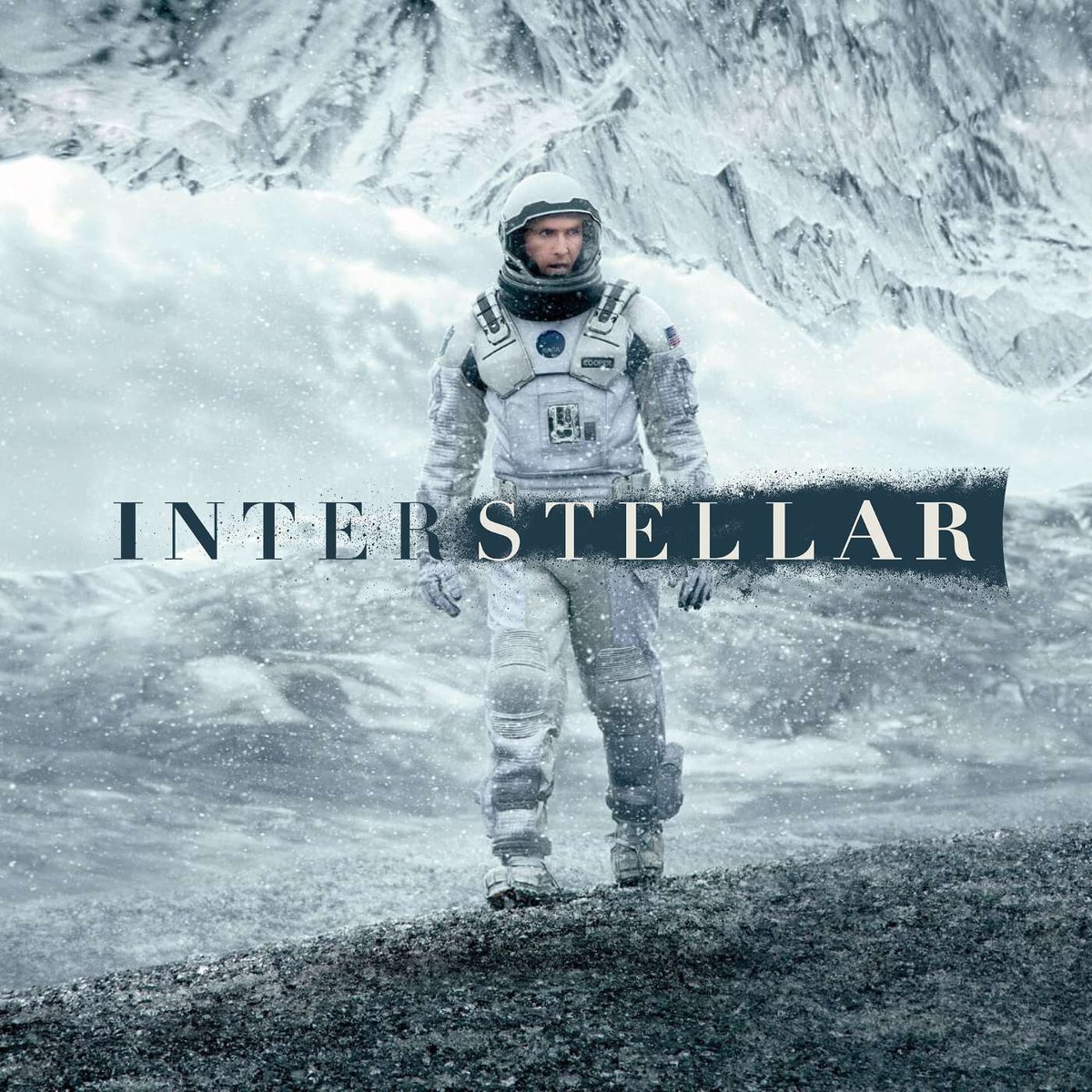
And the film weaponises that maths emotionally with the water planet. Miller’s planet orbits so close to Gargantua that time itself runs differently there: every single hour on the surface costs seven years back on Earth. The crew drop down to retrieve a scientist’s data, the landing floods their engines, and then they spot what they think is a mountain range on the horizon. It’s not a mountain range. It’s a wave. A wall of water the size of a skyline rolling towards them while they stand there waiting for the engines to drain, and every minute of that wait is quietly detonating years of their lives. It’s one of the most suspenseful sequences Nolan has ever cut, and the tension isn’t the wave, it’s the clock. They lose a crew member down there, and when they finally claw their way back to the Endurance, a few hours on the surface have cost them over 23 years. Romilly, the crewmate who stayed behind, has aged more than two decades alone on that ship waiting for them. And then Cooper sits down to watch 23 years of backed-up video messages from his children, his son growing up, graduating, grieving, giving up on him, all in one sitting. McConaughey’s face in that scene is some of the finest acting of his career, and this is the man who did True Detective.
Then comes the second planet, and one of the best-kept casting secrets in modern film history. The crew arrive at an ice world where the scout astronaut has put himself into cryogenic sleep, they wake him up, and it’s Matt Damon. Nobody knew Matt Damon was in this movie. He wasn’t in the trailers, he wasn’t in the marketing, he wasn’t in any of the published cast lists. Nolan kept him completely out of it, and in 2014 that reveal landed like a thunderclap in cinemas. And Damon plays a part you almost never see him play. I wouldn’t call Dr Mann a villain, and I think that’s what makes him work. He’s a brilliant man who spent years utterly alone on a dead world, cracked under the weight of it, and falsified his planet’s data purely out of a desperate need to be rescued. He’s not evil. He’s misguided and terrified, and terrified people do catastrophic things. Mann throws an almighty spanner in the works. He turns on the crew, one of his rigged systems kills poor Romilly, and he steals a lander to make his own run at the Endurance and, in his head, back to Earth.
And that betrayal sets up the sequence I’d put up against anything Nolan has ever shot. Mann attempts to force his way into the Endurance with an improper docking seal, the airlock blows, Mann is killed instantly, and the explosion sends the Endurance into a violent spin, damaged and tumbling towards the planet’s atmosphere. Cooper’s response is to fly their small Ranger craft up and dock with a space station that is spinning like a dropped coin, matching its rotation manually while Hans Zimmer’s organ builds underneath. Brand tells him it’s not possible. Cooper answers that it’s necessary. Cards on the table, it’s one of my favourite scenes in any science fiction film ever made, and Zimmer’s score deserves its own mention here. Nolan famously commissioned it by handing Zimmer a single page about a father and his child, without telling him it was for a space epic, and that’s exactly why this enormous cathedral-organ score always sounds like it’s about family rather than rockets.
Into the Dark, and Back to Murph
The damaged Endurance can’t simply cruise to the third planet, Edmunds’ world. The only way to get there is a slingshot around Gargantua itself, and the fuel margins mean the ship can’t carry everyone’s weight through the manoeuvre. So the robot TARS detaches first, and then Cooper follows, dropping his own craft into the black hole, shedding the weight Brand needs to make it, while gathering the readings from inside a black hole that humanity has never been able to obtain. Anne Hathaway’s Brand continues on alone, and Cooper falls into the dark.
And this is where Interstellar swings for the fences. Inside Gargantua, Cooper finds himself in the Tesseract, a fifth-dimensional construct built by future humans, where time is laid out as a physical place. Every moment of Murph’s bedroom, stacked side by side like books on an infinite shelf. And the film’s most beautiful reveal clicks into place. Murph’s ghost, the books falling, the patterns in the dust, the presence she felt as a little girl, was never a ghost at all. It was her dad. It was Cooper, reaching back through time via gravity, trying to communicate across the one thing that crosses every dimension. Because Murph, now a brilliant physicist played by Jessica Chastain, has discovered that Michael Caine’s character lied to everyone. He solved his famous equation decades ago and knew it was useless without data from inside a black hole. Data which her father now has. Cooper encodes it into the second hand of the wristwatch he gave her as a child, tapping it out in Morse code across the decades, and grown-up Murph, trusting a ghost she stopped believing in, cracks the equation and gives humanity the gravity solution it needs to leave the dying Earth behind.
Quick word on the robots, because they deserve it. TARS and CASE are two of my favourite artificial characters in anything, and they shouldn’t work at all. They’re these bizarre rectangular slabs, honestly the strangest-looking contraptions you’ve ever seen, and part of your brain is permanently asking how these things actually move, right up until one of them cartwheels across a water planet at frightening speed to save Brand’s life and you stop asking questions. Bill Irwin’s dry, sarcastic voice work as TARS gives the film half its laughs. And here’s a lovely detail I got slightly wrong in my own head for years. The robots aren’t all named after real scientists, but the one Mann rigged as a trap is called KIPP, and that is absolutely Nolan tipping his hat to Kip Thorne, the physicist behind the whole film. The science advisor gets a robot. I love that.
The supporting cast is ridiculous in hindsight, too. A very very young Timothée Chalamet as Cooper’s son Tom, years before anyone knew that name, with Casey Affleck playing him as an adult. John Lithgow as the weary grandfather. Topher Grace turning up as Murph’s colleague. Wes Bentley and David Gyasi rounding out the crew. This film is quietly stacked from top to bottom.
One practical warning before you press play. This is a long, dense film, nearly 3 hours, and it is not one to have on in the background. Take your eye off the ball for 10 minutes and you will be completely lost. It asks for your full attention, and it earns it.
But look, that’s just how Interstellar landed for me, and I’m well aware I’m a Nolan fan reviewing a Nolan film. Entertainment is subjective. A near 3-hour physics lecture wrapped around a family drama might be exactly what sends someone else running for the remote, and that’s completely okay. For my money, though, some films are worth crossing a galaxy for, and this is one of them.
Listen to this episode
Follow Frame 70 on your favourite podcast app and new episodes find you the moment they drop.