The Odyssey
Nolan takes on the oldest journey ever told, shoots every frame on IMAX, and delivers a 3-hour mythic epic with a surprisingly tender human heart. It might just be the film of the year.
 9.2/10 · ESSENTIAL
 This is a big one for the podcast, because The Odyssey is the very first Christopher Nolan movie we’ve ever reviewed on the show, and it’s kicking off a proper Nolan run. In the coming weeks we’re taking a look at Interstellar, and honestly, once we’re in that world I suspect we’ll keep going with a few more of his films after that. So consider this the start of a conversation that’s going to stretch across the next couple of months. And what a film to start with: a near 3-hour epic adaptation of one of the oldest stories human beings have ever told each other. There is a lot to get through, so settle in.
Setting the Stage
Before we get into my reaction, I want to set the stage a little, because I think it matters here more than usual. There are two epic poems at the heart of all this, both attributed to the ancient Greek poet Homer. The first is the Iliad, and if that sounds familiar, that’s the one the Brad Pitt movie Troy was loosely based on, back in 2004. That poem covers the Trojan War itself, the decade-long siege of the city of Troy. And then there’s the Odyssey, which picks up after Troy falls, and it’s all about one man: Odysseus, the king of Ithaca, the guy whose cunning gave the Greeks the wooden horse. It’s the story of his journey home after that war. A journey that should have been a short sail across the sea, and instead takes him 10 years. That’s the story Nolan is telling here, and the film follows it faithfully. The horse, the cyclops, the sirens, the sorceress, the suitors circling his wife back home, all of it.
Now, there’s something I have to address straight away, because I found it honestly quite amusing in the buildup to this movie. There was so much noise online. People complaining about the way the actors talk, about certain things not looking authentic, about certain actors who apparently shouldn’t be playing certain roles because it’s not, quote, genuine to that era. So let me just say this plainly. This is a Greek myth. It never happened. There were no cyclopes. There were no giants stalking the coastline. There were no sirens luring sailors onto the rocks with a song. This is an ancient epic poem, and it’s written like one: a mythical tale about a man trying to get home to his family, passed down through thousands of years of retelling. So when people say it’s not authentic, of course it’s not. It’s completely fictional. I’m not going to spend one second of this review picking apart casting choices, or actors using the wrong kind of English, or whether the Greek and Trojan soldiers are dressed period-accurately. It’s a tale. It’s a very, very old one. And judged as a tale, which is the only fair way to judge it, this movie absolutely soars.
A Landmark Production
Let’s talk about the production for a second, because it’s remarkable. The entire film was shot on IMAX cameras, and that makes it the first feature film in history shot entirely with IMAX cameras. If you know anything about those cameras, you’ll know how limiting they are. They’re enormous, they’re loud, they’re notoriously difficult to work with in tight spaces. Nolan has been pushing them further with every film, from Dunkirk to Oppenheimer, but going the full distance here, every single frame, is a genuine landmark. And knowing how restrictive that equipment is, it’s incredible how far they pushed the boundaries, because this film goes everywhere. It was shot on location across Italy, Greece, Iceland, Morocco and Scotland, and you feel every one of those landscapes. Nothing about this movie feels like a soundstage.
Now, full honesty from me: I don’t have an IMAX theatre where I’m based, so I couldn’t experience it the way it was truly designed to be experienced. But I absolutely saw it on the big screen, and let me be crystal clear about this. That is the way this film has to be seen. If you have access to a proper IMAX screen, fingers crossed for you, because I can only imagine what those vistas and set pieces feel like at that scale. But even on a standard big screen, this thing is overwhelming in the best possible way.
I also got lucky with something before the movie even started. I was able to watch a 25-minute behind-the-scenes making-of documentary ahead of the screening, and it was absolutely incredible. Nothing in it ruins the film, but it shows you the sheer scale of what they built, how epic these set pieces really are, and there was some fantastic material with the composer, Ludwig Göransson. If that name rings a bell, he’s the man behind the music for The Mandalorian, and he’s become Nolan’s regular collaborator too. He scored Tenet and Oppenheimer, and he took home the Academy Award for that Oppenheimer score. The work this guy does across film and television is just outstanding, and on the strength of what he delivers here, he’s going to keep doing huge things for a long time. Because in this movie, the score and the sound design don’t just support the picture. They thunder through you like their own character. There were moments in that cinema where I could feel the audio in my chest.
The quickest connection my brain made while watching this, and this is exactly the kind of thing I love sharing on this show, was to a very old movie. Lawrence of Arabia, David Lean’s masterpiece from the early sixties. And I’m talking specifically about the cinematography styling here. Both films have these enormous, sprawling set pieces, these vast compositions where tiny human figures move across colossal environments. Desert, ocean, mountains, ruins. That old-school, epic-scale approach to framing a picture. It struck me almost straight away, and it never left me. If you’ve never seen Lawrence of Arabia, and this movie gives you a taste for that kind of grand, patient, painterly filmmaking, go seek it out. It’s one of the great big-screen experiences ever made, and The Odyssey feels like Nolan deliberately reaching back toward that tradition.
The Journey, the Trials, and the Heart
So let’s talk about the story itself, and how the film actually unfolds. I’ll keep this light on detail, because so much of this is better discovered on screen. The first thing to know is that the movie is not linear. It jumps and weaves, and it feels like lots of small mini-stories all woven together into one enormous tapestry. Much of the journey is told through flashbacks, mostly with Odysseus recounting his story while stranded on the island of the goddess Calypso, played by Charlize Theron, or in tellings to other people he meets along the way. And I loved that choice, because it means we experience the journey the way Odysseus tells it. Which is exactly right for this material. The Odyssey has always been a story about storytelling, a tale that survived for thousands of years because people sat around fires and told it to each other. The structure honours that. There’s also a lovely bit of craftsmanship in how it’s bookended. The film opens on a great feast banquet, and the final act returns us to that same kind of room, and when you realise what Nolan’s done with that mirroring, it’s really satisfying.
The movie kicks off with an image we all know too well: the Trojan horse, sitting there in the sand. From there it jumps to the end of the war and the start of the voyage home, and the film just does not stop. And I mean that literally. This is basically a 3-hour movie and it does not have a single dull spot. Not one. From the very beginning, it moves. Part of what keeps it moving is the parallel story back home in Ithaca, which I really enjoyed. Odysseus’s son Telemachus, played by Tom Holland, now grown up in his father’s long absence, dealing with the suitors who have invaded his home and are harassing his mother Penelope, played by Anne Hathaway. Robert Pattinson plays Antinous, the most arrogant of those suitors, and he is deliciously hateable in the role. That home thread gives the whole film its emotional anchor. Every monster, every storm, every trial out on the sea means something because we keep cutting back to what’s waiting, and what’s rotting, at home.
Now, the trials themselves. The first mythical creature we meet is the cyclops, Polyphemus, and the cave sequence is one of the most impressive things I’ve seen in a cinema in years. The visuals are amazing, the sheer scope of that cave and that creature, and here’s the kicker: they shot it practically, in a real cave. The audio in that sequence just rips directly through you. The dread of it, trapped in a cave for days with no way out, with something enormous between you and the daylight, is proper nightmare material. And it matters to the story too, because the cyclops is the son of Poseidon, god of the sea, and what Odysseus does to escape is exactly what curses the entire journey home. That’s why a short voyage becomes 10 years of wandering. One act of cleverness, and one act of pride, and the sea itself turns against him.
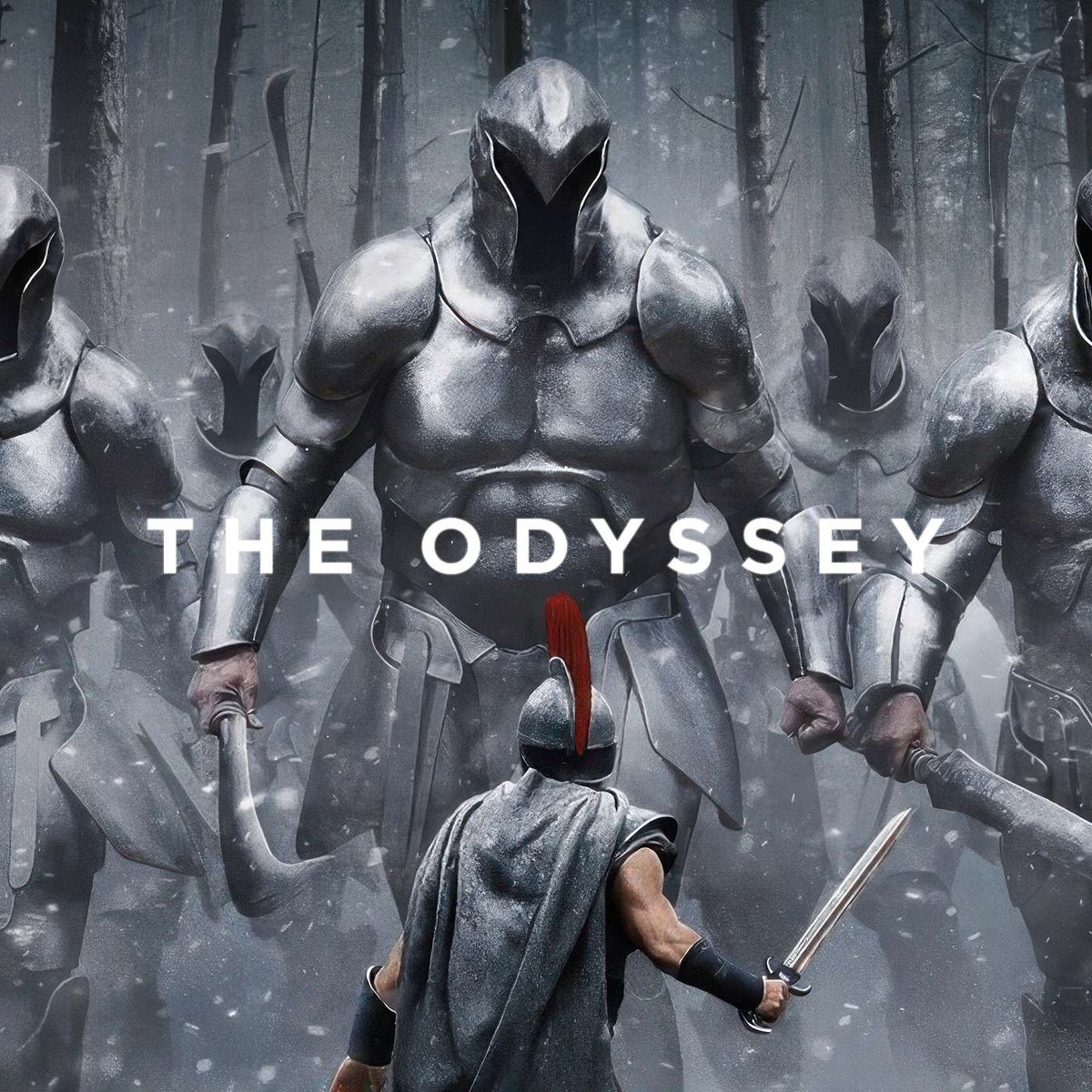
And the trials keep coming, each one distinct, each one memorable. There are the giants, the Laestrygonians, these towering figures in metal armour that look almost like machines, huge in scope and honestly terrifying, and once again our heroes are running, just trying to survive. First the cyclops, now this. There’s the sorceress Circe, played by Samantha Morton, who makes the men gorge themselves, stuffing their mouths. She keeps animals on her island that are really men she’s transformed and trapped, moulding them like clay, turning sailors into pigs. That’s straight from the book, by the way, and it’s rendered here with this queasy, dreamlike menace. There’s a journey into the land of the dead, this black, drained landscape where Odysseus faces the men he lost in the campaign, and where he’s told how to find his way home… and warned not to expect a welcome when he gets there. There are the sirens, and the film does the famous version properly. The men plug their ears with wax, but Odysseus, being Odysseus, refuses the wax and has himself tied to the mast so he can hear the song and survive it. There’s Charybdis, the monster’s whirlpool, an entire set piece built around the ocean trying to swallow a ship whole. And threaded through all of it is one quietly devastating truth: with every single stop on the journey home, they’re losing men. The crew that left Troy keeps shrinking, and the film never lets you forget the cost.
And then there’s Calypso. Seven years stranded on her island, with Charlize Theron playing this goddess who has been feeding Odysseus the lotus flower, keeping his memory clouded, keeping him hers. It’s the framing device for so much of the film, and it’s where the movie asks its most interesting question. Because this isn’t just a story about a man fighting monsters to get home. It’s about what kind of man the war and the journey have made him, and whether the person who finally washes up on the shores of Ithaca is the same person who left. When he does finally arrive home, looking like an old man, grey and weathered, to a broken household… I won’t go deeper into how that final act unfolds, because it’s so much better discovered on screen. What I will say is that the fight to set his house straight is an emotional rollercoaster, and the music through that whole sequence is just incredible. And the closing lines sounded to me like the final words were lifted directly from the book, which felt like exactly the right note of respect to end on.
Let’s talk performances, because this cast is absurd. Matt Damon is brilliant as Odysseus. He doesn’t just play the character, he embodies him. The cunning, the weariness, the guilt, the stubborn refusal to stop moving toward home. It’s all there, and so much of it happens in his face rather than his dialogue. And here’s a nice bit of trivia for our upcoming Nolan run: Damon and Anne Hathaway were both in Interstellar, the very film we’re reviewing next, so keep that in mind when we get there.
But the performance I want to spotlight is Tom Holland as Telemachus. I was honestly surprised at the range this guy has. Obviously we’ve watched him as Spider-Man for years now, and he’s done other things. If you want to see how good he was even as a kid, go find The Impossible from back in 2012. But it was so good to see him step out of his comfort zone here. He plays the son very, very well. This young man who has grown up in the shadow of a legend he’s never met, trying to become worthy of a father who might not even be alive. His own journey, setting out to search for word of Odysseus, is one of my favourite threads in the whole film. And beyond those two, there are so many actors here it’s impossible to name them all. Zendaya as the goddess Athena, watching over Odysseus and intervening when the fates allow, plus Lupita Nyong’o, Jon Bernthal, John Leguizamo, Bill Irwin and more. Everyone understood the assignment. Nobody is phoning it in.
And here’s the thing that surprised me most, the thing I keep coming back to. For all the spectacle, the cyclops, the giants, the whirlpool, the burning city, I am overwhelmed by how much heart this movie has. Nolan sometimes gets accused of being a cold, clinical filmmaker, all mechanism and no soul. Not here. This is a film about a father and a son who don’t know each other. About a wife holding a kingdom together with nothing but patience and wit. About a man who has seen and done terrible things, trying to find his way back to being a husband and a father. The myth is the vehicle, but the heart is the engine. That’s what elevates this above being just a monster tour with an incredible budget.
So where does that leave us? Look, it’s a Christopher Nolan movie, and part of me could have just said: it’s brilliant, go see it, it has to be seen on the big screen, the end. Perfect review, shortest episode we’ve ever done. But this one earns the long conversation. It’s a faithful, enormous, surprisingly tender telling of a story that’s been told for thousands of years, made by a filmmaker operating at the absolute peak of his powers, with a cast that turns up for him at every level. 3 hours, and not a single dull spot. If this is the start of our Nolan run, we could not have asked for a better opening chapter.
But as always, that’s just how the film landed for me. Entertainment is subjective, and a 3-hour mythological epic won’t be everybody’s idea of a night out. What swept me away completely might not connect with you at all, and that’s completely okay. But for my money, this is the journey of the year, and I’d sail it again tomorrow.
Listen to this episode
Follow Frame 70 on your favourite podcast app and new episodes find you the moment they drop.