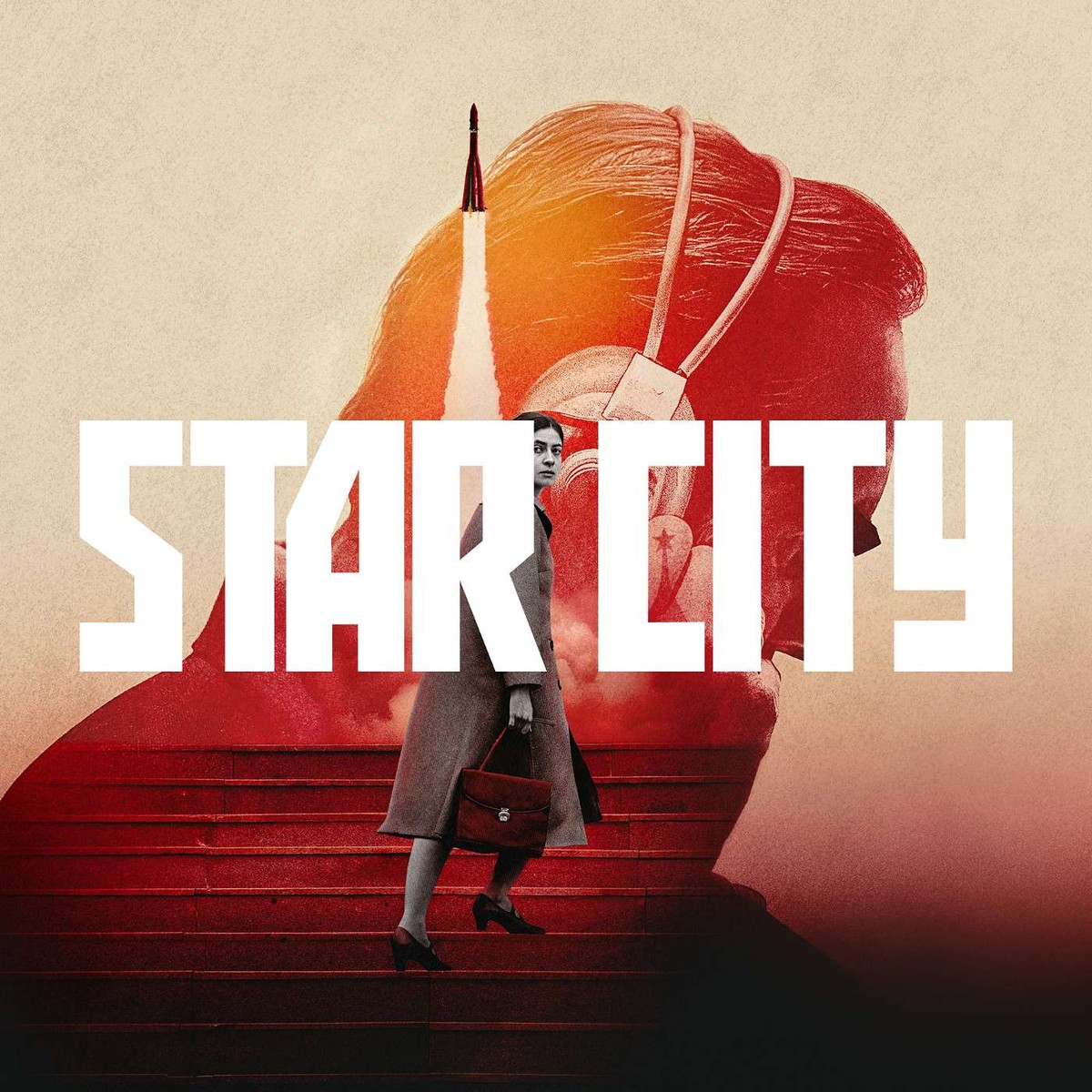
Star City
The Soviet side of the For All Mankind universe finally gets its own show, and it's a superb Cold War pressure cooker about surveillance, paranoia and the brutal cost of reaching for space.
 8.4/10 · GREAT
 Star City is the 2026 series created by Ben Nedivi, Matt Wolpert and Ronald D. Moore, starring Rhys Ifans, Anna Maxwell Martin and Agnes O’Casey, and this one comes with some history for me. It’s a spinoff of For All Mankind, the Apple TV alternate history series that asks a very simple question: what if the Soviet Union got to the Moon first? I have been a big watcher of For All Mankind from the very beginning, and I absolutely love that whole alternate reality setup. For me, the first three seasons of that show were brilliant. Season four, I’ll be honest, was good but not great. There were a few stretches that felt a little bit too slow for me, and a few storylines that drifted into more generic territory. So when I heard they were doing a spinoff, and not just any spinoff, but one that flips the entire lens over to the Soviet side of the space race, I was genuinely excited. Because here’s the thing. For All Mankind touches on Star City and the Soviet program constantly. There is so much back and forth with the Soviet Union across those seasons. But we had never actually seen that world from the inside. The cosmonauts, the engineers, the KGB minders, the whole secretive machine behind the Soviet lunar triumph. That was the missing half of this universe, and now we finally get to walk through the door.
The Other Side of the Space Race
The season opens in 1969, right at the moment this whole alternate timeline splits from our own: Alexei Leonov becoming the first man on the Moon. But the show makes a really smart choice straight away, because we don’t witness that moment through mission control celebrations. We see it through two women on the ground. Leonov’s terrified wife, hauled from her apartment for questioning at the exact moment her husband is making history. And Irina Morozova, played by Agnes O’Casey, walking briskly through the apartment blocks of Star City to get to her desk in the surveillance department. That opening tells you everything about what this show is going to be. This is not a hopeful space saga. This is a Cold War thriller about surveillance, paranoia and control, where the space race is almost the backdrop rather than the main event. And for fans of the original show, there’s a lovely bit of connective tissue baked right into the casting, because Irina Morozova is a character we already know from For All Mankind, where she was portrayed by Svetlana Efremova. So what we’re really watching here is an origin story: how a wide-eyed young officer with a young daughter slowly becomes the woman we meet decades later in the parent show. Watching those first pieces click into place is one of the real pleasures of the season.
Those first two episodes are heavy, and I mean that as a compliment. Seeing just how much surveillance sits on top of these cosmonauts and their families is genuinely unsettling. There are listening devices threaded through people’s homes. Neighbours watching neighbours. You literally cannot do a thing in this world without the KGB finding out about it. Irina is assigned to surveil the home of celebrated cosmonaut Valya and his wife Tanya, a former professional pianist, and the show does something really clever with that setup, because Irina slowly starts to feel a connection with Tanya through the very act of spying on her. She’s listening to this woman’s life through a wire, and she starts to care. That tension, between the person Irina is supposed to be for the state and the person she actually is, becomes the emotional spine of the whole season. And early on she uncovers discrepancies around a wrongly punished cosmonaut named Yana, and starts to realise that the state she serves is simply unwilling to admit its own fatal errors. From that point she’s quietly investigating the world she’s part of, and you can feel the ground shifting under her feet episode by episode.
Now let’s talk about the look of this thing, because the setting is one of my favourite parts of the entire show. The Star City complex itself is brilliant. It has that old Soviet feel down to the bone: the concrete, the corridors, the paperwork, the checkpoints. Even the colour palette is dialled right down. Everything is duller and moodier compared to For All Mankind, and that contrast is clearly deliberate. Because For All Mankind, even in its ’60s and ’70s era, always looked quite polished. NASA had the money, and the show wore that on screen. Star City makes you feel the opposite. You can tell the Soviet Union doesn’t have the American budget, and the show builds that scarcity into its storytelling. There are more failures. There is more death. And crucially, there is a culture of hiding it all. This is a system so proud that when something goes wrong, they don’t tell anyone. They sweep it under the carpet, they rewrite the story, and they carry on as if nothing happened. Watching that machinery of denial grind away underneath the triumphant headlines is where the show really earns its Cold War thriller credentials. And a fun production note here: the series was actually filmed in Vilnius in Lithuania, with filming taking place throughout the city, and honestly you can feel that authenticity in every exterior shot. None of it feels like a backlot.
No Russian Accents, and Why That Works
Okay, now for the thing I found super unusual at first, and I know I won’t be the only one. None of the actors playing Soviet characters put on a Russian accent. Nobody. There are English actors, Irish actors, a Welshman in Rhys Ifans, and they all just speak in their own natural voices. And I found that quite jarring in the first episode, I’m not going to lie, because For All Mankind handled its Russian characters differently. When we dealt with the Soviets over there, we usually got Russian dialogue with subtitles or actors with genuine Russian backgrounds. So I did some digging after finishing the season, because there had to be a reason. And it turns out this was a very deliberate creative choice. According to co-creator Ben Nedivi, early in development there was actually a consideration to use all Russian actors and make the show entirely in Russian, but they realised it just wasn’t going to be possible. The showrunners even consulted Craig Mazin, the man behind the 2019 miniseries Chernobyl, which used English-speaking actors as Soviet characters, and his advice was blunt: “This is the only way to do it. Do it this way. Trust me.” Instead of forcing accents, the cast found ways to distinguish their characters through their own specific creative decisions. Rhys Ifans put real thought into his character’s voice, using the background of Sergei Korolev, the actual figure the Chief Designer is modelled on, as his inspiration. And showrunner Matt Wolpert pointed out that there was no single correct way people spoke across the Soviet Union. Different regions had different speech styles, so the team wanted to avoid creating a fake, uniform version of Russian speech. And honestly, once I understood the reasoning, it made complete sense to me. Chernobyl is one of the finest pieces of television ever made, and nobody in that show attempts a Russian accent either. And here’s the truth of my own experience: by the end of episode two, I was completely used to it. It didn’t faze me at all after that. Your mileage may vary on how long that adjustment takes, but trust me, the show earns your patience.
And a big part of why it earns that patience is the cast, because the actors here are absolutely brilliant across the board. Rhys Ifans as the Chief Designer is fascinating. This brilliant, driven man pushing the Central Committee for new missions while being forbidden to ever leave the Soviet Union himself. The state’s greatest asset and its prisoner at the same time. If you only know Ifans from Notting Hill or as Otto Hightower in House of the Dragon, this is a completely different gear for him. Then there’s Anna Maxwell Martin as Lyudmilla Raskova, the head of the KGB surveillance operation, and let me tell you, that woman is a nasty piece of work, and she is played by an absolutely brilliant actress. If you’ve seen Maxwell Martin in Line of Duty, you know exactly how chilling she can be while barely raising her voice, and she brings all of that here. Agnes O’Casey carries the emotional weight of the season as Irina, and Alice Englert is great as Anastasia Belikova, the untested cosmonaut whose rise mirrors all the fraught politics of putting a woman in space. Because in this world, both nations are weighing the optics of a female cosmonaut, but in 1960s Russia, loyalty to the Party matters more than qualifications. And the show wrings some of its darkest material out of that, like Sasha, a reckless cosmonaut played with real charm by Solly McLeod, being coerced into a sham marriage with Anastasia, because as one official puts it, a woman cannot represent the Soviet Union unmarried. Meanwhile his affair with Valya’s wife Tanya is simmering away underneath the whole arrangement. It’s soap opera material on paper, but the constant presence of the state turns every personal entanglement into a matter of life and death.
The Back Half Catches Fire
The back half of the season is where everything catches fire. Valya’s identity as an American asset is uncovered. He’s the mole who’s been feeding information to the other side, and suddenly this celebrated hero cosmonaut is being hunted by the KGB. And his escape route is one of the most audacious ideas the show pulls off. He manoeuvres his way onto a secret mission to Venus, a mission the KGB doesn’t even know is being sent, taking another man’s place on the crew. If he can get himself off the planet, he’s in the clear. I love that. Only in this universe can a spy thriller resolve itself with a man literally fleeing Earth. And while all of that is unfolding, the power struggle between the Chief Designer and Raskova comes to a head, with the Chief Designer arrested and placed under house arrest, and Star City handed to new leadership more interested in monitoring the Americans than actually reaching for space. Watching the scientists’ frustration boil over as their work stalls is quietly heartbreaking.
Now, the one structural thing I missed. For All Mankind famously ends every season with that little epilogue jump, a 30-second tease that flings you years into the future and gives you a taste of where things are heading next. Star City doesn’t do that, and I’ll admit I was sitting there waiting for it. So I went looking for answers on that front too. As of right now, there is no official confirmation of a second season. Apple has not announced whether the series will return, and that’s not unusual for the streamer, which often waits weeks or even months after a season ends before making renewal decisions. But the signs look really good. The season sits at 97% on Rotten Tomatoes from 30 critics’ reviews, and every sign currently points towards a renewal, with Apple likely just crunching the completion numbers first. And here’s the bit that recalibrated my expectations. I went in assuming season two would do a big 10 or 15 year jump like the parent show always did, but the showrunners have said Star City likely won’t use For All Mankind’s massive time jumps, meaning a second season would grow directly out of the first season’s storylines. Which, the more I sit with it, is probably the right call. This show is a pressure cooker. Time jumps release pressure. Staying put keeps the lid on.
Before I wrap up, some connective tissue for you. The most obvious companion piece here is Chernobyl. Same era, same oppressive machinery of Soviet denial, same approach to accents, and if you loved Star City and somehow haven’t seen it, fix that immediately. Adam Nagaitis, who plays Valya, was actually in Chernobyl, and he was also outstanding in The Terror, another slow-burn story about brave men being destroyed by forces bigger than themselves. And obviously, if you’ve come to Star City fresh without seeing For All Mankind, you now have five whole seasons of the parent show waiting for you. Start from season one and watch this same Moon landing from the American side of the wall. It’s a brilliant way to experience this universe from both directions. And more broadly, this show continues Apple TV’s remarkably strong run for me. Severance, Slow Horses, Silo, For All Mankind itself. As per usual with Apple TV shows, they very rarely let me down, and there’s a strong slate of returning series this year that I’m already looking forward to covering.
But look, that’s just how Star City landed for me. Entertainment is subjective, and a show this bleak and slow-burning won’t be for everybody. What worked for me may not work for you, and that’s completely okay. But for my money, this is the strongest expansion this universe could have asked for, and I’ll be first in the queue when season two gets the green light.
Listen to this episode
Follow Frame 70 on your favourite podcast app and new episodes find you the moment they drop.