Pressure
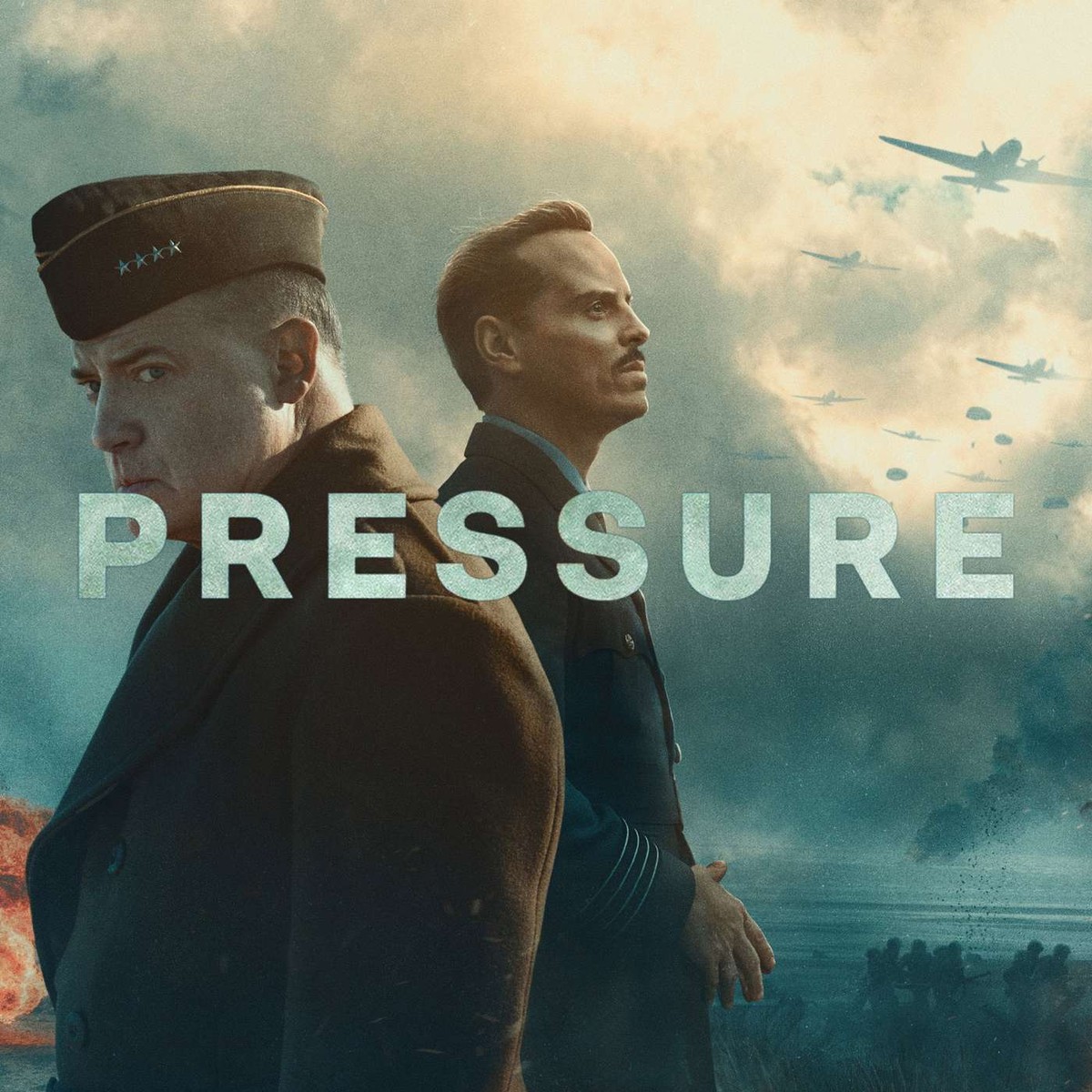
Andrew Scott and Brendan Fraser turn the 72 hours before D-Day into a gripping chamber piece, where the most consequential weather forecast in history leaves no safe choice, only degrees of disaster.
 8.5/10 · EXCELLENT
 This one is a little different for me, because it’s not a trip back into the vault. Pressure is a brand new 2026 release, directed by Anthony Maras and starring Andrew Scott, Brendan Fraser, Kerry Condon, Chris Messina and Damian Lewis, and I was lucky enough to catch it at an advance screening. I have to tell you, I walked in with high hopes. Anyone who knows me knows I’ve been reading about the Second World War my whole life. I grew up in the years just after the war ended, when it was still fresh in everyone’s memory, and I’ve read every book and watched every documentary on the subject I could get my hands on. So a film about the 72 hours before D-Day, told from an angle I’d never seen on screen before, was always going to have my full attention.
Let me set the scene for you. Pressure is based on David Haig’s 2014 stage play of the same name, and Haig co-wrote the screenplay with director Anthony Maras, the Australian filmmaker behind Hotel Mumbai. It comes from Working Title, the same production house that gave us Darkest Hour, and you can feel that pedigree in every frame. The story is a true one. It’s June 1944, the Allies are ready to launch Operation Overlord, the invasion of Normandy, and the whole thing hinges on something nobody can control. The weather.
The Most Important Forecast Ever Made
Andrew Scott plays Group Captain James Stagg, the Scottish chief meteorologist attached to Allied headquarters, and Brendan Fraser plays General Dwight D. Eisenhower, the Supreme Allied Commander who has to make the final call. Stagg’s job sounds simple on paper. Tell Eisenhower what the weather will be doing over the English Channel on June 5, the planned date of the invasion. In practice, he’s being asked to make the most consequential weather forecast in human history, with the fate of roughly 150,000 men riding on whether he gets it right.
The film also gives Eisenhower a shadow hanging over him from the start, and it’s a piece of history worth knowing going in. Six weeks before D-Day, a full-scale rehearsal for the landings called Exercise Tiger went terribly wrong, and hundreds of American servicemen were killed in a practice run that was supposed to be the safe part. The film lets that failure sit quietly behind Fraser’s performance the whole way through. Every time Eisenhower looks at a map, you can feel him remembering that even the rehearsal cost him men, and the real thing will be a thousand times bigger. It’s a lovely piece of writing, because it means the general’s caution never feels like weakness. It feels like a man who has already paid a down payment on this decision and knows exactly what the full price could be.
From the very first scenes, I could see there was going to be tension between these two men, and that tension is the engine of the whole picture. This is not a war film in the way we usually mean it. There are no beach landings here, no sweeping battle sequences. It’s a chamber piece, most of it playing out in the rooms and corridors of Allied headquarters, over desks and maps and weather charts. And honestly, it doesn’t need anything more than that. The film generates more suspense out of a barometer reading than most modern thrillers manage with a full action budget.
What surprised me most is just how much conflict there is packed into those rooms. Because it isn’t only Stagg against the weather. Chris Messina plays Colonel Irving Krick, an American meteorologist whose forecasting method couldn’t be more different from Stagg’s. Krick works from historical patterns, looking back at what the weather did in previous years at the same time and drawing his predictions from that. Stagg is the data man, tracking the actual weather fronts moving across the Atlantic, and what he sees coming is a dangerous storm. Krick sees clear skies. And here’s the kicker. Krick’s forecasts had served Eisenhower well earlier in the war, so Ike has every reason to trust him. The arguments between Stagg and Krick are some of the most intense scenes in the film, two men shouting about isobars and cold fronts, and somehow it’s absolutely riveting, because you never forget what’s hanging on the answer.
And there’s another layer of pressure sitting on top of all of it, which the film handles beautifully. A delay isn’t a free option. Every day the invasion slips, the greater the risk that the Germans discover what’s coming and the whole element of surprise is lost. So Eisenhower is caught between two catastrophes. Launch into a storm and watch the landing craft founder in violent Channel waters, or hold off and risk the entire operation being exposed. There is no safe choice, only degrees of disaster, and the film makes you feel the weight of that in your chest.
The Scientist and the Soldier
Let’s talk about the performances, because this film stands or falls on them, and it stands tall. Andrew Scott is quietly magnificent as Stagg. He plays him as a taciturn, precise, slightly prickly Scot who is not remotely interested in telling powerful men what they want to hear, and watching him hold his ground in a room full of generals is something to behold. Most of us know Scott from his flashier roles, but this is a performance built on stillness and conviction, and I found it completely convincing. Brendan Fraser makes for a fascinating Eisenhower. He’s warmer and more physically imposing than the Ike we’ve seen in other films, and he really captures the loneliness of supreme command, a man carrying a burden that nobody else in the world can share. The scenes where Scott and Fraser go toe to toe are the best in the picture, the scientist and the soldier trying to find common ground between certainty and doubt.
I also want to mention Kerry Condon as Kay Summersby, Eisenhower’s secretary and confidante. It could have been a thankless role, but Condon gives the film its human warmth, the person who sees the toll all of this is taking on Ike when the door closes. Damian Lewis rounds out the headline cast as General Montgomery, all clipped impatience and supreme self-belief, and he’s clearly having a wonderful time with it.
On the filmmaking side, Maras does a wonderful job making rooms feel dangerous. The headquarters is a grand old English country house, all high ceilings and polished wood, and the contrast between those calm, stately spaces and the storm of anxiety inside them is used to great effect. The weathermen work almost blind, waiting on scraps of data phoned in from weather ships and stations scattered from Newfoundland to the African coast, and the film turns each incoming report into a small moment of dread. Volker Bertelmann’s score keeps the tension humming underneath it all without ever shouting over the drama. The whole thing comes in at a lean 100 minutes as well, and I admired that discipline. No flab, no detours, just a story told at exactly the length it needs.
The War Nobody Puts on Screen
Something else the film made me appreciate, and this is where my inner history reader really lit up. We have to remember what weather forecasting actually was in 1944. No satellites, no computer models, no radar coverage of the Atlantic. These men were drawing their charts by hand from scattered readings, and from that patchwork of numbers they had to see a storm coming days before it arrived. When you understand how thin the information was, what Stagg did stops looking like meteorology and starts looking like nerve. He had to be right, he had to know he was right, and he had to convince the most powerful men in the free world to stake everything on it. The film understands that, and it treats the science with the respect it deserves without ever turning into a lecture.
Here’s the thing that really stayed with me, and I jotted it down straight after the screening because it’s true. Nobody ever thinks about the weather when they think about how the war was won. We think about the beaches, the paratroopers, the armadas. But if the invasion had gone ahead on June 5 as planned, into the teeth of that storm, the greatest amphibious operation in history could have ended in catastrophe before a single man reached the sand. The decision to hold for 24 hours and go on June 6 may be the most important weather call ever made, and this film finally gives that story its due. It also struck me that after 80 years of D-Day pictures, from the grand old epics through to the modern beach landings we all know, the movies had somehow never told this part. The big battles have all had their turn on screen. It’s the small rooms that were still waiting, and I’m delighted somebody finally opened the door.
Watching Pressure also sent my mind straight to another film, and I’ll make you a promise about this one. A few years back there was a picture called Operation Mincemeat, with Colin Firth, telling the true story of the British deception plan that fooled the Germans ahead of the invasion of Sicily in 1943. Different operation, earlier chapter of the war, but it’s cut from exactly the same cloth as Pressure. Both films are about the invisible side of victory, the war that was fought in back rooms by scientists and planners and intelligence men whose names never made the newsreels. Watching Pressure has made me want to go back and give Operation Mincemeat a proper look, so keep an eye on this space, because I’ll be bringing you a review of that one down the track.
If I’m reaching for a criticism, the film takes a little while to find its rhythm. The opening stretch has a lot of pieces to move into place, a lot of uniforms and titles to keep track of, and it’s only once the central forecast dispute takes hold that the picture really locks in. But be patient with it, because once it grips you, it does not let go, right through to the closing credits.
That’s just how Pressure landed for me, though. Entertainment is subjective, and a slow-burn chamber piece about weather charts might not be everyone’s idea of a night at the pictures, even if it had me on the edge of my seat. What works for me may not work for you, and that’s completely okay.
Listen to this episode
Follow Frame 70 on your favourite podcast app and new episodes find you the moment they drop.