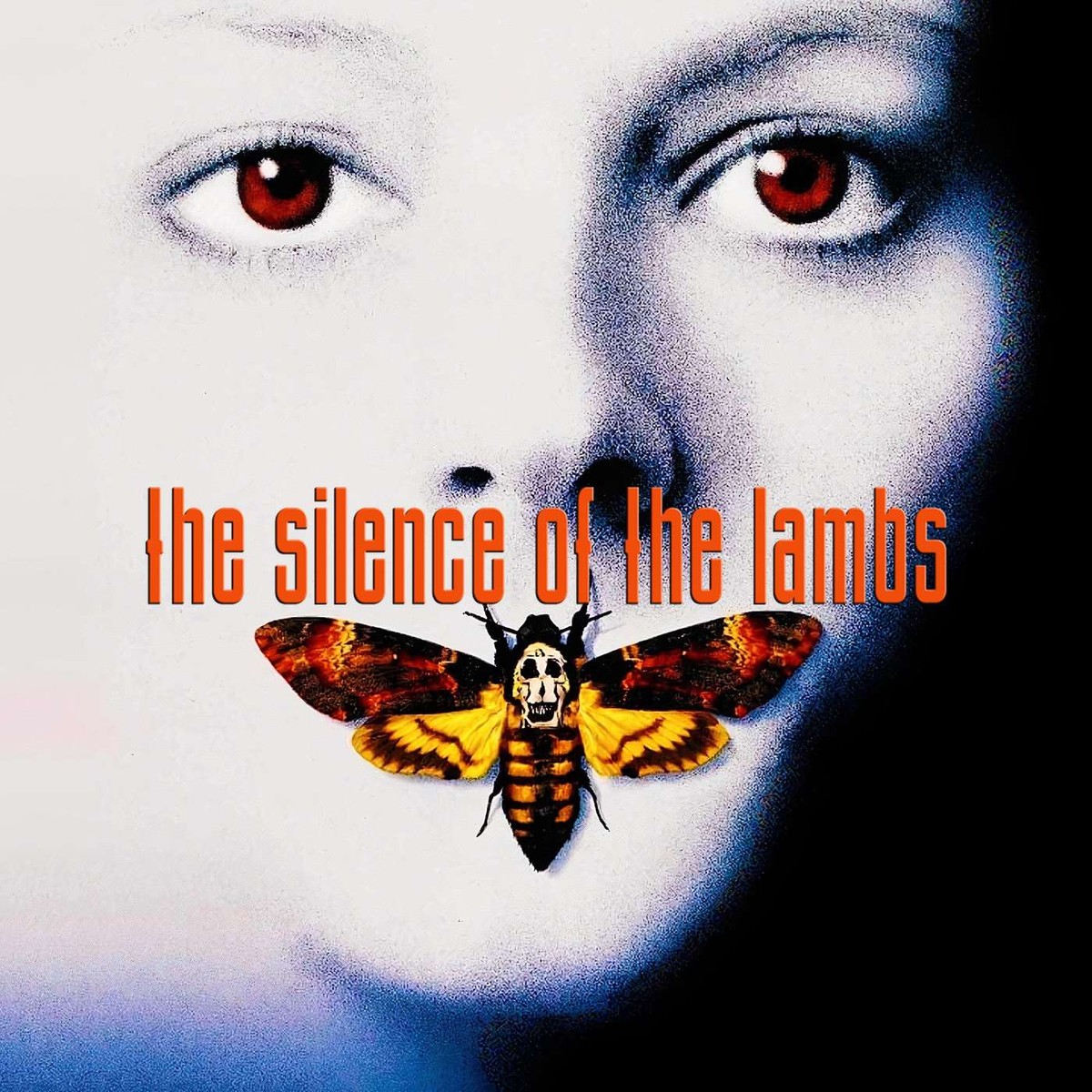
The Silence of the Lambs
Evil doesn't need to be loud. It can sit quietly in a chair, smile politely and ask you a question, which is why this 1991 thriller still gets under your skin more than 30 years later.

This one comes from a screenplay by Ted Tally, adapting Thomas Harris’s 1988 novel, and it was released by Orion Pictures back in 1991. Interestingly, this wasn’t actually the first time Hannibal Lecter had appeared on screen. Michael Mann had adapted Harris’s earlier novel Red Dragon as Manhunter in the mid-’80s, with Brian Cox playing the doctor. That film has its own cult following, and it’s well worth seeking out, but it was this one that turned Lecter into a cultural phenomenon. It swept through awards season, it embedded itself in the public imagination, and more than three decades later it still sits near the top of almost every list of the greatest thrillers ever made. So the question going in isn’t really whether it’s good. It’s whether it still holds up. And honestly, it does. It absolutely does.
The Silence of the Lambs is one of those films that comes along once in a generation and manages to do almost everything right. It’s a psychological thriller, a crime drama and, at times, a horror film, but it never relies on blood, violence or cheap scares to keep you interested. Instead, it gets inside your head, and it creates an atmosphere of unease that stays with you long after the credits have rolled. At the centre of it all is Clarice Starling, played by Jodie Foster, a young FBI trainee who is given an assignment that initially seems relatively straightforward. She’s sent to interview the imprisoned Dr Hannibal Lecter, a brilliant psychiatrist and convicted murderer, in the hope that he can provide information about another killer who is currently at large, a man the press have nicknamed Buffalo Bill. From the moment Clarice arrives at Lecter’s cell, the film takes us into a very different kind of psychological battle.
A Psychological Chess Match
One of the things that makes the film so effective is that Lecter is not presented as a typical movie villain. He’s calm, polite, extremely intelligent and almost charming. He doesn’t need to shout or threaten anyone. He simply looks at people and talks to them, and that’s what makes him so frightening. There’s a feeling throughout the film that Lecter is always several steps ahead of everyone else in the room. He studies Clarice from the moment she arrives, and rather than simply answering her questions, he begins questioning her. What follows between them is essentially a psychological chess match. Clarice needs Lecter’s help to catch Buffalo Bill, and Lecter knows it. He uses that knowledge to control the conversations, offering her pieces of information, but only if she’s prepared to reveal something about herself in return.
And this is where Jodie Foster’s performance becomes so important. Clarice could easily have been written as just another inexperienced agent who becomes frightened when confronted by a dangerous criminal. Instead, Foster gives her a quiet determination. Clarice is intelligent, but she’s also vulnerable, and although she’s surrounded by experienced male investigators, she refuses to be intimidated by them. Her conversations with Lecter are especially compelling because neither character completely dominates the other. Lecter has the intellectual advantage, but Clarice has something he finds interesting: determination. We gradually learn that she grew up in difficult circumstances, and she tells Lecter about a memory from her childhood of hearing the lambs crying and wanting to save them. She couldn’t, and that memory has stayed with her ever since. Lecter recognises that her investigation isn’t simply about catching a murderer. There’s something personal behind her drive to rescue Buffalo Bill’s latest victim, Catherine Martin. She wants to save Catherine, and she also wants, in some sense, to silence those lambs. That’s where the title comes from, and it’s what elevates this from a procedural into a genuine character study.
While Lecter dominates the psychological side of the story, Buffalo Bill provides the physical threat. Ted Levine plays Jame Gumb, the man behind the nickname, and his performance is deeply unsettling. What makes the character frightening isn’t simply that he’s a murderer. It’s the way he behaves when he’s alone, particularly in the scenes in his basement. The film deliberately gives us glimpses of his world without explaining everything at once. We see the sewing equipment. We see the moths. We see the strange relationship between him and his little dog, and gradually the pieces begin to fit together in the most horrifying way imaginable. And here’s the thing: the film doesn’t need to constantly show violence to make this land. Much of the terror comes from knowing what is happening and waiting for the characters to discover it. That’s one of Jonathan Demme’s greatest achievements as director. He understands that what you don’t see can sometimes be far more frightening than what you do. By the way, if you only know Ted Levine from this film, it’s worth mentioning he later spent years playing the gruff but loveable Captain Stottlemeyer in the detective series Monk, and the fact that both performances come from the same actor tells you everything about his range.
Into the Basement
Then there’s the moth. The death’s-head hawkmoth becomes a symbol of Buffalo Bill’s obsession, and it gives the investigators one of the crucial clues that eventually points them towards him. What I appreciate is that the film uses the moth without turning it into some ridiculous supernatural symbol. It’s simply another piece of evidence that helps Clarice and the FBI understand the killer. Meanwhile, Lecter has been moved out of the Baltimore hospital where he’s normally held and put in a makeshift cell in a Memphis courthouse, and it’s there that he escapes in one of the film’s most disturbing sequences. Using a small piece of Dr Chilton’s pen to pick his handcuffs, he frees himself, kills his two guards and gets out of the building in a way I won’t fully describe here, because it’s much better discovered on screen. The film shows the attack itself, but it leaves the worst of what he’s done for the authorities to discover afterwards. Once again, the movie lets your imagination do some of the heavy lifting.
The climax comes when Clarice, following up on Buffalo Bill’s first victim, ends up at the door of a man calling himself Jack Gordon. It’s only when she sees a death’s-head moth inside the house that she realises who he is, and he flees into the basement with Clarice in pursuit. He switches off the lights, and she finds herself in complete darkness while he watches her through night-vision goggles. We see Clarice stumbling blindly, unaware that he’s standing within arm’s reach of her, and for the audience it’s almost unbearable. We can see him. She can’t. Then he reaches out towards her and cocks his revolver, and at the sound of it she turns and fires. It’s an extraordinarily effective sequence because the film has placed us almost entirely in Clarice’s position. We don’t know exactly where the danger is, and neither does she. When the gunshots finally come, the tension is released in an instant. Clarice has survived, Catherine has survived, and when Clarice takes down Buffalo Bill, it isn’t simply the conclusion of a murder investigation. It’s the moment she confronts the darkness she has been pursuing throughout the entire story.
Two Extraordinary Performances
Now, I have to talk about Anthony Hopkins, because his performance is extraordinary, one of the most memorable in film history, despite him appearing on screen for a surprisingly short amount of time. Hopkins doesn’t overplay him. He keeps his voice controlled, his movements precise and his expression largely calm, and that restraint is exactly what makes the character so terrifying. The famous shots of Lecter speaking straight to Clarice are particularly effective here. Demme and his cinematographer, Tak Fujimoto, frequently place the camera directly in front of the actors, so it feels as though the characters are speaking to us. When Lecter looks straight into the lens, it creates this deeply uncomfortable sense that we are the ones being examined. Fujimoto, incidentally, went on to shoot The Sixth Sense for M. Night Shyamalan, and you can feel the same patient, unnerving eye at work in both films. And Foster matches Hopkins beautifully. Clarice isn’t as flamboyant as Lecter, but that’s exactly why she works. There’s a wonderful contrast between the two characters. Lecter represents knowledge without morality, while Clarice represents determination guided by a desire to save people. Their relationship is one of the most fascinating dynamics in the entire movie, and it’s why Lecter, arguably one of the greatest villains ever put on screen, isn’t actually the main villain of this particular story. He’s something else: an intelligent monster who temporarily becomes Clarice’s reluctant guide, helping her solve the case entirely on his own terms.
The supporting cast deserves a mention too. Scott Glenn plays Jack Crawford, Clarice’s superior, and gives him a grounded presence. Crawford understands Clarice’s abilities, but he also knows that sending her to Lecter is going to put her under enormous psychological pressure. There’s a very real sense throughout the film that Clarice is trying to prove herself in a world dominated by older, experienced men, and the film never needs to turn this into a speech about sexism. It simply shows us Clarice navigating that world, and she does it extremely well. Anthony Heald is excellent as Dr Chilton, who provides an interesting contrast to Lecter. He’s nowhere near as intelligent or sophisticated, but he believes he is, and that makes his scenes with the doctor particularly entertaining. The film also makes brilliant use of sound. The silence of the title isn’t just a reference to Clarice’s childhood memory. Silence becomes part of the film’s atmosphere, and there are moments when the absence of music or background noise makes a scene feel even more uncomfortable.
Then there’s the awards story, which is remarkable in its own right. The film won five major Academy Awards: Best Picture, Best Director for Jonathan Demme, Best Actor for Anthony Hopkins, Best Actress for Jodie Foster and Best Adapted Screenplay for Ted Tally. It was only the third film ever to sweep all five, after It Happened One Night and One Flew Over the Cuckoo’s Nest, and no film has done it since. It also remains the only horror film to win Best Picture. And if this film leaves you wanting more of this world, there’s plenty to explore. Hopkins returned in Hannibal and in a fresh adaptation of Red Dragon, and years later Mads Mikkelsen gave us a completely different, hypnotic take on the character in Bryan Fuller’s Hannibal television series, which I’d argue is one of the most visually striking shows ever made for network television. Demme, for his part, followed this up with Philadelphia, proving he could pivot from psychological horror to heartfelt drama without missing a beat.
More than three decades later, The Silence of the Lambs still holds up, because it isn’t dependent on special effects or technology. Its power comes from its writing, its performances, its direction, its cinematography and its sound. The story is carefully structured, and we’re given information at precisely the right moments. We know Lecter is dangerous. We know Buffalo Bill is dangerous. But we don’t always know exactly what either man is thinking, and that uncertainty keeps the tension humming from start to finish. For me, one of the most impressive things about it is the way it balances several different genres. It’s a police procedural. It’s a psychological thriller. It’s a horror movie. It’s a character study. And underneath all of that, it’s a story about Clarice Starling. The case matters because Clarice matters. We want her to find Buffalo Bill, we want Catherine Martin to survive, and we want Clarice to overcome the memories that have haunted her since childhood. This is a film that understands evil doesn’t always have to be loud. Sometimes evil can sit quietly in a chair, smile politely and ask you a question, and that is far more frightening.
Rated OCT 2026LISTEN TO THIS EPISODE
Follow Frame 70 on your favourite podcast app and new episodes find you the moment they drop.