Cape Fear
Bardem is superb and the Herrmann score still chills, but this third run at Max Cady unravels in its back half, hanging its biggest reveal on a scar nobody could have pieced together.
 6.1/10 · SOLID
 And look, I’m going to be upfront with you right from the top on this one, because I think you deserve to know where I landed before we go any further. I really wanted to love Cape Fear. I have been a pretty big spokesman for Apple TV shows, I’ve said many times that Apple TV never really lets me down, that anything I start over there I enjoy and see through to the end. This one tested that. It starts off really well, and I was excited through those first few episodes, but the last three fell short a fair bit for me, and by the time the credits rolled on the finale I was more exhausted than anything. Unfortunately, this one was a little bit of a mess. Not a disaster, there is real quality in here, and we’re going to give that quality its due, but a mess all the same. So let’s talk about how we got there.
Three Generations of Max Cady
First, some context, because this story has serious mileage on it. This is the third major go at the same material. John D. MacDonald wrote the novel back in 1957, and it was called The Executioners. Hold onto that title, because it comes back later in a way I actually really liked. That book became the 1962 film with Gregory Peck and Robert Mitchum, and then Martin Scorsese remade it in 1991 with Robert De Niro and Nick Nolte. And here’s the interesting wrinkle: Scorsese is back for this one, executive producing alongside Steven Spielberg, with Nick Antosca creating it for television and Morten Tyldum directing the pilot. So the pedigree behind this thing is genuine heavyweight stuff, and that’s a big part of why my expectations were where they were.
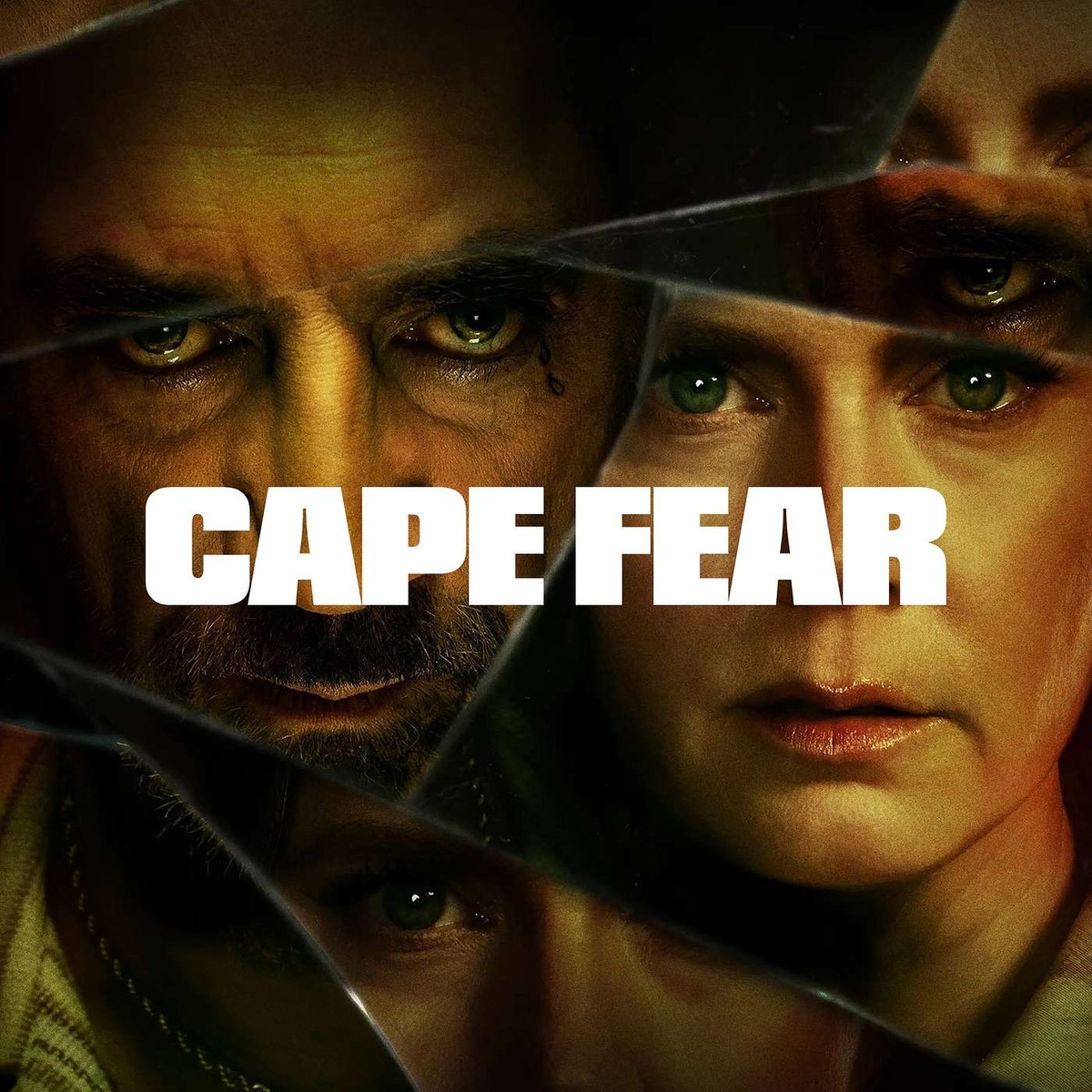
The big structural change this version makes is that the guilt gets split between two people instead of one. Amy Adams plays Anna Bowden, who was Max Cady’s defence attorney and talked him into a plea deal. Patrick Wilson plays Tom Bowden, the prosecutor who put that deal in front of him. The two of them met across that trial and married afterwards, and now they’re one of Savannah’s power couples with two teenage kids. So when Cady walks out 17 years later, after nearly two decades inside for allegedly murdering his wife Melissa, a crime he says he didn’t commit, he is not chasing a stranger. He’s walking back into the orbit of the two people whose careers were built on the wreckage of his life. On paper, that’s a genuinely smart evolution of the story. It gives you two guilty parties, two marriages’ worth of secrets, and a much murkier moral picture than either film ever had.
And the modern dressing works too, at least conceptually. This Cady comes out of prison into a world of true crime podcasts and documentary crews, and some corners of that world treat him as a folk hero: the wrongfully convicted man, the system’s victim, the redemption story everybody wants a piece of. He plays right into it. He does the interviews, he talks about fixing his life, he opens a restaurant, and the show even gives that restaurant a name that made my skin crawl when I clocked it. Melissa and Adam, named after the wife he was convicted of killing and the son she was carrying. Meanwhile the Bowden kids, Zack and Natalie, are getting slowly pulled into the web. Zack’s got a mysterious online girlfriend, Natalie’s exhausted and unseen by her parents, and both of them start feeling the walls closing in well before Mum and Dad do. On the other side of the investigation you’ve got Anna working with her colleague Noa, played by the always brilliant CCH Pounder, digging into the buried details of Cady’s original case and uncovering his estranged family out on the water: his father Robert, played by Ron Perlman, and his sister Crystal, played by Juliette Lewis. That’s the board. 10 episodes to play it out.
What Works: Bardem, Herrmann, and the Water
So let’s start with what worked, because plenty did. The opening credits are very, very well done, honestly one of my favourite parts of the whole show. They use the older theme music from the films, and the camera cuts land on these visual patterns, a lot of dirt in the image, overloaded colour palettes, that sinister music slamming into big reds on the screen with shapes coming right at you. It’s very similar in spirit to the original movie, and there’s a reason for that. Those four notes underneath everything are Bernard Herrmann’s, written for the 1962 film, adapted by Elmer Bernstein for Scorsese in 1991, and re-recorded here by Jeff Russo. Antosca has said that Scorsese and Spielberg both made it a condition that the Herrmann music stay, and thank goodness they did, because that score is doing heavy lifting every single time it shows up. The premiere even opens on a family barbecue in this inverted, high-contrast colour with the pool water washed a deep red, which plays as a direct nod to the opening of the 1991 version. When this show is honouring its lineage, it really sings.
And then there’s Javier Bardem, who is the reason this show works at all whenever it does work. He is doing a really, really good job with Max Cady. The whole performance is a double act: the version of himself he plays out to the media, this nice guy trying to redeem himself, fix his life, get his restaurant off the ground, and then the man underneath, completely pulling the strings the entire time. Bardem makes both halves believable, and more importantly he makes the seam between them almost invisible, so you’re constantly watching his face trying to work out which Cady you’re looking at in any given scene. We already knew from No Country for Old Men that this man can make stillness terrifying, and he brings that same quality here. The menace is never in the volume, it’s in the patience.
I thought the characters were good across the board, actually, and I particularly liked that the kids seemed to be figuring things out a lot quicker than the parents were. That felt true to life and it gave Zack and Natalie something to actually do rather than just being targets. I also really liked the relocation. They keep most of it in one place, and Cape Fear itself becomes the area Max grew up in and goes back to, riverside, houseboats, his family rooted out there on the water. I never got to the book, so I can’t tell you if that’s truer to how MacDonald originally wrote it, but I understood what they were going for and it gives the show a proper Southern gothic flavour. And calling the final episode The Executioners, the actual title of the original novel, I thought that was a really classy touch.
Where It Comes Apart
But here’s where the conversation turns, and I have to be honest with you: the back third of this show is where it all came apart for me. Now, I can’t properly explain why it lost me without getting into where those final episodes actually go, so if you’d rather discover all of that on screen for yourself, consider this your friendly nudge to skip ahead to the final thoughts. For everyone still with me, things become a lot more predictable in that final stretch, and I was connecting the dots as a viewer far too early. That is for sure. And the thread I enjoyed least was the whole Cady sister storyline. The show spends a couple of episodes making you believe there’s some kind of weird ancestral thing going on with Max’s half-sister Crystal, this dark family mythology brewing out on the river, and then by the end it turns out that wasn’t a thing at all. It turns out Crystal was the one who killed Max’s wife and took the baby. And what follows is genuinely grim. Max wipes out what’s left of his own family aboard that houseboat, shooting Crystal and a young man named Luke, turning on his father Robert with a dog crate and a can of gasoline, and torching the whole vessel. It’s a brutal sequence, and I’ll give the show this, it does not flinch. But buried inside it is the plot problem that broke the whole thing for me, and it became my Frame 70 Moment for all the wrong reasons.
Then there’s Anna and Tom themselves, and this one hurts to say because I rate Amy Adams and Patrick Wilson enormously. I found the Bowdens a little bit boring, and honestly a little bit whiny. They spend so much of the season falling over themselves, half a step behind everything, not really knowing what’s going on, and for two lawyers who are supposed to be the best in the business, that just falls short. The show needs them to be formidable for the cat and mouse to have any tension, and too often they’re just mice. Meanwhile Cady’s reach into their home is horrible in ways that do work. He has a young girl on the inside tormenting the family, working on both kids, and the show reveals in episode 4 that she’s Nevaeh Valentine, Cady’s own daughter, raised into the plan through prison video calls from the time she was around 12 or 13. That reveal is chilling, and it’s one of the few big swings in the season that properly landed for me. But the bigger problem is this: when you’re taking a story that’s been told for nearly 70 years, a story a lot of the audience already knows beat for beat, you really need to think outside the box. And with a handful of exceptions, I just don’t think they nailed that. I was expecting more, especially from the people behind it.
Let’s do some connective tissue, because this story’s history is half the fun of talking about it. I remember watching the Cape Fear movie back in the ’90s with De Niro, and in that one, Cape Fear was somewhere the family fled to. The Bowdens escape to their own houseboat on the Cape Fear River in North Carolina, and that’s where the whole climax plays out on the water. This version flips that, keeping the family planted in Savannah and making Cape Fear Max’s home turf instead, which I thought was a clever inversion even if it changes the flavour of the ending. And here’s my favourite bit of casting trivia in the whole production: Juliette Lewis, who plays Crystal here, played the Bowden daughter Danielle in that 1991 film, and earned an Oscar nomination for it at just 18 years old. Her scene with De Niro in that school theatre is still one of the most uncomfortable things Scorsese ever put on film. And her character’s end in this series also plays out on a houseboat. Whether that’s deliberate or not, it’s a lovely, grim little echo across 35 years. The visual lineage runs deep too. The 1991 titles were designed by Saul and Elaine Bass, built around those distorted reflections in water, and this series echoes that palette right there in its own opening imagery. If you’ve never gone back to the 1962 original, Robert Mitchum’s Cady is a very different animal to both De Niro and Bardem, less theatrical, more coiled, and it’s well worth your time as a double feature with this.
And on Apple TV more broadly, I remain a huge advocate, this one stumble aside. Ted Lasso is back for a new season running weekly into October. Trying continues to be one of the most quietly lovely shows on any platform. I’ve finished the second season of Sugar and there’ll be a review coming for that one. Dark Matter is back and underway with its second season running through to the end of October, and I am really looking forward to the next season of Foundation, which filmed in Prague earlier this year. So fingers crossed for a much better end of the year.
So, final thoughts. Look, I really wanted to enjoy this one, and there are stretches where I did. It’s a handsome production, the credits are superb, that Herrmann music still puts ice in your veins, and Bardem is doing top-shelf work from the first episode to the last. If you’ve come to this completely cold, if the earlier films and the book have passed you by, then a lot of what felt predictable to me will probably hit you fresh, and you may have a much better time than I did. But it just didn’t gel for me. The back third unravels, the Bowdens never earn their billing, and the big reveal is held together with string. Apple hasn’t announced a second season, it was billed as a limited series from the start, and honestly, this isn’t something I’m going to be keeping on my radar at all.
But as always, that’s just how Cape Fear landed for me. Entertainment is subjective. What left me cold might be exactly the slow-burn Southern gothic someone else has been waiting all year for, and if Bardem’s Max Cady gets under your skin the way he clearly wants to, this could easily be your show of the season. If you watch it, come and tell me. I’d love to hear whether it gripped you where it let me go.
Listen to this episode
Follow Frame 70 on your favourite podcast app and new episodes find you the moment they drop.